

Thailand and Vietnam sit side by side on many travelers’ wish lists. Both promise dazzling scenery, deep culture, incredible food, and good value. Yet each country delivers a distinctly different travel experience. Understanding those differences is the key to deciding where your time and budget will go furthest.
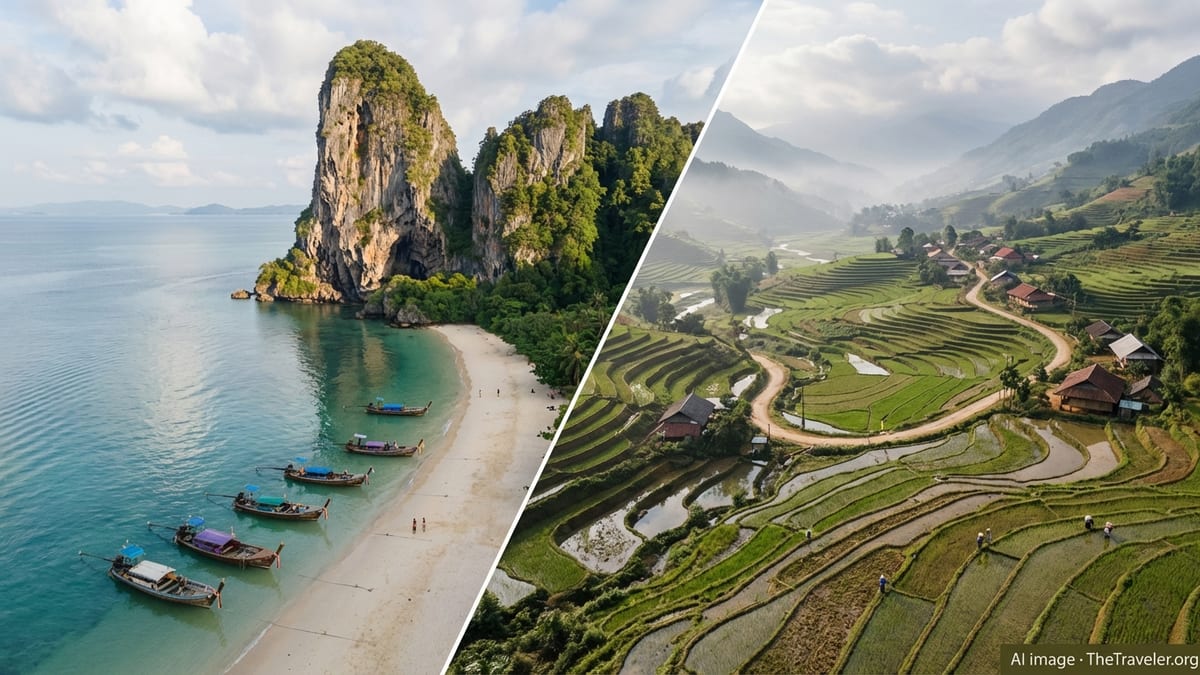
Overall Vibe: Same Region, Very Different Feel
Thailand and Vietnam share tropical coastlines, Buddhist temples, and fragrant street food, but the feel on the ground is strikingly different. Thailand has long been one of the world’s most visited destinations, with more than 30 million international arrivals in 2025, a mature tourism industry, and a wide range of polished resorts, tour options, and nightlife hubs. You feel that infrastructure the moment you land: clear tourist districts, English-language menus, and a well-practiced hospitality machine.
Vietnam, by contrast, is newer to mass tourism and still feels more raw and fast-changing. Major cities like Hanoi, Ho Chi Minh City, and Da Nang are booming, and beach centers such as Nha Trang and Phu Quoc are now lined with resorts. Yet outside these hubs, Vietnam retains a sense of discovery: rural villages, misty mountain passes, and small towns where foreign visitors are still a novelty in many neighborhoods.
If you want a smoother, more predictable holiday where the tourism ecosystem is deeply established, Thailand usually wins. If you prefer a slightly more adventurous feel and don’t mind a bit of friction in exchange for authenticity and rapidly evolving destinations, Vietnam often feels more exciting and less polished in a good way.
For a first trip to Southeast Asia, Thailand can be easier and more forgiving. For a return trip to the region, or for travelers who like to feel they are slightly ahead of the curve, Vietnam can feel fresher and more surprising.
Costs and Value for Money
Both countries remain excellent value compared with Europe, North America, or Australia, but Vietnam is typically a little cheaper on the ground, especially once you leave the most popular tourist spots. In both places you can find everything from very basic budget rooms to ultra-luxury resorts, but day-to-day costs like local meals, simple guesthouses, intercity buses, and Vietnamese coffee or street snacks usually run a bit lower in Vietnam.
Thailand’s prices have risen with its tourism maturity and currency strength. Beach hotspots like Phuket, Koh Samui, Koh Phi Phi, and parts of Krabi now routinely charge near-Western prices for seafront hotels and trendy restaurants. In Bangkok and Chiang Mai, you can still travel cheaply if you stick to local food courts, street stalls, and simple hostels, but midrange and above now feel noticeably more expensive than comparable options in Vietnam’s Hanoi, Hue, Hoi An, or Da Nang.
Transport also tends to cost slightly less in Vietnam, especially on buses and trains. Thailand, however, offers a broader range of options, from low-cost internal flights on several domestic airlines to well-organized tourist buses and private transfers. You may pay a bit more, but trips are often quicker and more straightforward to arrange, which some travelers consider worth the premium.
If you are a strict budget traveler looking to stretch every dollar, Vietnam usually gives you more for less, especially over longer stays. If you are comfortable with moderate prices for greater choice and convenience and are willing to pay resort premiums on famous islands, Thailand remains very good value but no longer ultra-cheap in its most iconic spots.
Visas, Entry Rules, and Practicalities
Entry rules change frequently, so travelers should always check official government sources close to departure. Broadly, Thailand has been simplifying arrival formalities while Vietnam has been expanding its e-visa system to attract more visitors. Both trends make trips to either country more accessible than in the past.
Thailand now relies on a digital arrival system known as the Thailand Digital Arrival Card, required for foreign nationals entering by air, land, or sea. Travelers complete the form online within 72 hours before arrival, replacing the old paper immigration card. Separate from that, many nationalities, including visitors from North America and much of Europe, enjoy visa exemption for short stays, while others use a straightforward visa-on-arrival or pre-arranged visa system. The key for Thailand is making sure you complete the digital paperwork accurately and on time.
Vietnam, meanwhile, transformed its entry regime by extending the standard tourist e-visa validity from 30 days to 90 days and permitting both single and multiple entries within that period. The e-visa is available to citizens of many countries and can be applied for via Vietnam’s official portals. In late 2025, authorities added dozens of new e-visa checkpoints at airports, land borders, and seaports, so it is now far easier to arrive and depart Vietnam by different routes, including international cruises.
Practically speaking, Thailand often requires less advance planning for short, simple holidays, particularly if your passport is among those exempt from visas. Vietnam now suits longer, more flexible itineraries thanks to the 90-day e-visa and multiple entry option. For multi-country Southeast Asia trips, Vietnam’s expanded ports of entry make open-jaw and overland itineraries more realistic than just a few years ago.
Weather, Seasons, and When to Go
Thailand and Vietnam are both tropical, but their geography and monsoon patterns differ, which can strongly influence your choice depending on travel dates. Thailand offers more predictable “classic beach season” timing, while Vietnam’s long, S-shaped coastline creates more regional variation.
In Thailand, the cool and dry season from roughly November to February is peak time almost nationwide, with comfortable temperatures and lower humidity, especially in the north around Chiang Mai and Chiang Rai. From March to May, heat builds, and from roughly June to October much of the country sees regular monsoon rains. The Andaman coast (Phuket, Krabi, Phi Phi) is generally best from November to April, while the Gulf coast (Koh Samui, Phangan, Tao) has a slightly different pattern and can be attractive at times when the Andaman is stormy.
Vietnam’s climate is more complex. The north (Hanoi, Ha Long Bay, Sapa) has four seasons, with cool winters and hot, humid summers; spring and autumn are often the most pleasant. Central Vietnam (Hue, Hoi An, Da Nang) is typically sunny and dry from about February to August, but can see heavy rains and typhoons later in the year. The south (Ho Chi Minh City, Mekong Delta, Phu Quoc) is tropical year-round with a pronounced dry season roughly from December to April and a rainy season from May to November.
If you are traveling during the northern winter and want reliable beach weather without too much climate complexity, Thailand can be simpler to plan. If you can be flexible with your route and time certain regions right, Vietnam lets you chase good weather up and down the country almost any month by shifting between north, center, and south.
Cities, Culture, and Historical Experiences
Both countries offer vibrant cities, distinctive religious architecture, and deep historical narratives, but the flavor is different. Thailand’s cities tend to feel more geared to tourism, with neon nightlife and modern shopping malls sitting near glittering royal temples. Vietnam’s urban centers are more intense and layered, reflecting French colonial history, recent conflict, and rapid modernization.
Bangkok is Thailand’s sprawling, chaotic capital and one of Asia’s great mega-cities, with ornate temples like Wat Pho and Wat Arun, the Grand Palace, riverside markets, and skyrocketing rooftop bars. Chiang Mai and Chiang Rai in the north showcase Lanna culture with dozens of temples, mountain scenery, and laid-back cafes, plus easy access to hill country and ethical elephant sanctuaries. In the northeast and deep south, you can find far fewer tourists and a more local feel, though infrastructure can be patchier.
Vietnam’s Hanoi feels older and more compact, with tree-lined boulevards, narrow Old Quarter streets, lakes, and French architecture. It is a city of tiny stools on the sidewalk, strong coffee, and a rich street-food culture. Ho Chi Minh City (Saigon) is bigger and brasher, with a modern skyline, war-era museums, and an entrepreneurial energy. Historic sites linked to the Vietnam War, imperial capitals like Hue, and ancient trading towns such as Hoi An provide a strong sense of modern history and heritage in a relatively small radius.
If your priority is gilded temples, royal pageantry, and a mix of nightlife and spirituality, Thailand stands out. If you are drawn to layered 20th-century history, colonial streetscapes, and a sense of political and cultural change, Vietnam’s cities can be more compelling. Both countries offer meaningful cultural immersion, but Vietnam often feels more historically introspective, while Thailand feels more celebratory and ritual-rich.
Beaches, Islands, and Natural Landscapes
Thailand has long been synonymous with tropical island escapes. Its beaches are one of the main reasons it attracted nearly 40 million annual visitors before the pandemic, and they remain among the world’s most recognizable: limestone cliffs in Krabi and Railay, long sandy stretches in Phuket and Khao Lak, and party-friendly bays in Koh Phangan alongside laid-back coves on Koh Lanta and Koh Lipe.
Vietnam used to lag behind in beach tourism but has been catching up quickly. Coastal cities such as Da Nang, Nha Trang, and Quy Nhon now have long strands of sand backed by modern hotels, while islands like Phu Quoc and Con Dao have emerged as notable beach destinations. However, Vietnam’s beaches tend to feel a bit more seasonal and weather-dependent, and large-scale development can sometimes feel abrupt compared with Thailand’s more mature island scenes.
On land, both countries are spectacular. Thailand offers dense jungles around Khao Sok National Park, waterfalls in the north, and accessible national parks not far from Bangkok. Vietnam counters with dramatic karst seascapes in Ha Long Bay and Lan Ha Bay, terraced rice fields and ethnic-minority villages around Sapa and Ha Giang, and winding mountain passes near the Chinese border that attract motorbikers and photographers.
If your dream trip revolves around island hopping with well-developed tourism services, turquoise water, and a huge range of accommodation from backpacker to ultra-luxury, Thailand is hard to beat. If you lean more toward dramatic landscapes, mountain scenery, and a mix of coast and highlands that still feels less saturated with tourists, Vietnam has the edge.
Food, Nightlife, and On-the-Ground Experience
Food alone is enough reason to visit either country. Thailand’s cuisine is world famous, with spicy curries, vibrant salads, and wok-fired noodle dishes available from street carts and shopping-mall food courts to fine-dining restaurants. Vegetarian and vegan travelers generally find Thailand easier, as plant-based options are widely recognized in tourist areas, and many menus are already in English.
Vietnamese food is more subtle and herb-driven, with iconic dishes such as pho, bun cha, banh mi, and fresh spring rolls. Street food culture is intense and often cheaper than in Thailand, especially away from the most touristy districts. Coffee culture in Vietnam is especially strong, from tiny roadside stools serving condensed-milk coffee to stylish specialty cafes in Hanoi and Ho Chi Minh City.
For nightlife, Thailand’s long-standing reputation is well deserved. Bangkok has everything from chic cocktail bars and world-class rooftop venues to neon entertainment districts. Islands like Phuket and Koh Phangan are known for big parties, but quieter nightlife scenes exist on many other islands. Vietnam’s nightlife has grown rapidly, with rooftop bars, craft beer scenes, and late-night cafes, but it generally feels more subdued, with a stronger emphasis on eating and socializing than on large-scale clubbing.
In terms of daily logistics, Thailand’s high volume of tourism means you will find more English spoken in major destinations, more signage in multiple languages, and a greater density of tourist services, from organized tours to travel agencies. Vietnam is catching up fast, particularly in major cities and coastal resorts, but you may need to navigate more language barriers and improvise a bit more, especially in rural or less-visited areas.
Safety, Ethics, and Overtourism
Both Thailand and Vietnam are generally considered safe for visitors, with millions of tourists visiting each year without serious incident. Petty crime like pickpocketing and bag snatching can occur in busy tourist areas in both countries, and the usual big-city precautions apply. Overall violent crime against tourists remains relatively rare, and most trips are trouble-free.
Thailand’s long tourism boom has, however, created certain strains. Popular islands and bays can feel crowded in peak season, and concerns about scams, dual pricing, and occasional safety lapses in transport and adventure activities have been widely discussed in regional media. Authorities have responded with periodic crackdowns and new safety campaigns, but travelers should still use common sense when booking boat trips, nightlife excursions, and motorbike rentals. There have also been recent security warnings regarding parts of Thailand’s border region with Cambodia, which travelers should monitor through official advisories.
Vietnam, being somewhat earlier in its tourism lifecycle, tends to feel less overtouristed outside major hotspots like Ha Long Bay and parts of Hoi An, where crowding and environmental pressure have become real issues. Many rural and coastal provinces are actively courting investment, and new resorts are going up quickly, so the sense of discovery may diminish over time. Still, for now, it is often easier to find quiet countryside and relatively undeveloped stretches of coast in Vietnam than in Thailand.
From an ethical standpoint, both countries are working through issues such as wildlife tourism, coral protection, plastic waste, and the impact of rapid development on local communities. Travelers who prioritize responsible tourism can make a difference by choosing certified operators, avoiding exploitative animal attractions, respecting local customs, and considering slower itineraries that spread spending beyond the most saturated spots.
Who Should Choose Thailand and Who Should Choose Vietnam?
In the end, “better” depends on your travel style, interests, and tolerance for uncertainty. Thailand is often the stronger choice if you want a first-time Southeast Asia trip with fewer logistical hurdles, more English spoken, and highly developed tourist infrastructure. It suits travelers seeking classic beach holidays, lively nightlife, easy internal flights, and a wide selection of family-friendly or honeymoon-ready resorts.
Vietnam is often the better fit if you prefer a sense of discovery, are comfortable with a bit more unpredictability, and are particularly interested in contemporary history, mountain scenery, and fast-changing cities. Budget-conscious travelers on longer trips also tend to find that Vietnam stretches their money further, especially when staying for several weeks on a 90-day e-visa.
Family travelers may gravitate toward Thailand for its polished resorts, kids’ facilities, and smoother logistics, while backpackers and slow travelers might appreciate Vietnam’s combination of affordability and variety. That said, both countries span a wide spectrum: you can absolutely do a luxury trip in Vietnam or a rough-around-the-edges adventure in Thailand if you choose your route accordingly.
If time and budget allow, many travelers choose not to decide and instead combine both countries in a single journey. With improved air links and expanded visa options, flying from Bangkok to Hanoi or Ho Chi Minh City is now straightforward, allowing you to experience the best of both in one extended trip.
The Takeaway
Thailand and Vietnam are not rivals so much as complementary destinations that highlight different sides of Southeast Asia. Thailand brings ease, iconic islands, and deeply established tourism; Vietnam offers dynamism, layered history, and landscapes that still feel, in many corners, refreshingly unpolished.
If you imagine your perfect trip as lazy days on famous beaches, a clear nightlife scene, and minimal planning stress, Thailand is likely your best starting point. If your ideal journey leans toward weaving through chaotic old quarters, trekking past rice terraces, and watching a rapidly changing country at close range, Vietnam may speak more strongly to you.
Whichever you choose, success lies less in picking the “right” country and more in matching your expectations to what each place genuinely offers. Build in time to slow down, respect local rhythms and customs, and leave room for serendipity. Whether your next flight lands in Bangkok or Hanoi, an open-minded approach will reward you with the flavors, sounds, and human encounters that make this corner of the world unforgettable.
FAQ
Q1: Is Thailand or Vietnam cheaper for travelers?
Both are good value, but Vietnam is generally a bit cheaper for accommodation, local meals, and overland transport, especially outside the main tourist hotspots.
Q2: Which country is better for a first-time visitor to Southeast Asia?
Thailand is usually easier for first-timers thanks to its long-established tourism industry, wider use of English in tourist areas, and straightforward internal transport.
Q3: Where has better beaches, Thailand or Vietnam?
Thailand still has the edge for classic tropical island holidays, with more famous beaches, better-developed island infrastructure, and a wider range of resort options.
Q4: Is Vietnam safe for solo travelers, including women?
Vietnam is generally safe for solo travelers, including women, provided you use common big-city precautions, avoid poorly lit areas at night, and secure your valuables.
Q5: Do I need a visa to visit Thailand or Vietnam?
Many travelers receive visa exemptions or simple-on-arrival entry for Thailand, while Vietnam now offers a 90-day e-visa for many nationalities; always check current rules before booking.
Q6: Which country is better for food lovers?
Both are outstanding: Thailand offers bold, spicy flavors and many vegetarian options, while Vietnam shines with fresh herbs, soups, and strong coffee culture at very low day-to-day cost.
Q7: Can I easily combine Thailand and Vietnam in one trip?
Yes, frequent flights link Bangkok with Hanoi, Da Nang, and Ho Chi Minh City, and Vietnam’s expanded e-visa system makes multi-country itineraries more straightforward than in the past.
Q8: Which is better for families with children?
Thailand often works better for families thanks to its family-friendly resorts, calmer beach options, kids’ facilities, and a very well-practiced tourism sector used to hosting children.
Q9: Where will I experience fewer crowds?
Both have busy hotspots, but outside famous sites, Vietnam typically offers more opportunities for less crowded countryside, mountain areas, and emerging coastal destinations.
Q10: If I love nature and trekking, which should I choose?
Vietnam is especially strong for trekking and mountain scenery around Sapa and Ha Giang, while Thailand offers excellent jungle, waterfalls, and national parks, particularly in the north and south.