

More news on this day
International passengers planning trips to Thailand from mid-2026 are facing a sharp rise in costs after authorities approved a steep increase in airport fees, a move that is already stirring debate over whether the kingdom risks pricing itself out of Asia’s intensely competitive tourism market.
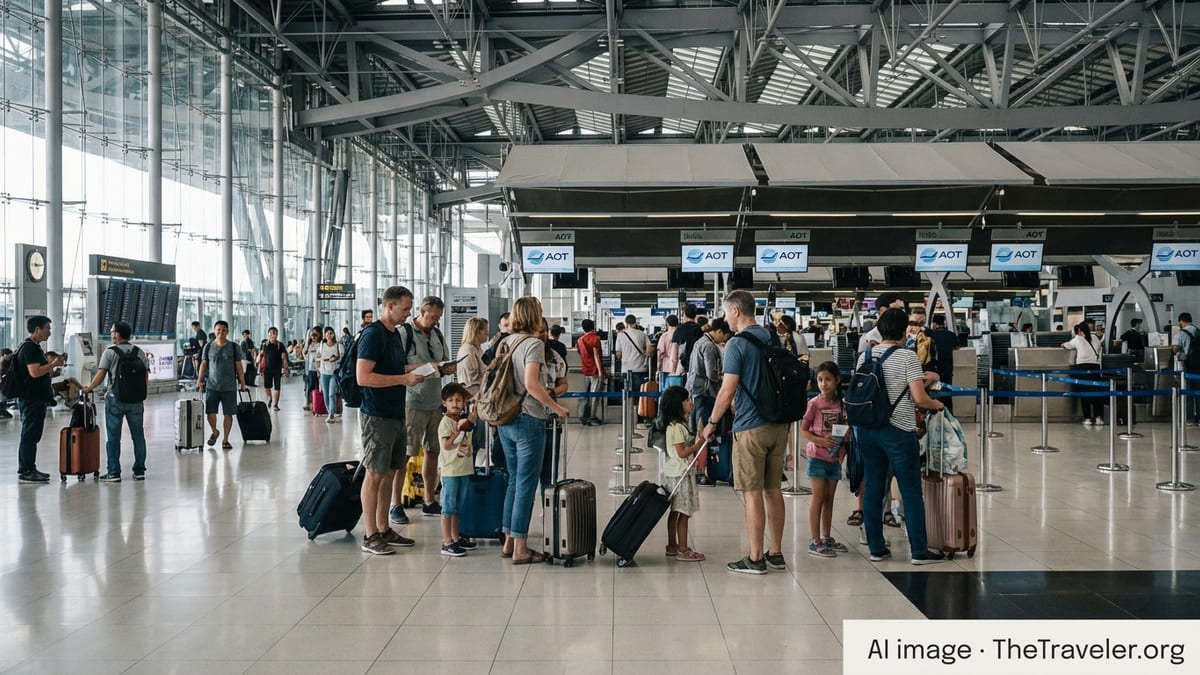
What Thailand’s New Airport Fee Actually Covers
The Airports of Thailand public company, known as AOT, has received regulatory approval to lift the passenger service charge on outbound international flights at the six major airports it operates. The fee, currently set at 730 baht per passenger, will climb to 1,120 baht from mid-2026, a jump of 53 percent that will be folded into airfares rather than collected at the terminal check in counter. The new rate will apply at Bangkok’s Suvarnabhumi and Don Mueang airports as well as Phuket, Chiang Mai, Hat Yai and Chiang Rai.
The passenger service charge is meant to finance airport operations and infrastructure, including security screening, terminal maintenance and customer facilities such as boarding gates and air conditioning. AOT executives argue that the higher levy remains a relatively small portion of an international ticket, especially on long haul routes, and say revenue from the increase is needed to fund a massive multiyear expansion program at Suvarnabhumi and other airports. Internal studies presented to regulators emphasized that the fee is embedded in the ticket price and not collected separately at departure, an attempt to reassure passengers that there will be no surprise cash payment at the airport.
Domestic travelers will be spared any immediate impact from the higher levy. AOT has said that the passenger service charge on domestic flights, currently 130 baht per person at its six airports, will stay unchanged for now. However, separate decisions by Thailand’s Department of Airports have already led to smaller increases at a series of regional airports, suggesting that the broader trend is toward higher charges across the system, even if the headline rise in international fees attracts most of the attention.
The higher fee is distinct from Thailand’s still pending nationwide tourism entry levy, a 300 baht charge on foreign arrivals that has been repeatedly delayed and is not yet in effect. For now, travelers will see the outbound airport fee show up first on tickets, while the question of a separate tourism tax remains unresolved in policy debates in Bangkok.
Mid 2026: When Higher Charges Hit Travelers’ Wallets
The new airport fee is scheduled to take effect around mid 2026, with Thai aviation officials and AOT indicating a start date in June following a period of public consultation and final administrative steps. Once the change is fully notified, airlines will begin incorporating the higher passenger service charge into tickets for flights departing after the implementation date, meaning that many travelers booking return journeys later this year for travel next summer could already be paying the increased amount without realizing it.
Travel industry analysts say the timing is delicate. International arrivals to Thailand recovered strongly after the pandemic but have recently shown signs of softening, with visitor numbers in 2025 falling compared to the previous year and early 2026 figures indicating a further decline. Critics argue that asking passengers to shoulder higher fees at a moment of weakening demand is risky, especially as neighboring destinations in Southeast Asia compete fiercely on price and ease of access.
The impact of the fee will vary depending on the type of ticket and length of journey. For a budget traveler on a short haul route from nearby hubs such as Kuala Lumpur, Singapore or Hanoi, an extra 390 baht built into the fare represents a noticeable percentage increase. For long haul passengers arriving from Europe, Australia or the Middle East, the additional cost is a smaller slice of an often much higher base fare, but it nonetheless contributes to a broader trend of rising charges, surcharges and taxes that have steadily pushed ticket prices upward over the past two years.
Forward looking booking data will be closely watched in the coming months as airlines update their systems and begin marketing fares that incorporate the higher charge. While most economists expect only a modest dampening effect on demand, industry officials stress that Thailand’s overall pricing profile now matters more than ever at a time when travelers are becoming particularly sensitive to total trip costs, including accommodation, transport and on the ground expenses.
Financing a Mega Expansion at Suvarnabhumi and Beyond
Thai officials frame the higher airport fee as a necessary trade off to deliver long promised upgrades at Suvarnabhumi, Bangkok’s main international gateway, and a network of fast growing regional airports. AOT has laid out an ambitious plan to build a vast new South Terminal at Suvarnabhumi in three phases over the next decade, along with a fourth runway and associated road, utility and support infrastructure. The aim is to eventually boost the airport’s annual capacity to around 120 million passengers, up from the roughly 60 million threshold it was originally designed to handle.
The South Terminal project, with an estimated price tag of over 200 billion baht, is central to Thailand’s aspiration to solidify Bangkok’s status as a regional aviation hub connecting Europe, the Middle East and Asia Pacific. By relying on higher passenger service charges rather than large scale state borrowing, the government hopes to limit the burden on public finances while still delivering infrastructure upgrades that it says are essential for long term competitiveness. AOT projects that the fee hike will generate roughly 10 to 13 billion baht in additional annual revenue, money that can be used to service debt and finance construction.
At Suvarnabhumi, the first phase of the expansion will focus on external road systems, utilities and ground preparation on land earmarked for the new runway and terminal buildings. Subsequent phases will see sections of the South Terminal come online, allowing authorities to refurbish aging parts of the main terminal without choking capacity. In parallel, upgrade projects are planned at Don Mueang, which serves a large share of low cost carriers, and Phuket, where tourist arrivals at peak times regularly push current facilities to their limits.
Supporters of the fee increase argue that passengers ultimately benefit from better airports, shorter queues, improved baggage systems and more spacious departure halls. They note that international travelers are accustomed to paying airport charges in many parts of the world and that Thailand’s previous passenger service fee had remained unchanged for years despite rising operating and capital costs. For them, the latest decision simply aligns Thailand with global practice while providing a clearer funding stream for critical aviation infrastructure.
Critics Warn of a New Era of Expensive Travel
The sharp jump in the airport fee has drawn strong criticism from opposition politicians, aviation commentators and some business groups, who say policymakers risk tipping Thailand into a new era of expensive travel just as the tourism sector is struggling to regain its pre pandemic momentum. A former deputy leader of the Democrat Party, who has frequently spoken out on aviation policy, warned that the higher charge would leave Suvarnabhumi more expensive than several leading global hubs, potentially undermining its appeal as a transit point for international carriers.
Critics also question whether the timing of the fee hike reflects the realities of the market. International arrivals, they note, have fallen from their recent peak, with 2025 seeing fewer visitors than 2024 and early 2026 data pointing to another year on year decline. Hoteliers and tour operators in popular destinations such as Phuket and Chiang Mai report softer forward bookings and more aggressive discounting as they compete for a shrinking pool of customers. In that context, any additional cost imposed on outbound passengers risks tipping marginal travelers toward cheaper alternative gateways in the region.
Consumer advocates stress that the airport levy is only one of several new or proposed charges that travelers are being asked to absorb. Hotels in some provinces have introduced local tourism taxes, while authorities continue to debate the separate 300 baht national entry fee on foreign visitors. Although that measure has been postponed until at least mid 2026, its potential future introduction, combined with the higher airport charges, feeds perceptions that visiting Thailand is becoming steadily more expensive, especially for budget conscious travelers and families.
For airlines, the concern is that higher passenger service charges could further squeeze yields on already slim routes. Carriers can in theory pass the full cost on to passengers, but they must do so in a market where price comparisons are instant and competitors may choose to prioritize capacity in countries with lower charges. Some low cost airlines have already signaled that they will review their Thailand network planning once the higher fee is fully confirmed, though none have announced concrete cutbacks.
Tourism Fee Delays Contrast with Rising Airport Charges
The contrast between the rapid progress on airport fees and the repeated delays to Thailand’s national tourism tax has added a layer of complexity to the policy picture. The 300 baht entry fee on foreign visitors, often referred to locally by its Thai name and promoted as a tool to fund tourist insurance and destination upgrades, has been under discussion for years. It has been approved in principle, shelved, revived and postponed again, most recently with officials indicating that it will not be introduced before the middle of 2026 at the earliest.
As of early 2026, there is still no nationwide tourism fee in force. Foreign travelers arriving by air, land or sea continue to pay standard visa charges where applicable, along with existing airport and departure fees, but there is no additional national levy collected at the border. That has helped keep Thailand’s upfront entry cost relatively low compared with some destinations that impose visa fees, e visa processing charges and separate tourism taxes at the point of arrival.
Yet the steady march toward higher airport charges indicates that authorities are searching for alternative revenue streams to support tourism and transport infrastructure. Policy makers appear to have decided that adjusting the passenger service charge, which is handled through airlines and ticketing systems, is administratively simpler than rolling out an entirely new national fee that would require coordination across multiple ministries, immigration checkpoints and transport modes.
Travel industry representatives say the mixed signals can be confusing for visitors who may read headlines about new taxes and assume they are already in place. They argue that clear communication will be critical in the year ahead as the higher airport fee moves closer to implementation, particularly if the government decides to revive the tourism entry levy around the same time. Without consistent messaging, potential visitors could be deterred by the perception of a complex and expensive entry regime even if the actual charges remain relatively modest by global standards.
How Thailand Compares With Other Global Hubs
Supporters and critics of the new airport fee alike have scrambled to compare Thailand’s charges with those at major international hubs. While passenger service fees and airport taxes vary widely and are often bundled with other charges in complex ways, analysts say the planned 1,120 baht levy for outbound international passengers will place Suvarnabhumi and Don Mueang toward the higher end of the scale in Asia, though not at the very top globally.
Some airports in Europe and the Middle East already impose substantial passenger charges to finance multibillion dollar terminal and runway projects. London Heathrow, for example, has sought approval for increases in landing and passenger fees to support large scale expansion of its terminals and related infrastructure. Singapore’s Changi Airport has also introduced and adjusted various development charges over the years to fund new terminals and a fifth runway, arguing that world class facilities require steady capital investment and that passengers indirectly benefit from the results.
Thailand’s challenge is that it competes directly with several lower cost regional gateways that also offer extensive connections to the rest of Asia. Kuala Lumpur, Ho Chi Minh City and Manila have focused on attracting budget carriers and price sensitive travelers, often keeping charges at levels that appeal to airlines seeking to minimize operating costs. If Thailand’s higher airport fee widens the gap too far, industry experts warn, carriers may look to shift some capacity or develop new routings that bypass Bangkok in favor of cheaper hubs.
At the same time, there is an argument that quality and reliability matter as much as absolute cost. If the new revenue stream leads to tangible improvements in queue times, baggage handling, cleanliness and overall passenger experience, some travelers and airlines may accept higher fees as the price of using a better airport. Much will depend on how quickly AOT can convert additional income into visible enhancements, and whether projects stay on schedule and within budget over the next decade.
What International Travelers Should Do Now
For travelers planning trips to or from Thailand in late 2026 and beyond, the main practical implication of the new airport fee is that ticket prices for flights departing the kingdom are likely to be higher than they would have been under the old regime. Passengers booking return tickets that originate outside Thailand will see the increased levy reflected in the overall fare for the outbound leg from Bangkok, Phuket, Chiang Mai or other affected airports, even if they never see the fee itemized on their booking confirmation.
Travel advisers recommend that visitors keep an eye on fare trends over the coming months and consider being flexible with dates and routings, particularly if they are traveling on a tight budget. Comparing prices across nearby hubs, watching for sales from airlines seeking to stimulate demand and booking well in advance for peak travel seasons can help offset the impact of higher airport charges. Some travelers may also explore entering Thailand via regional airports operated by the Department of Airports or through neighboring countries, although any savings must be weighed against additional time and transfer costs.
Visitors should also be alert to potential policy changes related to the separate tourism entry fee. While there is no such national levy in place yet, the political debate around a 300 baht charge has not gone away, and a final decision could emerge around the same time the higher airport fee takes effect. Checking official announcements from Thai authorities and reputable news outlets before travel will help ensure that passengers are aware of any new costs that might apply at the border.
For now, Thailand remains broadly affordable compared with many long haul destinations, and the country’s mix of beaches, cultural sites and urban attractions continues to draw millions of visitors each year. Whether the new airport fee marks the start of a lasting shift toward more expensive travel, or simply a one off adjustment to fund overdue investments, will depend on how the tourism market responds once the higher charges are in place and the promised upgrades begin to take shape on the ground.