

More news on this day
For travelers staring down snaking security lines at major U.S. airports, a $99-a-year identity verification service is emerging as a shortcut that can save hours otherwise spent shuffling toward the TSA podium.
Get the latest news straight to your inbox!
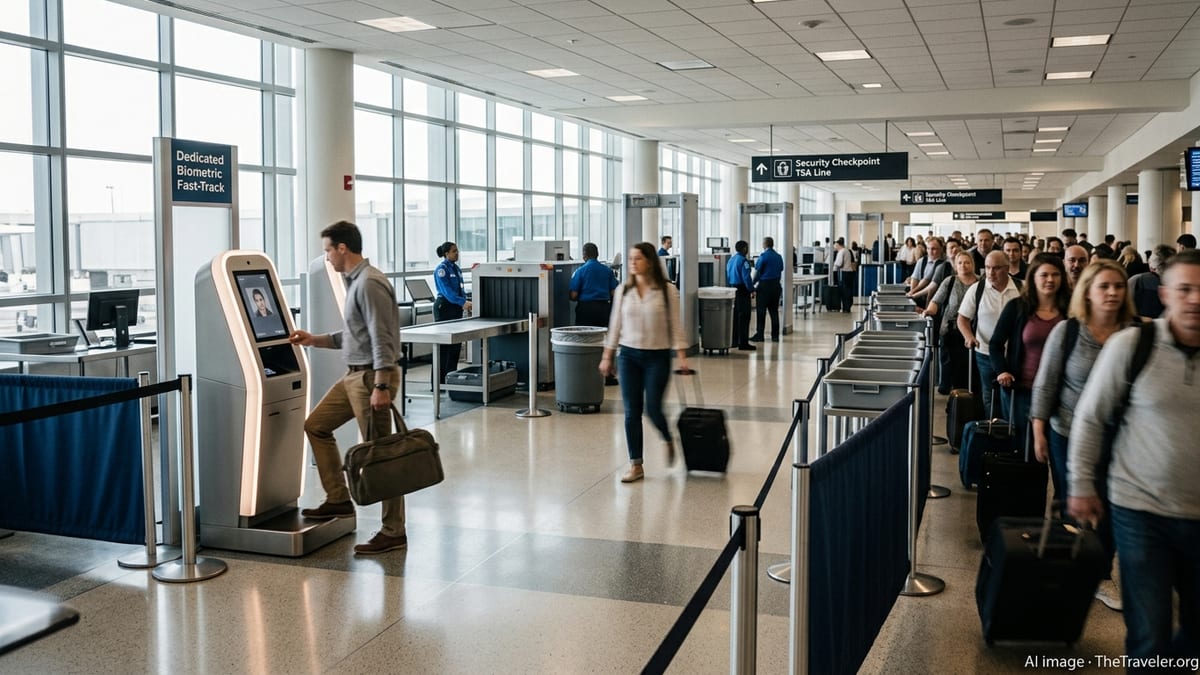
What the $99 fast-track service actually does
The service is part of a growing category of paid airport programs that rely on biometrics to verify identity before travelers reach the Transportation Security Administration checkpoint. Instead of waiting in the general queue to have an officer inspect a boarding pass and photo ID, members use a dedicated lane staffed by the company, scan a boarding pass, and confirm identity via fingerprint, iris, or facial recognition. Once verified, they are directed to the front of the appropriate TSA screening lane.
According to published coverage and company materials, these biometric lanes are now installed at dozens of large U.S. airports and operate alongside the standard TSA and TSA PreCheck queues. The core selling point is time: by moving the document check away from the government podium, the service aims to remove one of the biggest bottlenecks in the security process, particularly at morning and evening peaks.
Pricing varies by promotion and partner, but recent offers have dropped the first-year cost into the $99 range for many travelers via airline loyalty programs, co-branded credit cards, or limited-time discounts. In exchange, members receive a year of expedited ID checks at participating airports, with options to add family members for an additional fee.
The company’s marketing materials indicate that typical members save several hours over the course of a year of flying. For travelers who pass through busy hubs multiple times a month, that can mean turning a 30- to 45-minute security wait into a five- or ten-minute walk from curb to gate on crowded days.
How it works from enrollment to your first checkpoint
Enrollment begins online, where applicants create an account, provide basic biographic details, and consent to the collection and encrypted storage of biometric data. After that, travelers complete the process in person at a staffed airport kiosk, where their fingerprints, facial image, and sometimes iris scans are captured and matched to a government-issued identity document.
Once enrollment is finished and the membership is active, using the service becomes a two-step routine. At the airport, members look for the dedicated lane near the TSA checkpoint, where staff scan their boarding pass to confirm eligibility for that day’s flight. At a biometric pod or eGate, the traveler steps up to a device that reads their face or eyes and matches it with the stored profile.
If the match is successful, the system signals clearance, and the member is guided directly to the front of the TSA screening lane assigned to them. At some airports, newer eGates allow travelers to bypass a staffed podium entirely, moving straight from biometric verification to the X-ray conveyor. At others, a staff member escorts the traveler to a TSA officer, who performs a brief visual check before sending them into the screening area.
Importantly, the service does not replace TSA screening itself. Passengers still go through metal detectors or body scanners and bag X-rays like everyone else. The time savings come from skipping much of the line that forms before those machines, especially during holiday travel periods and at hubs that regularly report record passenger volumes.
When a $99 membership can save hours, and when it cannot
The promise of “saving four hours in line” is typically measured across multiple trips rather than in a single dramatic shortcut. Reports indicate that frequent flyers who pass through airports such as Atlanta, Denver, Los Angeles, and New York can gain the most, particularly during early morning business rushes and Sunday evening returns when standard security lines often spill into the terminal.
In these situations, members might cut a 45-minute or longer wait down to a few minutes at the document check, repeatedly, over the course of a year. Aggregated across a dozen or more trips, that can add up to several hours of time reclaimed from queueing, which is how providers arrive at their annual time-saved figures.
However, the membership is not a universal fast pass. At quieter regional airports with limited staffing, standard TSA and TSA PreCheck lines may already be short, making the dedicated biometric lane only marginally faster, if at all. In some terminals, traveler accounts describe scenarios where the paid lane backed up while neighboring TSA PreCheck queues moved more quickly simply because they had more screening machines in operation.
Because of these variations, travel analysts often suggest that the value of the $99 service depends heavily on a traveler’s home airport, typical departure times, and whether they already hold TSA PreCheck or Global Entry. For travelers who fly only a couple of times a year from smaller airports, the incremental benefit may be modest compared with the membership price.
How it compares with TSA PreCheck and Global Entry
The $99 biometric service sits alongside, rather than instead of, federal Trusted Traveler programs such as TSA PreCheck and Global Entry. TSA PreCheck is designed to speed up the physical screening portion of the process by allowing pre-approved travelers to keep on shoes and light jackets and leave liquids and laptops in their bags in a dedicated lane. Global Entry, meanwhile, focuses on faster immigration processing for international arrivals but includes TSA PreCheck as a benefit.
By contrast, the private biometric service targets the identity verification step that happens before baggage screening. It can be layered on top of TSA PreCheck, providing a fast lane to reach the already-expedited PreCheck screening area. For travelers who hold both, this combination can be among the quickest options currently available in many U.S. airports.
There are notable differences in cost structure and duration. While TSA PreCheck and Global Entry charge a one-time fee for five-year memberships, the biometric fast-track program charges annually, with the headline $99 price often tied to promotions. Some credit cards now reimburse either federal Trusted Traveler fees or private biometric memberships, which can reduce or eliminate out-of-pocket costs for eligible cardholders.
For travelers deciding where to start, publicly available guidance from travel advisors often recommends enrolling in TSA PreCheck or Global Entry first, as those programs directly affect the screening process and have multi-year validity. The $99 biometric add-on may then make sense for those who still face long lines at their local airports despite holding government-issued expedited status.
Privacy questions and what travelers should consider
The rapid spread of biometric checkpoints across airports and other venues has drawn increased attention from privacy advocates and consumer groups. These organizations note that services like the $99 fast-track program work by capturing and storing highly sensitive data such as facial images and iris scans, raising questions about data security, retention policies, and potential secondary uses.
Publicly available company filings and independent reporting describe safeguards such as encryption, internal access controls, and procedures for deleting data on request. At the same time, experts point out that any large biometric database presents an attractive target for cybercrime, and that long-term implications of widespread facial recognition in travel and beyond are still being debated.
Prospective members are encouraged by consumer advocates to weigh the practical time savings against these concerns. That includes reviewing the service’s privacy policy, understanding how long biometric data is stored, and checking whether information is shared with partners or government agencies beyond what is required to operate at airports.
For some travelers, especially those who fly weekly for work through congested hubs, the ability to reclaim several hours a year from TSA lines may outweigh those reservations. Others may prefer to rely on government-run programs alone, even if it means arriving at the airport a little earlier. As airports continue to test new biometric technologies and partnerships, the balance between convenience, cost, and privacy is likely to remain at the center of the conversation around services like this $99 fast-track membership.