

Stepping through the doors of the Basilica Cathedral of Notre Dame de Quebec is less like visiting a monument and more like entering a living chapter of North American history.
In the heart of Old Quebec, this working cathedral, pilgrimage site and architectural landmark rewards visitors who slow down, look closely and move through it with intention. From the first glimpse of its stone facade to the quiet of the crypt and the contemplation before the Holy Door, every stage of the visit can become its own experience.
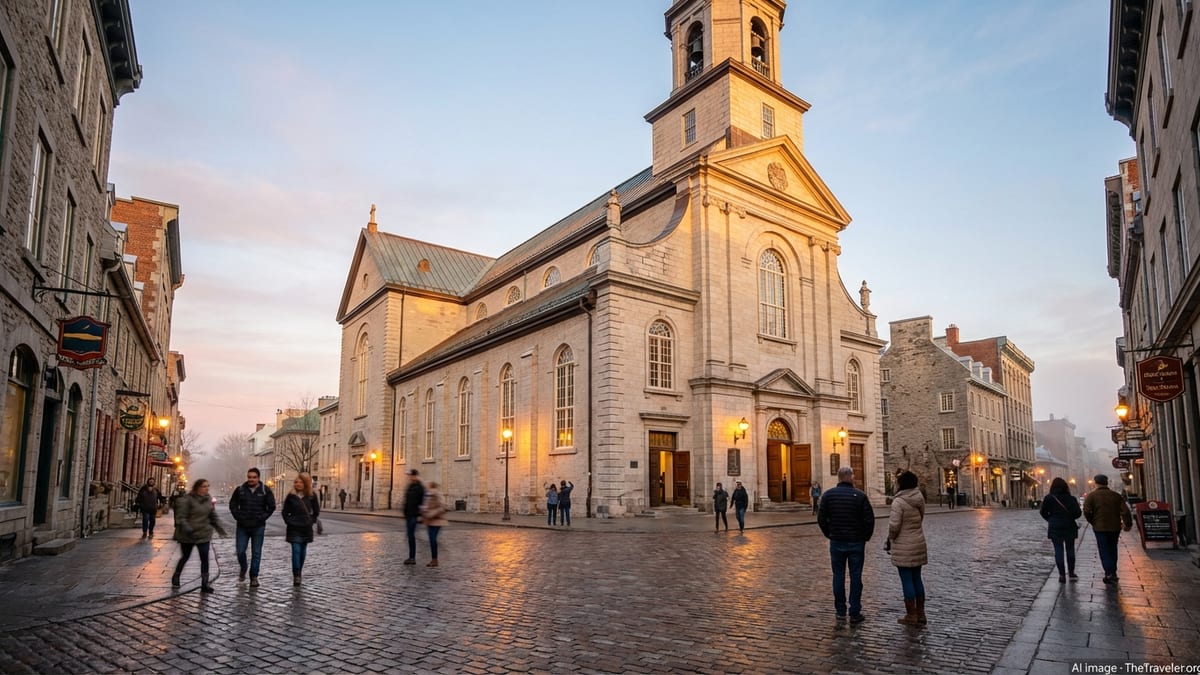
Arriving at the Heart of Old Quebec
The Basilica Cathedral of Notre Dame de Quebec stands just off City Hall Square, anchored in the compact historic core of Old Quebec. Approaching from the cobbled streets, the cathedral appears first as part of the wider urban ensemble, framed by civic buildings, narrow lanes and stone townhouses. The setting is as significant as the church itself, since the entire upper town is recognized as a World Heritage Site for its preserved French colonial fabric and city walls.
Most visitors arrive on foot, often combining the basilica with a broader walking circuit that includes the nearby seminary courtyard and the streets around Rue Saint-Jean. This is a wise approach, as it allows the exterior of the cathedral to be absorbed gradually: the bell tower rising above the square, the sculpted doors, the mixture of historic stonework and later restoration. Pausing on the plaza before entering gives a sense of the building’s scale and its role as the historic spiritual center of New France.
Because Notre Dame de Quebec is an active parish church, access is organized around both worship and visitation. It typically remains open during the day for quiet visits and prayer, with extended activity during the summer season when guides are available on site. There is no fixed ticketing gate at the main doors; instead, visitors are welcomed inside with a suggested donation for upkeep, leaving the entrance experience understated and respectful of the building’s religious function.
Before stepping inside, it is worth circling part of the exterior if time allows. On the north side of the basilica you will find access to the Pilgrims’ Garden and the Holy Door, as well as vantage points to appreciate the interplay between the cathedral and the surrounding streets. This walk around the perimeter introduces the idea that the site is not simply a single interior to be checked off, but a cluster of spaces and perspectives that reward exploration.
Understanding the Basilica’s Historical Role
To fully experience Notre Dame de Quebec, it helps to carry a sense of its long timeline. The church rises on the site of a chapel first built in the 1630s, only a few years after Samuel de Champlain founded the French settlement on the cliffs above the St. Lawrence River. Successive stone churches followed through the 1640s, forming the nucleus of Catholic life in the colony. By 1674, when the Diocese of Quebec was established, this modest high-town church became the first Catholic cathedral in North America, responsible for an immense territory stretching deep into the continent.
The basilica visible today is the result of rebuilding, enlargement and restoration layered across centuries. Funding from Louis XIV in the late seventeenth century supported the cathedral’s early expansion, affirming its place as a symbol of royal and ecclesiastical authority in New France. A century later, the church was badly damaged during the siege of Quebec in 1759, then rebuilt under British rule, largely following the previous plan but with new details. Subsequent fires and restorations in the nineteenth and twentieth centuries further shaped its appearance, leaving a complex but harmonious whole.
This evolving story is not merely a backdrop; it is present in the visitor experience. When you walk the nave, you are tracing the footprint of earlier chapels. When you look up at the decorative schemes and furnishings, you see the influence of the Baillairgé family of artisans, who designed and carved many of the interior elements over several generations. The designation of the basilica as a National Historic Site of Canada recognizes precisely this continuity: the building is both place of worship and a record of how architecture, faith and politics intertwined over four hundred years.
Keeping this history in mind as you move through the cathedral changes the experience from a simple sightseeing stop into a kind of time travel. Instead of focusing only on the most photogenic corners, you may find yourself noticing worn stone thresholds, mismatched details from different eras and small devotional objects left by parishioners. These traces offer a human scale to the building’s grand narrative.
First Impressions: Entering the Nave
Crossing the threshold into the nave, the contrast with the busy streets outside is immediate. Light filters through clear and tinted windows onto pale walls and gilded surfaces, creating an atmosphere that feels at once luminous and intimate. The interior belongs to the Baroque and neo-Baroque tradition more than the soaring verticality of Gothic churches; here the emphasis is on theatrical altarpieces, curving lines and elaborate ornament concentrated at the east end.
Allow your eyes a moment to adjust, then stand roughly halfway down the central aisle and make a slow 360-degree turn. This single gesture can anchor your entire visit. In front of you the main altar is framed by an ornate baldachin in rich gold tones, flanked by side chapels and layers of sculpted angels, columns and reliefs. Behind you the organ loft and rear gallery define the opposite axis. To each side, aisles and chapels unfold under a gently curved ceiling, with paintings, statues and devotional shrines tucked into alcoves.
The impression is one of careful composition rather than overwhelming bulk. The basilica does not rival Europe’s largest cathedrals in size; instead, its impact comes from proportion and detail. Gilding catches the light on carved moldings and capitals, while painted surfaces and stained glass add color in controlled doses. It is worth following the play of light at different times of day. Morning sun may emphasize side chapels, while late afternoon can pour warmth onto the main altar and its canopy.
At this stage, visitors often instinctively reach for cameras. Photographing the interior is usually permitted outside of services, but quiet behavior is expected. Rather than rushing to capture every angle, choose one or two vantage points and then put the camera away long enough to simply sit in a pew. The soundscape of footsteps on stone, the muted creak of wooden seats and, at times, the distant murmur of a rehearsal at the organ help translate the building from static monument to living space.
Exploring Chapels, Artworks and the Crypt
After taking in the central space, begin a slow circuit along one side of the nave and back along the other. This path will lead you through a sequence of chapels containing paintings, sculptures, reliquaries and altars dedicated to various saints. Interpretation panels, when present, offer basic explanations, but much of the experience lies in simply observing the texture of carved wood, the patina of old stone and the expressions captured in devotional art.
One of the most significant focal points is the funerary chapel and tomb of Saint François de Laval, the first bishop of Quebec. This chapel holds both spiritual and historical weight, attracting pilgrims as well as visitors interested in the early church in New France. Nearby, a large reliquary gathers relics associated with Canadian saints and blesseds, underlining the basilica’s role as a national devotional center.
Beneath the main floor lies the crypt, where several bishops and four governors of New France are buried. Access to this space is seasonal and typically offered through guided or supervised visits during the busier months. Stepping into the crypt, visitors encounter a more austere environment: plain masonry walls, stone vaults and simple markers. The contrast with the ornate church above is striking. Here, the emphasis shifts from visual splendor to contemplation of continuity and mortality, with layers of burials representing centuries of colonial and post-colonial history.
Keep in mind that access conditions to the crypt can change depending on conservation needs and staffing. When it is open, staff or guides will usually accompany visitors, providing context on who is buried there and how the space relates to the original seventeenth-century foundations. Even if a visit below ground is not possible, knowing that the crypt runs beneath the nave adds a vertical dimension to your understanding of the site, connecting the visible church to the unseen structures and stories underfoot.
The Holy Door and Pilgrims’ Garden Experience
One of the most distinctive elements of Notre Dame de Quebec is its Holy Door, installed as part of the parish’s 350th anniversary commemorations and recognized as the only such door in the Americas. Holy Doors are relatively rare in the Catholic world and are typically opened only during special jubilee years. When sealed, they still function as symbols and places of prayer; when opened, they become ritual thresholds through which pilgrims pass as part of a spiritual journey.
At Quebec’s basilica, the Holy Door is set within a stone wall near the Pilgrims’ Garden on the exterior side of the building. The bronze door itself, created by a Quebec artist, is rich with symbolic imagery, inviting reflection even when it is closed. During ordinary years, visitors may approach the door from the garden side, touch its surface and spend time in quiet contemplation. From inside the church, the door can be seen framed in the masonry, serving as a reminder of the broader spiritual connections that link this cathedral to Rome and other major pilgrimage sites.
When a Holy Year is declared and the door is opened for passage, the visitor experience gains an additional layer of meaning. The typical route invites pilgrims to follow a path through the garden toward the door, pausing for reflection before crossing the threshold into the basilica. The physical act of stepping through becomes a metaphor for leaving behind past burdens and moving toward renewal. Even for travelers who do not share the Catholic faith, this ritual framework can be appreciated as a cultural and psychological journey, a structured pause within typical sightseeing.
At present, the Holy Door in Quebec remains closed outside these designated periods, yet it continues to draw visitors intrigued by its rarity and symbolism. Staff and informational material on site can explain whether any current or upcoming jubilee celebrations will affect access. Regardless of its status, including time in your visit itinerary to walk the garden path and stand before the door gives a sense of the basilica’s global significance in contemporary Catholic practice.
Attending Mass, Music and Special Events
Because Notre Dame de Quebec is first and foremost a parish cathedral, the most authentic way to experience it may be to attend a Mass or service. Regular liturgies are celebrated in French, with some services offering elements in other languages when groups are present. Schedules vary by season and day of the week, so visitors should confirm details locally, but morning and Sunday celebrations are usually a constant presence in the cathedral’s rhythm.
During Mass, the basilica’s interior comes fully alive: candles are lit, the organ resonates through the nave, incense may perfume the air on solemn feasts, and the carved figures around the altar seem to participate in the unfolding ritual. Visitors are welcome to attend quietly, observing local customs such as standing and sitting with the congregation, and refraining from photography or movement during key parts of the liturgy. Even for those unfamiliar with Catholic rites, the structure of the service and the music can be deeply moving.
Beyond regular worship, the basilica periodically hosts concerts, recitals and special events that take advantage of its acoustics and its restored Casavant organ. These programs range from sacred music to organ recitals and sometimes choral performances aligned with seasonal celebrations. Attendance adds a different dimension to the visit, shifting focus from visual appreciation to the experience of sound in the historic space. Advance information is best obtained once in Quebec City, as programming can change from year to year.
It is also common for the cathedral to be a focal point during major religious celebrations in the city, including Holy Week, Christmas and special anniversaries linked to the diocese. At such times, access for casual visits may be more limited or adjusted around ceremonies, but the atmosphere on the surrounding square is vibrant, with parishioners, choirs and clergy moving in and out, underlining that this is not just an architectural relic but a living institution.
Planning Your Visit: Practical Tips From Entry to Exit
A complete experience of Notre Dame de Quebec begins before you arrive at the doors. Consider visiting earlier in the morning or later in the afternoon outside of peak tour-group hours. This timing generally allows for more contemplative time in the nave and easier conversation with staff or volunteers. In high season, when guides are often present, they can provide short explanations or, in some cases, more structured tours. These human encounters frequently add nuances that are not captured on panels or in guidebooks.
Dress expectations are respectful rather than strict. Modest attire suitable for a place of worship is appreciated, and comfortable footwear is important given the amount of standing and walking, especially if you plan to visit the crypt or spend time in the Pilgrims’ Garden. The cathedral is accustomed to receiving visitors from around the world, so signage and basic information can often be found in both French and English, though French remains the primary liturgical language.
Photography rules may change depending on services and events, but a general principle applies: refrain from photographing during Mass or when people are visibly at prayer. When the nave is relatively quiet, wide shots of the altar, vault and side chapels are usually acceptable. Consider limiting the use of flash to protect artworks and preserve the atmosphere. If in doubt, a discreet question to a staff member or volunteer will quickly clarify what is appropriate on the day of your visit.
As you plan your exit, allow time for a final slow walk from the altar end back toward the main doors. Turning around near the threshold to take one last look at the interior can be surprisingly powerful, anchoring the visual memory of the space. Once outside, resist the temptation to rush off immediately to the next attraction. Standing again in City Hall Square, with the cathedral at your back and the streets of Old Quebec unfolding before you, you may notice how the experience inside subtly alters your perception of the city beyond.
The Takeaway
Visiting the Basilica Cathedral of Notre Dame de Quebec is not simply a matter of stepping into a beautiful old church and ticking off a list of highlights. It is an encounter with a place that has continuously adapted to new eras while staying rooted in its original purpose as a house of worship and a symbol of faith in North America. From its seventeenth-century origins as a small colonial chapel to its present status as a National Historic Site and active cathedral, it gathers layers of history under a single roof.
A thoughtful visit moves in deliberate stages: the approach through Old Quebec’s streets, the first moment in the nave, the gradual discovery of chapels and artworks, the quiet depth of the crypt, the contemplation before the Holy Door and, for some, participation in a Mass or musical event. Each step offers its own vantage point on the building’s architecture, its role in the life of the city and its significance in the wider Catholic world.
Whether you come as a pilgrim, a history enthusiast, an architecture lover or a curious traveler, the key is to allow time and attention. In doing so, you will find that Notre Dame de Quebec reveals itself not as a static museum piece but as a living space where past and present meet. You enter as a visitor; you leave with a more textured sense of Quebec, its origins and its ongoing story.
FAQ
Q1. Is there an admission fee to visit Basilica Notre Dame de Quebec?
Entrance to the basilica is generally free, with visitors encouraged to make a voluntary donation to support maintenance, restoration and pastoral activities.
Q2. Do I need to book tickets or a time slot in advance?
Individual visitors typically do not need advance reservations. Group tours or special guided visits may require prior arrangements made directly with the cathedral.
Q3. What are the usual opening hours for visitors?
The basilica is generally open daily during daytime hours, with schedules adjusted by season and liturgical needs. Exact times are best confirmed once in Quebec City.
Q4. Is the Holy Door currently open for passage?
The Holy Door is normally kept sealed and opened only during specially designated Holy or Jubilee Years. Outside those periods it remains accessible for contemplation but not for crossing.
Q5. Can I visit the crypt beneath the basilica?
Access to the crypt is usually offered in the summer season and sometimes on special occasions, often through supervised or guided visits subject to conservation requirements.
Q6. Are guided tours available inside the cathedral?
In the busier months, staff or volunteer guides are often present and may offer short introductions or more structured tours. Availability and language options can vary by day.
Q7. Is photography allowed inside the basilica?
Photography without flash is generally tolerated for personal use when no services are in progress. Visitors are asked to avoid photographing during Mass or private prayer.
Q8. What is the best time of day to visit for a quieter experience?
Early morning and late afternoon outside of major feast days usually offer a more peaceful atmosphere, with fewer tour groups and more time for reflection.
Q9. Is the basilica accessible for visitors with reduced mobility?
Main-level access is possible for many visitors with reduced mobility, though some areas, including the crypt and certain exterior paths, may present challenges.
Q10. Can non-Catholic visitors attend Mass or other services?
Yes. All respectful visitors are welcome to attend Mass and services, following local customs and refraining from receiving Communion if not in line with their tradition.