

More news on this day
Air travel in 2026 is being reshaped by two powerful forces at once, as a renewed U.S. government funding lapse collides with a widening Middle East conflict that is driving up fuel prices, disrupting routes and stretching aviation systems already operating close to their limits.
Get the latest news straight to your inbox!
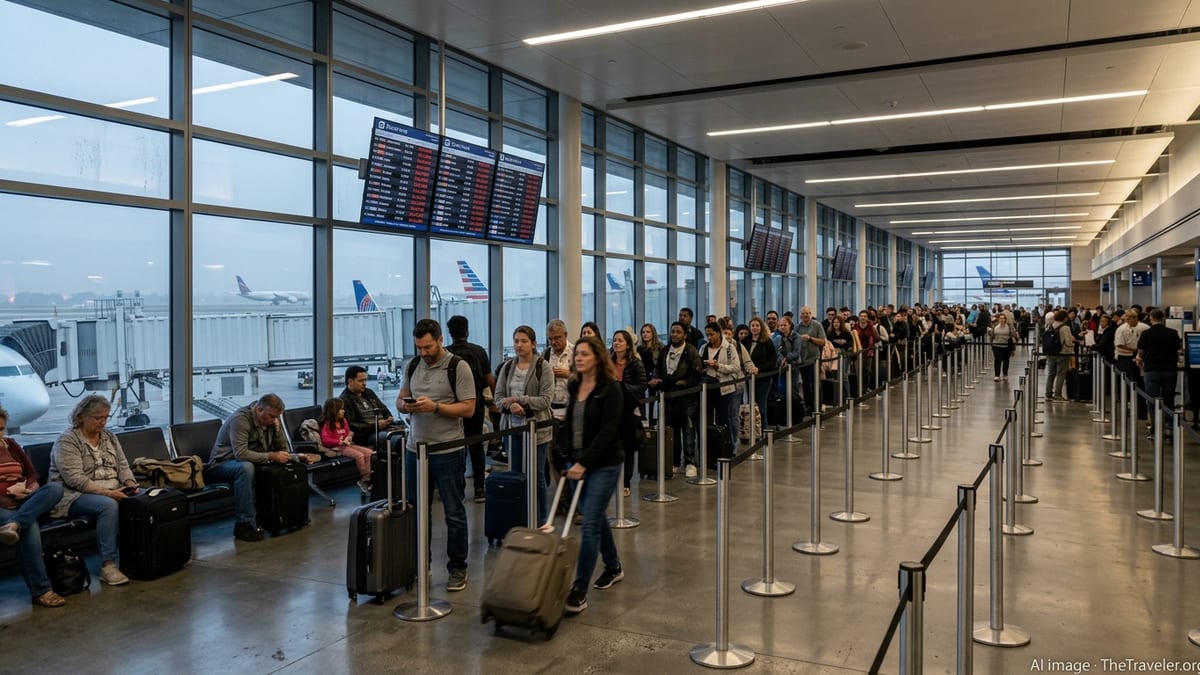
Shutdown Pressures Hit Security Lines and Schedules
The latest partial shutdown of the U.S. federal government, which began in late February, is again exposing how dependent air travel is on federal paychecks and staffing plans. Publicly available shutdown contingency documents indicate that most Transportation Security Administration officers and air traffic controllers must continue working, but without pay, while thousands of other Federal Aviation Administration and Department of Homeland Security staff are furloughed.
Reports from major outlets in recent days describe uneven but sometimes severe security bottlenecks at large hubs, with wait times stretching beyond two hours at peak periods. Coverage of operations at airports such as Chicago O’Hare and Atlanta’s Hartsfield–Jackson points to a pattern of higher callouts among unpaid workers, ad hoc use of supervisors and administrative staff at checkpoints and growing uncertainty about day to day staffing levels.
Past shutdowns in 2025 and earlier showed that even modest shifts in staffing can cascade across the system, triggering more delays and cancellations as available controllers are spread thin and noncritical safety work is postponed. Analysts note that the current funding lapse comes on top of a long running controller shortage that the FAA has been trying to address through new hiring and training initiatives, leaving less buffer for any new disruption.
Travelers are already adjusting behavior in response. Consumer travel coverage suggests more passengers are arriving at airports earlier, avoiding tight connections and building in extra time on itineraries that pass through historically congested hubs. Airlines are using schedule changes and dynamic rebooking to absorb some of the disruption, but the result for many passengers is longer travel days and a higher risk of missed flights when something goes wrong.
Global Conflict Drives Rerouting, Fuel Spikes and Higher Fares
While domestic U.S. operations are strained by the shutdown, a rapidly escalating conflict in the Gulf and wider Middle East is reshaping long haul flying patterns. Reports from aviation analysts and international agencies since early March describe a sharp increase in airspace closures, war risk insurance premiums and missile or drone threats near key corridors linking Europe, Asia and Africa.
Publicly available conflict assessments indicate that several Gulf hubs, including airports that once handled a significant share of Europe to Asia connecting traffic, have seen large cuts or temporary suspensions of service as airlines reroute around newly restricted zones. This has pushed more traffic onto longer paths that skirt the region, adding hours to certain journeys and complicating crew scheduling and aircraft rotations.
At the same time, attacks on regional energy infrastructure and shipping have driven up crude and jet fuel prices. Industry economic briefings suggest that fuel, which already accounts for roughly a quarter to a third of an airline’s operating costs, has become the most volatile line item in 2026 budgets. Some carriers, especially in Europe and parts of Asia, hedged a large share of their fuel needs early, but others, including several in emerging markets, are more exposed to spot price swings.
The immediate impact for travelers is visible in rising fares and surcharges on routes that rely on affected corridors. Travel trade publications are reporting higher prices and reduced capacity on some Europe–Asia and South Asia–North America itineraries, along with extended block times built into schedules to account for detours. For many passengers, flights that once took seven or eight hours now routinely run an hour or more longer.
Airlines Face Narrow Margins and Tough Choices
The convergence of higher fuel costs, rerouting and domestic operational stress comes at a time when global airline profits were already expected to be slim. Forecasts released by the International Air Transport Association in 2025 projected net profit margins in the low single digits for 2026, leaving carriers with limited room to absorb new shocks without passing them on to passengers.
Market commentary over the past two weeks highlights how quickly investor sentiment has shifted. Airline stocks from North America to Asia have come under pressure, with several large carriers withdrawing or revising 2026 guidance due to uncertainty over the duration of the conflict and fuel price volatility. Analysts point out that even a small increase in average fuel costs per gallon can erase much of a carrier’s annual profit if sustained.
Network planners now face difficult trade offs. Some long haul routes that relied on overflying the Middle East are being suspended or reoriented through alternative hubs, while others are kept but with reduced frequencies to limit exposure. According to financial and aviation industry coverage, airlines are weighing whether to retire older, less efficient aircraft as planned or keep them flying longer to preserve capacity, despite higher fuel burn.
Labor adds another layer of complexity. The same shutdown that is straining U.S. air traffic control staffing is also delaying some training and certification work, and global carriers continue to face tight labor markets for pilots, mechanics and ground staff. Combined with elevated fuel costs, that environment makes it harder to expand capacity quickly on routes where demand remains strong, reinforcing the upward pressure on fares.
The Traveler’s New Reality: Longer Journeys and Patchy Reliability
For passengers, the double squeeze of domestic political gridlock and geopolitical conflict is translating into a less predictable travel experience in 2026. Publicly available data and routing maps show longer average flight times on a range of international routes, particularly between Europe and Asia and between North America and South Asia, as aircraft avoid conflict zones and congested airspace.
Within the United States, shutdown related strains at security checkpoints and in air traffic control are combining with normal seasonal peaks to make delay patterns more erratic. Coverage of recent weekends describes airports that operate smoothly one day and then experience severe backups the next, depending on staff attendance and weather. That volatility is difficult for travelers to plan around, even as airlines and airport operators encourage use of apps and real time alerts.
Some passengers are responding by seeking alternatives where possible. Industry surveys and booking data referenced in travel reporting point to modest increases in demand for rail on shorter intercity corridors, as well as more interest in nonstop flights that avoid vulnerable hubs, even when they cost more. Others are building in extra buffer days around important events, wary that a single cancellation or missed connection could derail their plans.
Travel advisers increasingly recommend that passengers pay close attention to connection times, especially on itineraries that combine domestic U.S. segments with long haul routes transiting near affected regions. They also note that flexibility rules introduced during the pandemic have been tightened, meaning that schedule changes linked to external shocks may not always translate into fee free rebooking.
Infrastructure, Policy and the Long Road to Stability
The current turbulence in air travel is also exposing deeper structural issues that were building well before 2026. FAA financial reports and global aerospace industry analyses describe an aging fleet, persistent supply chain disruptions that are slowing new aircraft deliveries and a stubborn gap between the number of trained air traffic controllers needed and those available.
Efforts to modernize airspace management and expand controller training pipelines were already under way in the United States and other major markets, but repeated funding lapses risk interrupting that work. Policy analysts warn that stop start investment can make it harder to implement new technologies designed to improve efficiency, such as more precise satellite based navigation procedures that shorten flight paths and reduce fuel burn.
On the global stage, industry bodies are urging governments to coordinate more closely on conflict zone risk assessments and airspace management to prevent sudden closures that strand passengers and aircraft. Economic studies of the current Iran related crisis note that the near total shutdown of some regional hubs has ripple effects far beyond the Middle East, affecting cargo flows, tourism and business travel across multiple continents.
At the same time, the fuel shock is renewing attention on sustainable aviation fuels and efficiency gains as a hedge against future disruptions in oil markets. While adoption remains limited and costs are high, recent policy briefs suggest that airlines and regulators increasingly view diversification of energy sources as part of a broader resilience strategy for aviation, alongside more robust staffing, infrastructure upgrades and clearer protocols for operating near conflict zones.