

More news on this day
For years, travelers have accepted sluggish, patchy onboard Wi‑Fi as an unavoidable frustration of flying. Now, a new generation of low Earth orbit satellite networks, led by emerging provider Quvia and a growing field of LEO specialists, is challenging that assumption and promising to make bad airplane internet a relic of the past.
Get the latest news straight to your inbox!
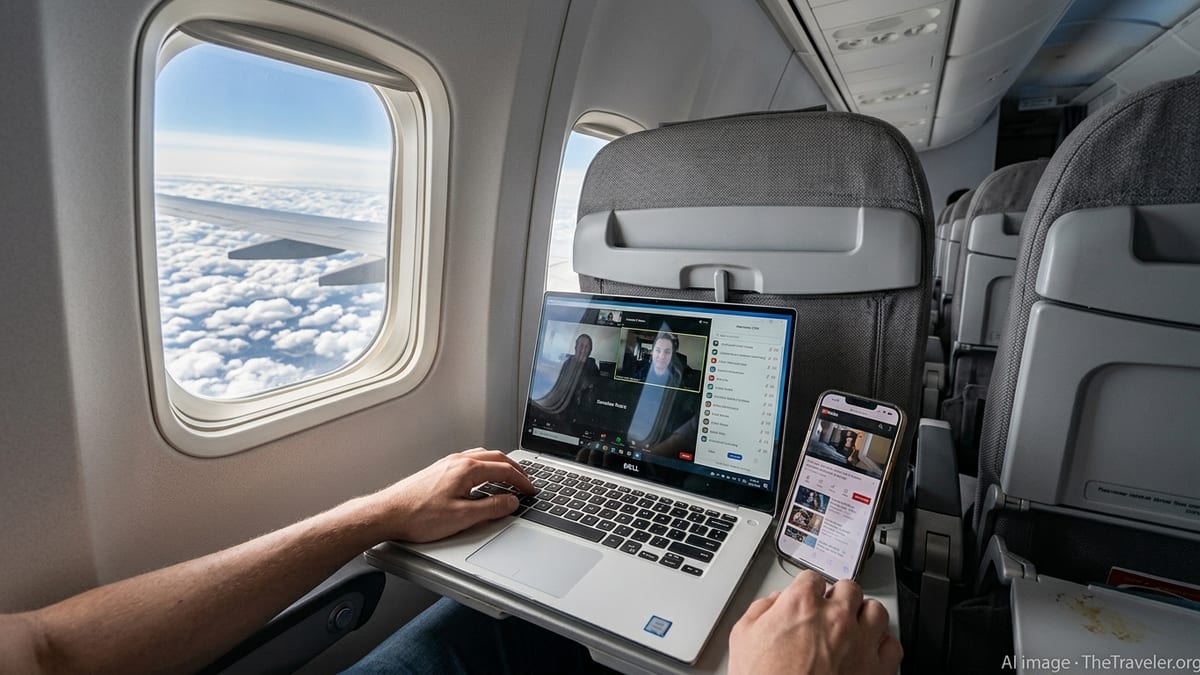
From Dropouts and Delays to Streaming in the Sky
The main reason airplane internet has historically been so unreliable comes down to physics. Most current systems rely on geostationary satellites parked about 36,000 kilometers above Earth. That distance introduces latency and limits capacity, especially when hundreds of passengers are trying to connect at the same time on a single aircraft.
Low Earth orbit constellations flip that model by moving satellites much closer, typically a few hundred to around 1,200 kilometers above the surface. The shorter distance cuts latency significantly, creating a browsing experience that feels closer to home broadband. It also allows networks to reuse spectrum more efficiently across many smaller satellites, increasing overall bandwidth available to aircraft.
Reports from early LEO deployments in aviation show passengers able to stream video, join video calls, and use cloud applications with fewer interruptions than with traditional geostationary services. This sets a new benchmark for what travelers expect at 35,000 feet and creates an opening for newcomers like Quvia to compete with long-established connectivity providers.
Publicly available technical analyses indicate that LEO systems can deliver latencies measured in tens of milliseconds rather than the hundreds that are typical of high-altitude satellites. For business travelers trying to work in real time and leisure passengers accustomed to always-on streaming, that difference feels substantial.
Who Is Quvia, and What Is It Trying to Change?
Quvia is positioning itself as a fresh entrant in the low Earth orbit connectivity race, targeting aviation as one of its core use cases. While larger brands in the satellite world have captured attention with massive constellations and headline airline deals, Quvia’s strategy focuses on a dedicated LEO architecture and aviation-tailored ground infrastructure designed from the outset around in-flight needs.
According to publicly available material, Quvia’s network blueprint centers on dense coverage along high-traffic flight corridors, rather than spreading capacity evenly over remote regions where few aircraft operate. That approach aims to reduce congestion in the skies where it matters most, focusing beams and bandwidth on transcontinental and transoceanic routes that historically suffer the worst connectivity.
Quvia also promotes a tightly integrated software platform for airlines, combining satellite capacity management with cabin network optimization. Instead of treating the aircraft simply as a terminal at the edge of the network, Quvia’s model treats each plane as a moving node, continually adjusting handoffs between satellites, shaping traffic, and prioritizing latency-sensitive applications.
For passengers, the result is designed to be less about raw speed peaks and more about consistency. A steady, video-capable connection from gate to gate, without the familiar midflight slowdown when everyone logs on at once, is the outcome airlines are being promised as they evaluate next-generation LEO options.
A Crowded Sky: How Quvia Fits Into the LEO IFC Landscape
The timing of Quvia’s push into aviation comes as LEO capacity is rapidly expanding across the industry. Operators behind large low Earth orbit constellations are increasingly targeting aircraft, ships, and remote enterprises as key growth markets. In parallel, established in-flight connectivity providers are adopting multi-orbit strategies that blend their existing geostationary networks with new LEO partnerships.
Recent announcements in the satellite sector highlight a shift toward hybrid architectures. Major players have outlined plans to integrate LEO capacity into existing aviation offerings, often through agreements with dedicated low Earth orbit constellations. These arrangements are intended to give airlines the best of both worlds, using geostationary satellites for broad coverage and LEO for high-performance routes and bandwidth-hungry cabins.
Within this context, Quvia is pitching itself as a pure LEO specialist that can slot directly into airline connectivity portfolios. Rather than operating across multiple orbital regimes, it aims to provide a focused low-latency layer that airlines or integrators can combine with other networks as they see fit. This gives carriers an alternative to vertically integrated models where a single provider controls everything from ground stations to onboard equipment.
Industry coverage suggests that airlines are increasingly open to this sort of modular approach. As more carriers commit to free or low-cost Wi‑Fi as a brand promise, they are seeking a mix of partners that can deliver resilience, performance, and predictable costs. Quvia’s emergence adds another option to that toolkit, particularly for fleets that want to lean more heavily on LEO capacity.
What Better In-Flight Internet Actually Looks Like for Travelers
For passengers, the promise of the LEO revolution is straightforward: airplane internet that behaves more like the connection at home or in the office. That means faster page loads, smoother video, and fewer cryptic “service temporarily unavailable” messages midflight. It also means the ability to use modern tools such as cloud-based productivity suites, collaboration platforms, and rich media social apps without constant buffering.
Another shift tied to LEO deployments is the move toward gate-to-gate connectivity. Because the antennas and beam patterns driving low Earth orbit services can maintain links at lower altitudes, airlines have more flexibility to keep Wi‑Fi running during taxi and climb, subject to regulatory approvals and operational policies. For travelers trying to send last-minute messages before takeoff or coordinate arrivals while still on approach, that continuity can be a significant quality-of-life upgrade.
As more aircraft adopt LEO or hybrid GEO/LEO solutions, expectations are changing. Travelers increasingly view reliable onboard Wi‑Fi as a core part of the product rather than an optional add-on. Surveys cited in aviation trade coverage point to connectivity ranking alongside legroom and punctuality in shaping customer satisfaction, giving airlines a strong incentive to invest in higher-performing networks.
If Quvia and its LEO peers meet their performance targets at scale, the notion of going offline for hours on a long-haul flight could quickly feel outdated. Instead, connectivity may become something passengers only notice when it is absent, much as they do with power outlets or in-seat entertainment today.
Challenges Ahead in Ending the Era of Bad Airplane Internet
Despite the promise, Quvia and other LEO providers face significant hurdles in turning the vision of seamless airborne broadband into a global reality. Building and maintaining a constellation of low Earth orbit satellites is capital-intensive, and the aviation segment has exacting requirements for safety, reliability, and regulatory compliance.
Airlines, for their part, must weigh the benefits of upgrading hardware across their fleets against the cost and operational disruption of installations. Antenna design remains a critical piece of the puzzle. Electronically steerable, low-profile arrays that can track fast-moving LEO satellites without adding drag are still an area of rapid development and investment in the sector.
Spectrum coordination, cybersecurity, and interoperability with existing cabin systems add further complexity. Publicly available expert commentary notes that multi-orbit, multi-link architectures can deliver impressive resilience and performance but require sophisticated management tools and robust service level agreements to function smoothly in daily operations.
Quvia’s bid to help end the era of bad airplane internet will therefore depend not only on satellite technology but also on the company’s ability to integrate with airline strategies, certification pathways, and passenger expectations. If it can navigate those challenges alongside other LEO players, travelers may soon look back on buffering video and broken connections at cruising altitude as a relic of another era.