

More news on this day
After years of patchy signals, buffering videos and broken promises of “gate-to-gate Wi-Fi,” a new generation of low Earth orbit satellite networks and smart software platforms such as Quvia is rapidly redefining what passengers can expect from inflight internet.
Get the latest news straight to your inbox!
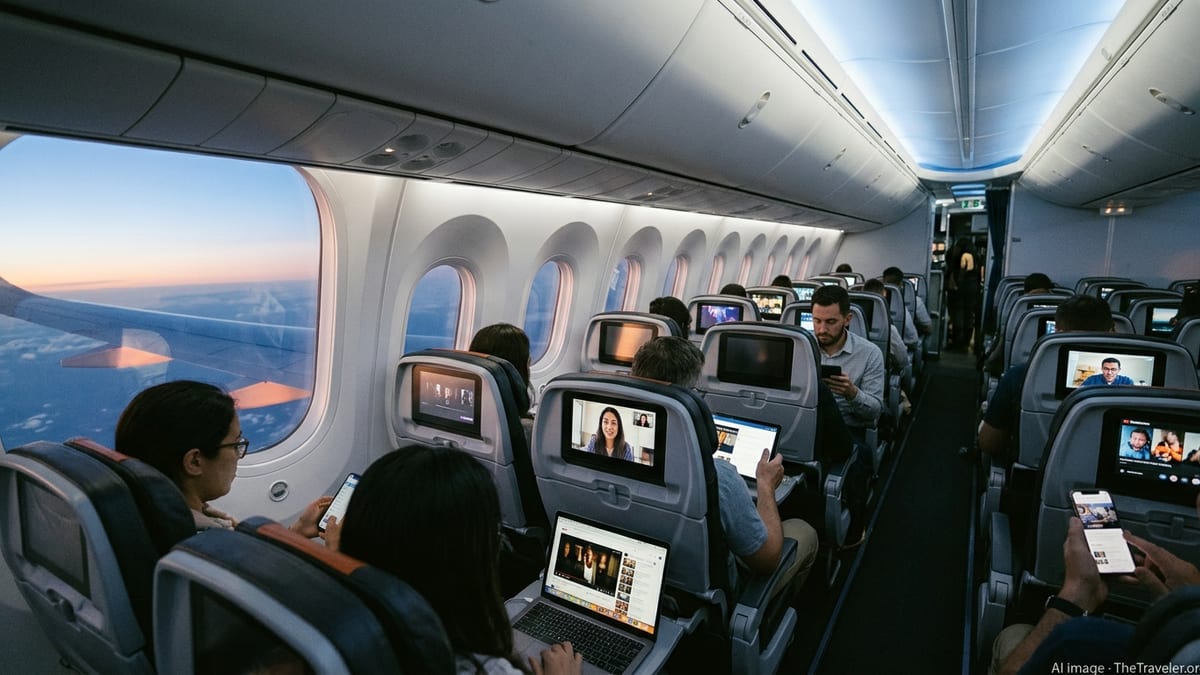
From Frustration to a New Connectivity Era
For more than a decade, inflight connectivity has been synonymous with compromise. Early systems relied heavily on geostationary satellites sitting tens of thousands of kilometers above Earth, introducing high latency, narrow bandwidth and frequent dropouts, especially over busy air corridors and remote oceans. Many airlines marketed Wi-Fi as a premium feature, but traveler feedback and published user accounts have repeatedly highlighted slow speeds and inconsistent performance.
The arrival of large low Earth orbit, or LEO, constellations is changing that equation. Positioned a few hundred to roughly two thousand kilometers above the planet, LEO satellites dramatically reduce signal travel distance, cutting latency and allowing higher throughputs. Publicly available performance data from airlines that have adopted LEO-based systems indicates that passengers can now stream high-definition video, join video calls and use cloud-based work tools almost as seamlessly as they would on the ground.
This shift is not only about adding capacity. It is also about enabling multi-orbit architectures that blend LEO with medium and geostationary satellites. That blended approach is designed to offer both speed and reach, as well as redundancy when one network is congested or temporarily unavailable. The challenge has been managing these complex, overlapping networks in real time onboard an aircraft.
That is where Quvia, a relatively new aviation technology company focused on quality-of-experience optimization, has started to attract industry attention. Rather than operating satellites itself, Quvia provides the intelligence layer that decides how and when aircraft connect to different satellite networks and how bandwidth is allocated among passengers and onboard systems.
Quvia’s Grid Platform and the Multi-Orbit Opportunity
Quvia’s flagship product, known as Grid, is billed as an AI-powered platform built specifically for commercial aviation. According to company materials and industry coverage, Grid sits between the aircraft’s onboard network and external connectivity providers, constantly assessing link performance, application demand and service-level targets. The platform can then adjust traffic flows, prioritize certain services and switch between satellite networks or orbits as conditions change.
This type of orchestration is becoming especially relevant as airlines move away from single-provider, single-orbit contracts. Reports from the inflight connectivity sector describe a growing number of carriers planning “multi-orbit” or “multi-link” strategies, combining LEO capacity with existing geostationary infrastructure and, in some cases, terrestrial links. Quvia’s stated aim is to ensure that these complex arrangements translate into a smooth experience at the seat, rather than a patchwork of variable service.
Partnerships are central to that strategy. SES, which operates a mix of geosynchronous and medium Earth orbit satellites, has announced plans to co-develop new-generation multi-orbit solutions with Quvia, highlighting a focus on improving quality of experience for mobility customers, including aviation. Separate announcements from antenna specialist ThinKom describe cooperation with Quvia to support multi-link inflight connectivity, underlining the need to coordinate not only networks in space but also hardware on the aircraft.
By positioning itself as an independent orchestration layer, Quvia is seeking to give airlines more control and flexibility. Public statements from the company and its partners emphasize the risk of carriers locking themselves into a single technology or commercial arrangement, particularly at a time when LEO constellations and flat-panel antennas are evolving rapidly. Grid is presented as a way to keep options open while still delivering measurable improvements in passenger experience.
JetBlue and Early Airline Adopters
One of the clearest indications of this shift comes from JetBlue, a long-time advocate of offering robust connectivity as part of its brand. In 2025, the airline selected Quvia to underpin its next-generation Fly-Fi service, which is scheduled to roll out across portions of the fleet from 2027. According to publicly available information from the airline and industry publications, JetBlue plans to blend an upcoming LEO-powered broadband solution with Viasat’s multi-orbit capable system on different groups of aircraft.
JetBlue’s challenge is ensuring that passengers have a consistent online experience regardless of route or aircraft type. The carrier’s plans call for Quvia Grid to manage the in-cabin network, monitor access points and troubleshoot issues in real time from a centralized platform. Reports indicate that this environment will allow the airline to balance traffic across the cabin, enforce service levels and host the customer portal while maintaining the option to orchestrate multiple satellite providers and orbits behind the scenes.
Industry analysis notes that this approach treats connectivity less as a bolt-on and more as core digital infrastructure, aligned with the way airlines now think about entertainment, retail and operational data flows. By pairing LEO capacity with intelligent network management, JetBlue and other early adopters aim to reduce one of the biggest pain points cited by frequent travelers: not knowing whether the Wi-Fi on a given flight will actually deliver.
Other carriers are moving in a similar direction, even if they are not yet using Quvia by name. Recent announcements from major satellite operators and inflight connectivity providers outline plans to integrate LEO capacity into existing services, expand electronically steered antenna deployments and enable multi-orbit coverage for both commercial and business aviation. Quvia’s partnerships place it near the center of this ecosystem, giving it an outsized role in shaping how the LEO revolution reaches passengers.
Inside the LEO Advantage for Passengers
For travelers, the technical distinctions between LEO, medium Earth orbit and geostationary systems matter only insofar as they change what can be done at 35,000 feet. Publicly reported flight tests of multi-orbit and LEO-enabled systems show peak download speeds that allow multiple passengers to stream video simultaneously, join live virtual meetings or upload large files without significant delays. Latency reductions, often measured in tens of milliseconds rather than hundreds, make real-time applications far more usable.
These improvements are particularly noticeable on long-haul routes that cross oceans or polar regions, where legacy inflight Wi-Fi has often struggled. LEO constellations, composed of hundreds or thousands of satellites, can provide more uniform coverage and reduce the risk of service blackouts along popular transcontinental and intercontinental corridors. When combined with geostationary or medium Earth orbit assets, they can also enhance resilience if one network experiences congestion or an outage.
Quvia’s role is not in launching these satellites but in making them usable in a dynamic cabin environment. Its software is designed to understand which applications are most sensitive to latency, which passengers or services are entitled to premium bandwidth, and how to route traffic accordingly. That might mean prioritizing video conferencing for business travelers during working hours, or allocating more capacity to streaming entertainment on leisure-heavy routes, all without passengers being aware of the underlying complexity.
As airlines lean into digital retailing and real-time operations, improved inflight connectivity also supports functions beyond passenger browsing. Aircraft health monitoring, predictive maintenance, crew applications and real-time disruption management all generate data that must be transmitted securely and reliably. Multi-orbit connectivity orchestrated by platforms such as Quvia promises to increase the volume and quality of that data, potentially improving punctuality and service recovery for travelers.
What Comes Next for Inflight Internet
The move to LEO-enabled, multi-orbit inflight connectivity is still in its early stages, and not all travelers will experience the benefits immediately. Many fleets continue to rely on older systems, and some airlines are taking a cautious approach to investing in new antennas, modems and cabin networks. There are also open questions around pricing models, with some carriers offering free access supported by advertising or loyalty programs, while others maintain tiered paid plans.
Nevertheless, industry roadmaps and recent partnership announcements suggest that the direction of travel is clear. Satellite operators are racing to fill out LEO constellations and add inter-satellite links, equipment manufacturers are bringing slimmer, lighter antennas to market, and connectivity providers are designing services that can hop between orbits without interrupting the passenger session. Within that landscape, Quvia and similar orchestration platforms are emerging as the glue that binds hardware and networks into a coherent whole.
For travelers, the most tangible change may be the fading of the familiar caution printed on boarding passes and seatback cards advising that Wi-Fi performance may vary. As more aircraft are equipped with LEO-capable, multi-orbit systems managed by intelligent software, the expectation is shifting toward internet access that simply works, much like in a hotel or airport terminal.
There are still challenges to address, including cybersecurity, spectrum coordination and the environmental impact of proliferating satellites. But for passengers who have long treated inflight Wi-Fi as a last resort, the LEO revolution, accelerated and orchestrated by platforms such as Quvia, marks a decisive break with the era of bad airplane internet.