

More news on this day
Travel in 2026 is increasingly defined by what some analysts are calling “the mystic outlands” trend, as travelers trade crowded capitals for remote, spiritually charged landscapes, dark-sky deserts, and nocturnal journeys that promise both escapism and inner recalibration.
Get the latest news straight to your inbox!
From Dark-Sky Deserts to Nocturnal Frontiers
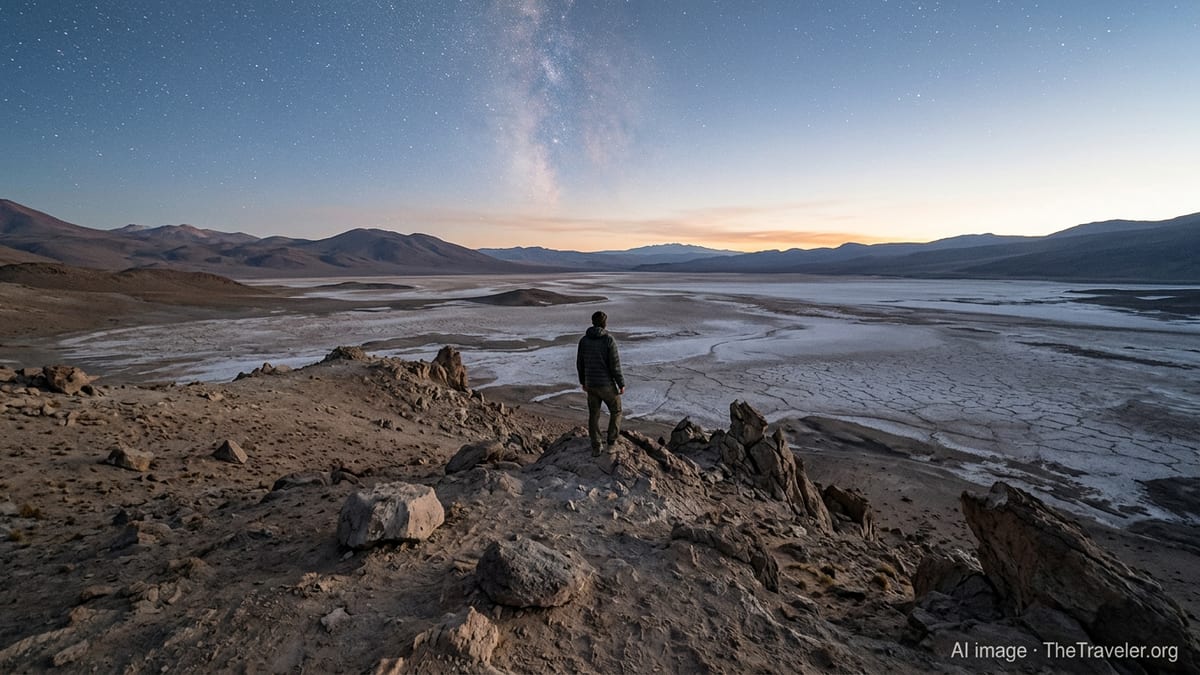
One of the clearest expressions of the mystic outlands trend is the rapid growth of dark-sky and astro tourism. Travel industry reports for 2026 highlight destinations such as Chile’s Atacama Desert, New Zealand’s accredited dark-sky reserves, and remote regions of South Africa’s Northern Cape as benchmark locations for stargazing travel. New itineraries built around the August 12, 2026 total solar eclipse, particularly in Spain’s Aragon region, are further accelerating demand for night-sky themed journeys.
Specialist operators are rolling out eclipse routes, telescope-equipped camps, and night photography workshops aimed at travelers seeking what marketing materials often describe as “cosmic perspective.” Tourism development documents from regions such as Utah, which is launching a “Dark Sky Mode” campaign in April 2026, show how destinations are positioning low light pollution as a premium asset rather than a limitation.
Parallel to astro tourism, noctourism more broadly is emerging as a mainstream category. Coverage in travel media describes rising interest in guided night hikes, moonlit wildlife safaris, lantern-lit historical walks, and open-air “star beds” in remote camps from East Africa to southern Europe. The night itself is being framed as a destination, with itineraries designed almost entirely around after-dark experiences.
This shift is not purely aesthetic. Industry commentary notes that dark-sky tourism helps spread visitor flows away from already saturated hotspots and into lesser-known rural regions, extending tourism seasons and bringing new revenue to remote communities that historically saw little benefit from international travel.
Spiritual Retreats and the Search for Transformative Landscapes
Alongside nocturnal travel, wellness and spiritual tourism are converging with the mystic outlands narrative. According to trend round‑ups from Condé Nast Traveler and niche wellness publications, wellness travel in 2026 is moving away from clinical biohacking and back toward nature-based, ritual-infused experiences in secluded settings. Retreats in the Peruvian Andes, for example, are framed as portals to Andean cosmology, timed to solstices and other celestial events.
Retreat operators across destinations from Estonia’s forested islands to Himalayan valleys are blending local belief systems with contemporary wellness formats. New programs publicized for 2026 reference pagan-influenced “earth faith” practices, ritual bathing, sound healing in open-air temples, and guided meditations at sunrise viewpoints. The destination itself becomes a central element of the practice, rather than a neutral backdrop.
The Global Wellness Institute and other research bodies have reported triple-digit growth in demand for spiritual and self-discovery travel in recent years, with travelers explicitly seeking experiences that combine astrology, energy work, and time in wild landscapes. That appetite is reflected in new product lines ranging from women’s transformation retreats to small‑group journeys focused on mythic rivers, sacred mountains, and centuries‑old pilgrimage routes.
At the more experimental edge, psychedelic retreats and plant‑medicine programs in jurisdictions where such practices are decriminalized or regulated continue to gain visibility. While tightly controlled and often controversial, publicly available information on these retreats shows that participants are drawn as much by the setting, such as rainforest lodges or mountain sanctuaries, as by the therapies themselves, reinforcing the centrality of remote, symbolically loaded environments.
Gen Z, “Spellbounding” Travel and the New Mysticism
The cultural roots of the mystic outlands trend reach beyond tourism. Lifestyle media and trend agencies point to a broader resurgence of mysticism among Gen Z and younger millennials, visible in everything from tarot and manifestation content on social platforms to astrology-guided decision‑making. One trend report from travel forecasters describes “Spellbounding” travel, in which astrocartography, numerology, or zodiac themes actively determine where and when people choose to go.
Globetrender’s analysis of spiritual travel notes a sharp rise in trips planned around birth charts, lunar phases, or personal “power places” mapped by astrologers. Travel platforms and small agencies are responding with packages marketed explicitly as “cosmically aligned itineraries,” featuring lunar eclipse retreats, new‑moon workshops, and stays timed to specific dates considered auspicious in various traditions.
Parallel reporting in mainstream magazines on the merging of money, career planning, and mysticism suggests this turn toward the esoteric is not limited to leisure. Surveys cited in that coverage indicate that large majorities of Gen Z and millennial respondents express some belief in “cosmic guidance,” which is now finding concrete form in how they structure time off, choose destinations, and evaluate what makes a trip meaningful.
For destinations and travel brands, this translates into a demand for narratives and experiences that feel symbolically rich. Haunted itineraries, myth-focused city walks, and “thin place” tours that emphasize folklore and liminal landscapes are being reimagined for a new audience that is as fluent in astrology apps as in traditional guidebooks.
No-Filter Landscapes and the Lure of the Remote
The mystic outlands trend is also a reaction against overt tourism development and algorithm-driven travel choices. Industry trend reports for 2026 talk about travelers seeking “no‑filter” landscapes, where minimal infrastructure, limited connectivity, and sparse crowds create a sense of discovery that is hard to replicate in mainstream hubs. This aligns with broader shifts toward slower, more intentional itineraries.
Destinations spotlighted in recent coverage as “mystical” share several traits: dramatic topography, layered spiritual histories, and a relative distance from mass tourism routes. Ethiopia’s highlands, Bolivia’s Salar de Uyuni, India’s Varanasi, and lesser-known corners of Bali feature prominently in 2026 destination round‑ups that focus on transformative or enigmatic places.
Outdoors‑oriented magazines highlight how astro tourism and noctourism are helping remote regions in Namibia, the Canary Islands, and northern Europe reposition themselves as year‑round escapes, with activities that are less vulnerable to weather and traditional high‑season crowding. The visual appeal of mirror‑like salt flats under star‑filled skies or volcanic islands protected by strict light‑pollution rules also makes these locations particularly suited to social media, reinforcing their aura of otherworldliness without the need for heavy built infrastructure.
However, commentators are increasingly emphasizing the need for responsible management as visibility grows. Dark-sky advocates, for example, warn that an influx of visitors without careful light and noise controls can erode the very qualities that made a place attractive in the first place, turning once‑pristine nightscapes into crowded viewpoints.
How the Travel Industry Is Packaging the Mystic Outlands
Tourism boards, tour operators, and hospitality brands are now actively incorporating mystic outlands language and imagery into their 2026 campaigns. National and regional tourism strategies reference astro tourism corridors, dark‑sky certification targets, and new routes that link observatories, sacred sites, and remote wellness centers. Marketing materials promote limited‑capacity night experiences, immersive storytelling with local guides, and off‑grid accommodations that foreground silence and stars.
Luxury travel media describe a growing preference for short, high‑impact escapes that pair a major urban center with two or three nights in a secluded, symbolically charged setting, such as desert camps near sandstone formations, island monasteries, or hilltop temples. In the Gulf region, trade publications report that travelers are increasingly “landscaping” itineraries around these intense, often nocturnal interludes, treating them as psychological resets.
Meanwhile, mainstream brands are experimenting with offerings that bring elements of the mystic outlands into more accessible formats. Urban hotels are introducing rooftop stargazing nights, sound‑bath sessions, and pop‑up wellness festivals that echo the atmosphere of remote retreats, while rail and cruise itineraries are adding night‑sky commentary, folklore talks, and visits to off‑grid communities as value‑added components.
Across these developments, 2026 is emerging as a watershed year in which travel is less about ticking off famous landmarks and more about entering environments that feel charged, liminal, and just a little uncanny. The rise of the mystic outlands encapsulates a growing desire for experiences that blur the line between vacation, ritual, and pilgrimage, set against some of the planet’s darkest skies and most evocative landscapes.