

More news on this day
On a winter morning in eastern China, as the Qilu No. 1 tourism train pulls out of Jinan Station, passengers settle into a journey where the real attraction is not how fast they arrive, but how much of Shandong’s culture and countryside they can take in along the way.
A Provincial Workhorse Turned Traveling Showcase
Launched in April 2025 as “Hospitable Shandong · Qilu No. 1,” the refurbished green train is officially billed as the province’s first named tourism service, linking 22 stations across 11 cities in Shandong. Rather than racing between major hubs, it moves at conventional speeds along a loop that connects industrial centers, coastal towns and historic inland cities, giving travelers time to watch wheat fields, village roofs and smokestacks slip by the window.
Operated in partnership with China Railway Jinan Group and Shandong Heavy Industry, Qilu No. 1 is designed as a one-stop tourism platform that bundles dining, lodging, transportation, sightseeing, shopping and entertainment into a single ticket. Its 15-car formation includes hard and soft sleeper cars, standard seating, dining and entertainment coaches, offering 666 seats and berths and targeting both families and small tour groups.
The naming of the train as a provincial cultural tourism project reflects a broader strategy by Shandong authorities to create recognizable travel brands. Drawing on the historical name “Qilu,” which refers to the ancient states of Qi and Lu that once occupied the region, the train positions itself as a moving introduction to the province’s layered past, from Confucian temples and imperial mountains to fishing ports and industrial shipyards.
For rail operators, Qilu No. 1 is also a way to extend the value of conventional lines that have been overshadowed by China’s high speed network. By slowing down the timetable, curating onboard experiences and tightly coordinating with destination marketing campaigns, the train transforms everyday tracks into a themed corridor for domestic and, increasingly, international visitors.
The Rolling Gallery: Art, Heritage and a Yellow River Fair
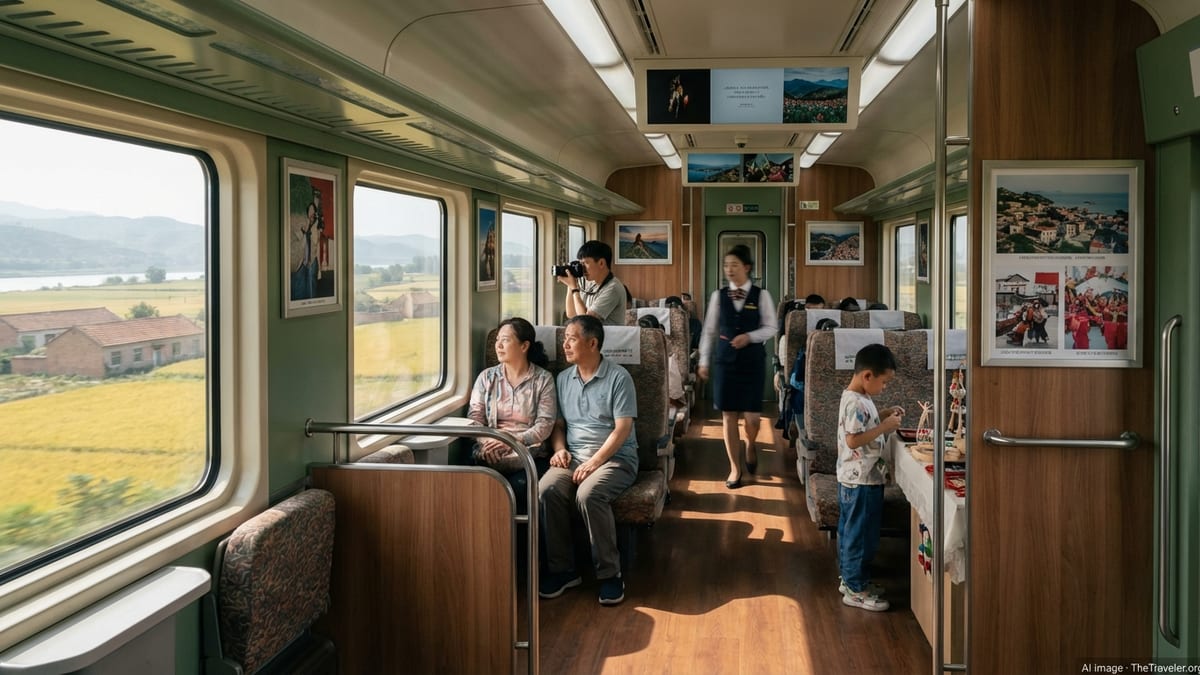
Inside, Qilu No. 1 doubles as a contemporary gallery and folk culture salon. In designated exhibition coaches, walls are lined with photography, ink paintings and design pieces that highlight Shandong’s landscapes and cities, while digital screens cycle through short films introducing local artisans, museums and festivals. Textiles and woodwork from different counties are displayed in vitrines between seats, inviting passengers to wander the carriages as they would a small museum.
During peak travel periods, especially around the Spring Festival rush, the train becomes what local officials describe as a “mobile Yellow River fair.” Paper cutting artists demonstrate delicate red silhouettes of horses and village scenes, folk performers show off shehuo masks, and calligraphers help families write New Year couplets at communal tables. Passengers can pause between carriages to try their hand at traditional crafts before returning to their bunks or window seats.
The gallery concept extends to taste and smell. Dining cars and pop up stalls showcase regional dishes such as Yimeng stir fried chicken, local noodles and snacks from mountain towns and coastal cities. Rural revitalization programs use the train as a rolling marketplace for products like peach wood carvings and specialty teas, with village officials stepping onboard at intermediate stops to introduce their communities and arrange direct sales.
For many travelers, that combination of art, performance and informal commerce is what differentiates Qilu No. 1 from conventional overnight services. Instead of killing time with a phone and instant noodles, passengers are drawn into a curated sequence of encounters that turns the passage between cities into part of the trip’s cultural content.
Slow Rail as an Antidote to High Speed Routine
The debut of Qilu No. 1 comes as Chinese authorities and railway operators experiment with themed and slower trains as a counterpoint to the country’s dense high speed grid. While bullet services have compressed journeys between major cities to a matter of hours, they offer little space for lingering in landscapes or interacting with fellow passengers beyond a quick exchange over the aisle.
Qilu No. 1 moves in the opposite direction. Timetables are structured to arrive at scenic or historic areas at daylight hours when possible, encouraging passengers to step off for short excursions, local food tastings or photo stops before reboarding. Travel agencies have begun bundling the train into multi day itineraries that combine onboard nights with guesthouse stays near attractions such as Mount Tai, Confucius sites in Qufu and coastal promenades in Qingdao.
For domestic travelers who have grown accustomed to fast trains and short breaks, the appeal lies partly in nostalgia. The green carriages, shared hot water dispensers and unhurried station dwell times recall an earlier era of rail travel. Yet the experience is less spartan than traditional slow trains, thanks to refurbished interiors, family friendly compartments and scheduled cultural programming that keeps younger passengers engaged.
For international visitors, particularly those exploring the province as an extension of trips to Beijing or Shanghai, Qilu No. 1 offers a relatively low stress way to sample second tier cities that are rarely included on first time itineraries. English language signage and multilingual announcements have been gradually expanded, and inbound tour operators are testing chartered sections of the train for small groups focused on photography, food or heritage themes.
Connecting Cities, Countryside and the Tourism Economy
Beyond its role as an attraction, Qilu No. 1 is intended to act as connective tissue for Shandong’s tourism economy. Its route links more than 200 scenic spots across the province, from mountain parks and coastal beaches to film studios and theme parks. Local governments along the line have coordinated to create joint ticketing, shuttle services and seasonal events tied to the train’s schedule.
In smaller inland cities and county level stations, the arrival of the tourism train brings a modest but noticeable boost in foot traffic for homestays, markets and cultural venues. Residents have begun organizing small welcome performances and seasonal fairs on platforms, turning what used to be routine stops into mini events that reinforce the sense of a shared, province wide project.
For Shandong Heavy Industry, whose branding appears prominently on the train, Qilu No. 1 is also a rolling showroom. Interior design elements highlight locally manufactured engines, buses and marine equipment through photographs and design stories, framing industrial products within the broader narrative of “intelligent manufacturing” and regional pride. In doing so, the train blurs the line between tourism promotion, cultural diplomacy and corporate storytelling.
As more Chinese provinces look to develop named tourism trains, Qilu No. 1 is being closely watched as a template for how slower rail services can be reimagined. Its success will be measured not only in passenger numbers, but in how effectively it can keep visitors onboard long enough to see Shandong as more than a waypoint between better known coastal and inland destinations.
A Moving Symbol of Shandong’s Cultural Rebrand
The emergence of Qilu No. 1 fits into a larger effort to rebrand Shandong from an industrial stronghold into a diversified cultural and leisure destination. Recent campaigns have emphasized “Hospitable Shandong,” film tourism circuits and Yellow River themed routes, betting that travelers are increasingly looking for experiences that combine outdoor scenery, heritage and local life.
By physically stitching together these initiatives along a single rail corridor, Qilu No. 1 operates as both transport and symbol. Its cars carry artworks from provincial museums, crafts from remote villages and branded messages from heavy industry groups, presenting them to a captive audience of commuters and vacationers who might otherwise never seek out a gallery or cultural fair.
For now, Qilu No. 1 runs as a regional experiment rather than a national franchise. Yet its premise speaks to a broader shift in how railways are being used in China: not only as high speed arteries for business travelers, but as platforms for slower, more immersive journeys that treat landscapes and local stories as core assets. On this rolling gallery, the distance between cities is reframed as an opportunity to linger, look and, perhaps, reconsider what a train ride can be.