

More news on this day
Long accustomed to routing through Dubai, Doha or Abu Dhabi, a growing share of transatlantic and transpacific travelers are instead booking itineraries that pivot around United Airlines’ powerhouse hubs at Newark and Chicago O’Hare, reflecting a shift in network strategy, premium demand and airport investment that is subtly reshaping global air traffic flows.
Get the latest news straight to your inbox!
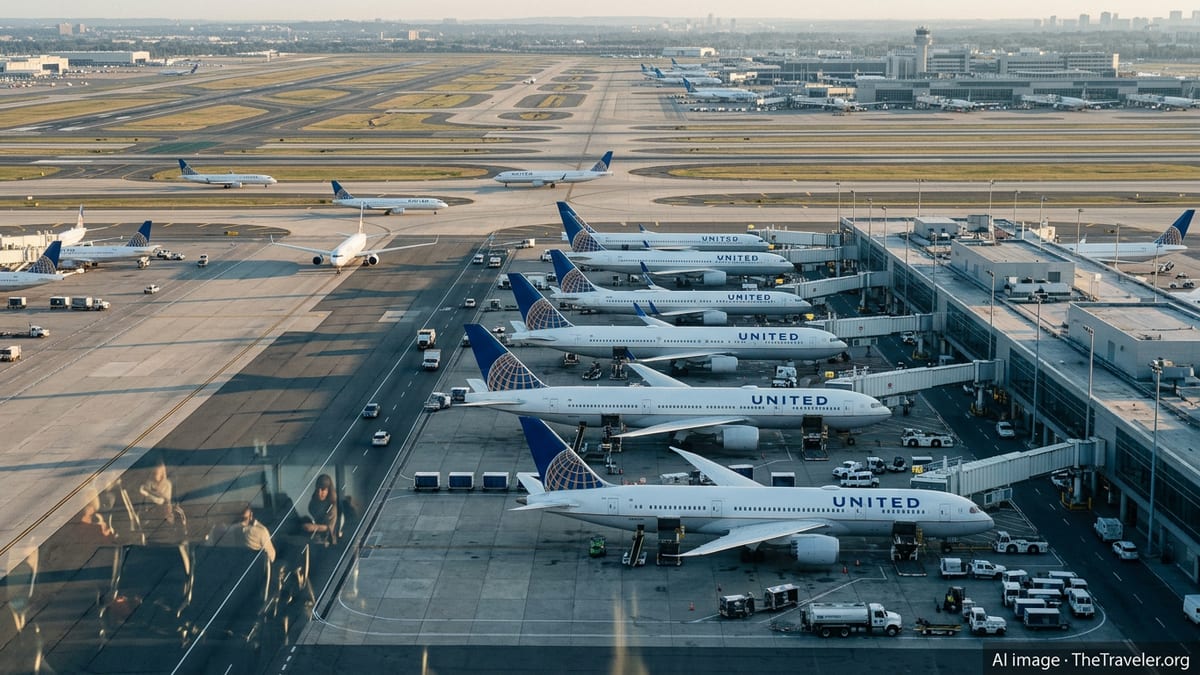
From Sixth-Freedom Circuits to Nonstop Logic
Gulf carriers built their global appeal on sixth-freedom traffic, turning Dubai, Doha and Abu Dhabi into giant mid-route junctions that stitched together the United States, Europe, Africa and Asia. Aviation data highlighted in recent Indian business coverage shows that more than 70 percent of passengers on Emirates, Etihad and Qatar Airways services linked to India use those hubs as transit points to third countries, underlining how central the connection model has been to their growth.
At the same time, U.S. carriers have been expanding fleets of long-range aircraft, improving cabins and redeploying capacity toward nonstop or single-connection options. For time-sensitive travelers, especially on corporate contracts, a same-carrier connection through a U.S. hub can be more attractive than a longer routing through the Gulf, even where onboard service is perceived as more lavish. This is particularly true in markets such as India to the United States and secondary European cities, where new nonstop links and carefully timed banks of flights at Newark and Chicago now offer credible alternatives.
The commercial debate has shifted from headline service standards to end-to-end journey time, reliability and loyalty economics. With more premium seats to sell and increasingly sophisticated revenue management, United and its domestic rivals are attempting to pull some of that sixth-freedom traffic back onto itineraries that remain within their own networks for a greater share of the trip.
For travelers, the result is a more complex choice set. Where a journey from Bengaluru to Boston via the Gulf once appeared the obvious solution, comparable one-stop routings via Newark, Chicago or other U.S. hubs can now match or beat total travel time, particularly as security and transfer processes at some Gulf hubs become more congested during peak waves.
Newark’s Quiet Rise as a Transatlantic and India Gateway
Newark Liberty International Airport has steadily cemented its role as United’s primary transatlantic gateway and East Coast hub. Publicly available airport data for the 12 months to late 2025 shows United with roughly two thirds of total passenger market share at Newark, underscoring the extent to which its schedule and connectivity define the airport’s proposition for long haul travelers.
United has layered onto that dominance with an aggressive wave of new long haul routes. A 2024 announcement billed as the largest international expansion in the airline’s history detailed eight new destinations, including five from Newark to cities such as Nuuk, Palermo, Bilbao, Madeira and Faro, many of them not served nonstop by other U.S. carriers. Those additions sit alongside a dense core of flights to London, Paris, Frankfurt, Delhi and Mumbai, creating multiple daily frequencies on trunk routes and niche options for leisure and diaspora traffic.
The carrier has also invested heavily in the ground experience at Newark. Industry coverage of United’s Polaris business-class product notes that the airline is enlarging and upgrading lounges at key hubs, with Newark gaining new Polaris dining facilities as part of a broader premium push. Together with closely timed banks of domestic departures across the United States, the airport increasingly functions as a “connection factory” in its own right, designed to keep travelers within United’s ecosystem from origin to destination.
This scale and integration matter when stacked against a Gulf connection. A traveler from a mid-sized U.S. city heading to a secondary European destination may now be offered a single connection via Newark, staying on United metal and within one loyalty program. That can compete effectively against an itinerary requiring a U.S. domestic leg, an ultra-long-haul to the Gulf, and a further regional connection, especially when corporate buyers weigh schedule resilience and disruption handling.
Chicago O’Hare as a Rebalanced Global Powerhouse
Chicago O’Hare has long ranked among the world’s most connected airports, and aviation analytics firm OAG’s Megahubs index has repeatedly placed it at or near the top of the list, with United as the dominant carrier by share of potential connections. Recent analyses of hub competition describe O’Hare as a rare example of a dual-hub field, with both United and American operating extensive networks and vying for long haul traffic.
Within that contest, United has been steadily building out its position. The airline’s own communications and airport fact sheets describe O’Hare as United’s primary international gateway, with around 560 daily departures when including regional affiliates and roughly 45 daily nonstop flights to nearly 40 international destinations. Local coverage and aviation commentary highlight Chicago-focused marketing campaigns and new gates that are expected to support additional long haul launches.
Infrastructure is also moving in United’s favor. O’Hare’s long-running redevelopment, branded as O’Hare 21 or ORDNext, includes plans for a new Global Terminal and satellite concourses intended to add gates, streamline international connections and expand processing capacity. Industry observers note that such projects are specifically designed to accommodate higher volumes of widebody operations, making Chicago better placed to host more ultra-long-haul services that compete with one-stop Gulf itineraries.
For passengers in the U.S. Midwest and central Canada, that translates into more options to reach Europe, the Middle East and Asia via Chicago without backtracking to coastal hubs or relying on Gulf carriers. Combined with refurbished Polaris lounges and expanded premium seating on transatlantic routes, Chicago’s upgraded facilities are positioning it as a viable alternative to routing long haul trips through Dubai or Doha.
Premium Cabins and Corporate Contracts Tilt the Scales
The competition between Gulf hubs and United’s domestic strongholds is increasingly playing out at the front of the plane. Business travel demand lagged broader leisure recovery after the pandemic, but financial and aviation press coverage indicates that premium cabins are once again central to airline strategies, with United, Delta and American all refurbishing long haul business products.
Recent reporting on United’s Polaris business-class evolution describes larger suites, doors on seats and bigger, higher-resolution screens, along with dedicated Polaris lounges at hubs including Newark and Chicago. Additional industry analysis notes lounge expansions, such as the Chicago Polaris space reopening with significantly more seating and enhanced bar and dining facilities, and Newark adding dedicated Polaris dining rooms as upgrades roll through the network.
These changes align with a shift in demand patterns. Corporations that once favored Gulf carriers for their service and network reach are now reassessing the value of tighter integration into a single U.S. carrier’s ecosystem, especially when premium hard products and ground services have narrowed the perceived quality gap. For travelers who place a premium on mileage accrual, upgrade potential and consistent service standards, a one-stop itinerary through Newark or Chicago can be as compelling as a longer journey via Dubai or Doha.
Price dynamics remain complex, with anecdotal fare data and traveler reports suggesting that United’s premium cabins can be expensive on peak dates yet subject to tactical discounting or upgrades close to departure. That mirrors strategies seen among Gulf carriers but plays out on routings that keep more of the trip within the United States and Europe, a factor that some corporate buyers weigh favorably from a risk and duty-of-care perspective.
Operational Headwinds and the Next Phase of the Hub Battle
The growing appeal of Newark and Chicago is not without constraints. Both airports face chronic congestion and air traffic control challenges, and publicly available regulatory notices show intermittent slot caps and arrival-rate restrictions at Newark to manage delays. Construction projects, such as runway closures and terminal refurbishments, can temporarily reduce capacity or complicate transfers even as they promise long-term gains.
United has adjusted its schedules in response, trimming or reshuffling some short-haul services from Newark and adding new routes from Chicago as part of a broader network optimization. Industry reports on recent timetable changes describe the airline dropping certain regional links from Newark, such as Albany, while boosting Chicago frequencies to smaller Midwestern cities, signaling a strategic effort to spread traffic more evenly across its hub system.
For Gulf carriers, the picture is also evolving. While they retain strong positions in traffic from the United States to South Asia, Southeast Asia and parts of Africa, capacity shifts, bilateral air service negotiations and emerging competition from Turkish Airlines and rising Asian hubs are all influencing flows. In that context, United’s strengthened hubs at Newark and Chicago represent just one front in a wider realignment of global connecting patterns.
Travelers stand to benefit from this multipolar landscape. More airlines are vying to carry long haul passengers via their home hubs, spurring investments in cabins, lounges and airport infrastructure from New Jersey to Illinois and across the Gulf. As United continues to deepen its presence at Newark and Chicago, the choice between a Gulf connection and a U.S. hub routing is becoming less about simple geography and more about schedule, comfort, loyalty and perceived reliability, a balance that increasingly favors the rising influence of these two American megahubs.