

Cruise embarkation rules are becoming more detailed heading into 2026, and many travelers are noticing that the “maybe it will be fine” packing approach is less reliable at the terminal. Cruise operators are not all using the exact phrase “zero tolerance,” but many are publishing firmer language about confiscation, denied boarding, and on-the-spot enforcement for specific categories of items.
Two forces sit behind this shift. Prohibited item lists are evolving, often by spelling out modern consumer devices that were rare a few years ago, rather than by inventing entirely new categories. At the same time, ports and cruise companies are investing in faster, more standardized screening and check-in flows that surface questionable items earlier and route more passengers through automated checks.
This news explainer focuses on verified policy updates and publicly posted guidance that travelers can use for 2026 planning as of March 2026. The practical goal is straightforward: understand what is changing, why it is happening, and how to avoid delays when your bag or device triggers secondary screening.
What is Changing in Cruise Prohibited Item Lists
Major cruise brands now publish prohibited-item guidance with more detail and more device-specific examples than in prior years, and the policies strongly emphasize that terminal screening is where enforcement begins. Across Carnival Cruise Line, Royal Caribbean International, Disney Cruise Line, Norwegian Cruise Line, MSC Cruises, Celebrity Cruises, and Virgin Voyages, the common thread is less tolerance for “gray area” items once they appear on the x-ray belt. These lists are what travelers should treat as the authoritative packing reference for 2026 planning, not social media checklists.
Alcohol remains one of the most confusing categories because it is both popular and highly variable by line, even when itineraries look similar. Royal Caribbean’s public guidance allows each adult of drinking age to carry on one sealed 750 ml bottle of wine or champagne, while prohibiting other alcohol such as beer and liquor and also limiting non-alcoholic beverages per room. Disney allows limited wine or sparkling wine and a limited quantity of beer for adults, but warns that alcohol found in checked luggage can delay delivery and can be removed without compensation.
Some cruise lines are also being more explicit about what happens to alcohol purchases made during the trip. Celebrity states that alcoholic beverages purchased in ports or onboard shops will be stored by the ship and delivered on the last day, and it also warns that alcohol seized on embarkation day will not be returned. Virgin Voyages similarly explains that alcohol in checked luggage will be collected at embarkation and returned once the voyage is complete, while still prohibiting travelers from bringing hard liquor and beer onboard in the first place.
Electrical accessories have become a frequent friction point for cruise passengers because modern cabins still have limited outlets, and travelers tend to overpack multi-plug solutions. Carnival’s guidance permits power strips, multi-plug box adapters, and extension cords if they do not include surge protectors, while Royal Caribbean explicitly lists power strips, extension cords, and multi-plug outlets as prohibited. Disney’s prohibited-items guidance also lists extension cords, power strips, multi-plugs, and surge protectors as prohibited, reinforcing that travelers cannot assume a universal rule across brands.
Heat-producing devices are another area seeing clearer bans and stricter interpretation because they map directly to shipboard fire risk. Royal Caribbean’s prohibited-items page calls out clothing irons and steamers as not allowed and says that appliances producing steam are prohibited, and Celebrity states that items generating heat or open flame are strictly prohibited because they create a fire hazard. Norwegian’s prohibited-items list similarly bans items containing heating elements such as immersion heaters and heating blankets, which is why small appliances often trigger secondary screening even when they feel “travel-sized.”
For 2026, wearable and privacy-adjacent electronics are an especially visible area of change. MSC’s guest conduct policy includes language restricting devices capable of covert or discreet recording or transmitting data, including smart glasses, in ship public areas. In February 2026, Royal Caribbean added smart glasses limits to its prohibited-items guidance and warns that violations can lead to confiscation, and Celebrity publishes similar restricted-area language and a recommendation to carry a non-smart backup pair.
Drones and other remote-controlled devices show how cruise prohibited items 2026 lists are expanding through both bans and tighter control procedures. Royal Caribbean and Celebrity allow drones onboard for use on land only outside port areas, but both warn that drones used onboard can be confiscated until the end of the sailing and can expose a guest to conduct action, including potential disembarkation at their own expense. Disney lists drones under prohibited remote-controlled devices, and Norwegian’s prohibited-items list bans remotely controlled or autonomously flying devices and drones outright.
Several lines are also clearer about newer “everyday tech” that can raise security or interference concerns. Disney explicitly lists streaming devices such as Fire TV sticks and similar products among prohibited items, and Carnival lists routers and other internet-related equipment among items that cannot be brought onboard. Royal Caribbean and Celebrity also call out certain transmitting devices like HAM radios among items not allowed, which matters for travelers who pack baby monitors, specialty radios, or other niche electronics without realizing the rulebook is different at sea.
Carry-on versus checked luggage rules are increasingly explicit, and that matters because both categories are screened. Disney emphasizes that alcohol must be packed in carry-on bags and warns that alcohol packed in checked luggage will be removed, while its broader prohibited-items language warns that confiscations during security screening can delay luggage delivery until later on embarkation day. Carnival similarly advises leaving luggage unlocked for security screening and warns that locked or oversized bags can cause delivery delays even when the contents are otherwise compliant.
Boarding Alarms and Enhanced Screening Technology
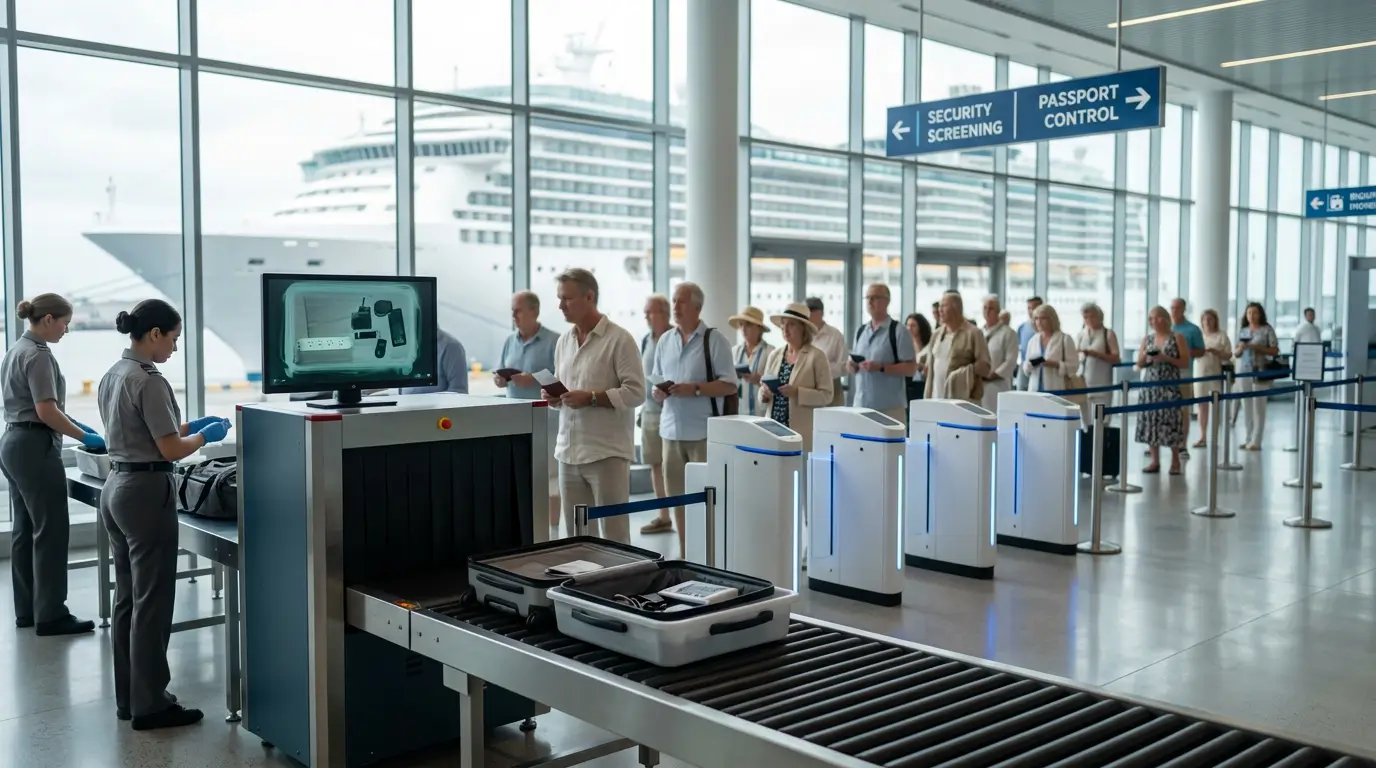
Cruise terminal screening is not identical to airport screening, but it uses familiar equipment and it is becoming more standardized as passenger volumes increase. Under United States cruise terminal security regulations, screening equipment may include metal detection devices and x-ray systems for persons and baggage, and terminals may also use explosives detection systems if included in an approved security plan. That is the context in which cruise boarding alarms happen: a walk-through detector alert, an x-ray review that flags a prohibited device, or a secondary bag search prompted by an unclear image.
Passenger experience reporting still describes cruise screening as generally less procedurally strict than the airport, but not less consequential. Cruise Critic’s boarding guidance describes document checks followed by x-ray scanning of carry-ons, and notes that the process is typically not as rigorous as TSA checkpoints, even though you should expect your bags to be scanned. The takeaway for 2026 is to plan for screening hardware, but do not assume airport packing norms fully translate to cruise rules.
A highly visible modernization example is the MSC Miami Cruise Terminal, inaugurated in April 2025, which the company promoted as implementing a “complete biometric journey.” MSC and industry reporting describe biometric face pods for passport validation, biometric e-gates that finalize embarkation, and a large number of security lanes designed to keep screening efficient at scale. Even when you opt out of biometrics, those terminals are built around fast identity validation and rapid routing into security lanes.
Similar modernization is underway in port infrastructure even when it is not framed as a “security upgrade” in public-facing language. PortMiami’s terminal development page describes continued cruise terminal development, including a future terminal project expected to open later in the decade. PortMiami has also described strategic investments in infrastructure and technology as part of its efficiency push during a period of record passenger volumes.
New cruise security rules are also showing up in the way lines manage arrivals. Carnival requires online check-in and enforces arrival appointments, stating that guests arriving early may be asked to return and that late arrivals may not be embarked. Celebrity similarly ties check-in to selected arrival windows and frames timed arrivals as a tool to reduce delays and improve flow through the terminal.
The main difference from airports is the rulebook that determines what the scanners are looking for. Cruise lines may be more restrictive than airlines on certain devices, such as specific power strips, drones, routers, and even some streaming hardware, even though those items usually fly in carry-ons without incident. That mismatch is one reason the screening line can feel “stricter” in 2026 even when the technology looks the same.
Why Cruise Lines Are Adopting a Zero-Tolerance Approach
The phrase cruise zero tolerance policy is best understood as a pattern of enforcement rather than a single new regulation for 2026. Multiple cruise lines explicitly reserve the right to confiscate prohibited items, deny boarding for serious violations, or take conduct action when a guest violates safety rules. The policies also increasingly spell out what happens next, such as legal escalation for illegal items or fees for specific onboard violations.
Fire prevention is a central explanation for why heat and electricity show up repeatedly in prohibited-items lists. Celebrity explicitly frames heat-producing items as prohibited because they create a fire hazard, and Virgin Voyages bans items with open flames or heating elements while carving out narrow exceptions for permitted hair tools. Norwegian and Disney similarly prohibit items with heating elements, which is why items like travel steamers and hot plates routinely trigger screening scrutiny.
Safety and legal compliance pressures also shape the strictest categories, particularly drugs, weapons, and self-defense sprays. Disney frames its illicit drug prohibition as aligned with U.S. federal regulations and local laws in destinations visited and warns that guests found in possession may be denied boarding and subject to severe legal penalties. Norwegian’s prohibited-items list states that illegal items lead to notification of the appropriate authorities, and Carnival emphasizes that marijuana remains prohibited under federal law and that consequences can include confiscation, law enforcement involvement, and guest removal.
Privacy and operational security concerns are another 2026 driver as consumer recording technology becomes less obvious. MSC restricts smart glasses in ship public areas, and Royal Caribbean and Celebrity publish restricted-area rules with potential confiscation for violations. Cruise industry reporting in February 2026 linked these updates to the growing prevalence of wearable audio and video recording devices and to the need to protect privacy in sensitive areas such as restrooms, youth spaces, and medical facilities.
Regulatory context also supports the industry’s sharper tone at the terminal. U.S. Coast Guard regulations establish that cruise ship terminals may use metal detection devices and x-ray systems for screening persons and baggage when documented in an approved security plan. That baseline helps explain why cruise terminals increasingly resemble other controlled transportation environments, even though cruise line prohibited lists can be more tailored and more restrictive than airline carry-on norms.
Identity modernization is the final structural reason policies feel tighter in 2026. A Department of Homeland Security final rule published October 27, 2025 expanded the legal framework for biometric identity verification for non-U.S. citizens and describes the use of facial comparison technology as efficient and accurate, including in sea-entry processes. While that rule is not a cruise-line “packing list” document, it reflects the broader direction of travel toward more biometric checks at transportation gateways, including maritime environments.
How This Affects High-Volume Ports
At PortMiami, the interaction between passenger volume, new terminals, and strict enforcement is visible because multiple large ships embark and debark on the same day. Miami-Dade County reported 8,564,225 cruise passengers in Fiscal Year 2025, the highest annual passenger count in the port’s history, and linked its performance to strategic infrastructure and technology investments. In a high-throughput environment like this, screening rules tend to be applied consistently because the operation cannot slow down for case-by-case negotiation.
PortMiami’s cruise safety and security guidance recommends arriving at least two hours before departure and emphasizes that security procedures, prohibitions, and documentation requirements vary by cruise line or destination. That is a practical reminder that ports provide the facility and screening environment, but cruise lines largely define what is and is not allowed onboard. It also means your boarding timeline depends on both terminal flow and ship-specific rules.
Stricter enforcement is often most noticeable on cruises from Miami because the port is built for scale and relies on timed surges rather than slow, individualized problem solving. If your carry-on includes common “flag” items like an unfamiliar power strip, a travel router, a drone, or a prohibited heating device, assume it may be pulled for inspection when screening staff see it on x-ray. That does not mean you will miss your sailing, but it often means you will lose time resolving the item at the checkpoint.
Terminal modernization can amplify that “no exceptions” feeling, even when the intent is smoother service. MSC’s new PortMiami terminal was promoted as using biometrics and e-gates alongside a high number of security lanes, and the port’s terminal development pipeline includes additional major projects targeted for later in the decade. High-tech terminals tend to standardize the flow, so passengers who deviate from policy stand out more quickly.
Other major homeports are experiencing similar volume dynamics, even when the local rulebook differs. Seatrade reporting in December 2025 noted that PortMiami’s record passenger movements were closely matched and surpassed by Port Canaveral’s own record passenger movements, underscoring how widespread high-volume embarkation has become. The more ports plan for peak-day throughput, the more travelers should expect timed entry, standardized screening, and less discretion at the checkpoint.
What Passengers Should Do Before Sailing in 2026
Treat the prohibited-items page as a living document, not a one-time checklist you read when you book. Disney notes that its alcohol policy is subject to change without notice, and Royal Caribbean reminds guests that the ship’s security team may prohibit or confiscate any item they deem impermissible. Rechecking policies close to departure is one of the highest-impact ways to avoid embarkation friction.
Before you pack, review your own “convenience kit” items, because that is where many 2026 updates are concentrated. Power strips, extension cords, surge protectors, streaming sticks, routers, and certain transmitting devices are all examples of everyday tech that can be prohibited depending on brand and itinerary. When in doubt, compare the exact wording in your cruise line’s list to what you are holding in your hand.
Pack embarkation-day essentials with the assumption that checked luggage is screened out of your sight and may arrive later. Carnival advises leaving luggage unlocked for security screening and warns that oversized or locked luggage may cause delivery delays, and Disney warns that prohibited items found during screening can delay luggage delivery until late evening on embarkation day. If a permitted but inspectable device is in your bag, keep any “need it today” items separate so you are not waiting on bag delivery to function.
Give yourself time buffers that match the new screening reality. PortMiami encourages passengers to arrive at least two hours before departure, and Carnival enforces arrival appointments, telling early arrivals to return and warning that late arrivals may not be embarked. Extra time is not only about crowds; it also absorbs a secondary screening stop if your carry-on is flagged.
If you travel with medical devices or mobility equipment, check the exceptions and physical limits early. Carnival’s safety information states that scooters that do not fit in the stateroom will not be allowed on board and that a guest may be denied boarding without compensation if they cannot make alternate arrangements. Disney also lists certain devices that may require inspection, such as humidifiers and sleep machines, which can affect what you bring and where you pack it.
Finally, if you wear smart-enabled eyewear or carry high-tech recording devices, plan for “restricted area” rules, not just a packing question. MSC restricts smart glasses in public areas of the ship, and Royal Caribbean and Celebrity outline shipboard spaces where smart glasses cannot be worn and warn that misuse can lead to confiscation. For travelers, that can mean carrying an alternative pair or choosing not to bring the device if it is essential for daily vision needs.
The Takeaway
The “Zero-Tolerance” 2026 shift is best understood as clearer prohibited-item language paired with more standardized screening and higher-throughput terminals. Across major brands, the categories most likely to cause embarkation friction are alcohol packed incorrectly, heat-producing appliances, electrical accessories like power strips, drones and remote-controlled devices, and newer electronics tied to privacy concerns such as smart glasses. The policies are not identical, so the safest planning move is always to check your specific cruise line’s prohibited items list rather than relying on what was allowed on a past sailing.
For passengers planning 2026 sailings, the calm approach is preparation, not guesswork. Recheck policies close to departure, pack with carry-on and inspection realities in mind, and arrive early enough to absorb a secondary screening stop or documentation issue without stress. That approach matters most at high-volume ports, where timed arrivals and standardized screening keep the terminal moving and leave less room for on-the-spot negotiation.
FAQ
Q1: Can a prohibited item be confiscated at the terminal, and will I get it back?
Confiscation at the pier is routine, but return policies vary by item and by cruise line. Celebrity warns that alcohol seized on embarkation day will not be returned, while other lines describe holding certain items, such as alcohol in checked luggage, until the end of the voyage. Disney also warns that prohibited items found during screening can delay luggage delivery and that alcohol packed in checked luggage can be removed without compensation.
Q2: Can you be denied boarding because of prohibited items?
Yes, and the clearest examples involve weapons, illicit drugs, or items that violate strict safety limits. Disney explicitly warns that guests found with weapons or illicit drugs may be denied boarding and face severe legal penalties, and Norwegian’s prohibited-items list notes that illegal items trigger notification to authorities. Some lines also warn of denied boarding for other noncompliance issues, such as required documentation or mobility devices that cannot be safely accommodated.
Q3:What are the alcohol rules for 2026 sailings?
There is no universal standard, so you must check your cruise line’s beverage policy as well as its prohibited-items page. Royal Caribbean allows each adult of drinking age to carry on one sealed 750 ml bottle of wine or champagne but prohibits beer and liquor, while Disney allows limited wine and beer for adults but requires it to be carried on and warns that alcohol in checked luggage will be removed. Virgin Voyages prohibits bringing hard liquor and beer onboard, allows limited wine per cabin in carry-on bags, and says alcohol in checked luggage will be collected at embarkation and returned later.
Q4: Are power strips allowed, and what about surge protectors?
This is one of the most line-specific rules, and it is a common cause of extra screening because many products look similar. Carnival permits power strips and extension cords if they do not include surge protectors, while Royal Caribbean prohibits power strips and multi-plug outlets, and Disney lists power strips and surge protectors among prohibited electrical items. Virgin Voyages allows certain multi-plug power strips only if they are subject to inspection and approval by the ship’s electrician.
Q5: Can I bring a drone in 2026?
Policies range from outright prohibition to tightly controlled permission. Royal Caribbean allows drones onboard for use on land only outside port areas but warns that drones used on the ship will be confiscated until the end of the cruise and may lead to conduct action, and Celebrity publishes similar language with possible disembarkation consequences for onboard use. Carnival allows drones only under a custody and port-use-only procedure, while Disney bans drones as remote-controlled devices and Norwegian lists drones as prohibited items.
Q6: When do the changes apply for 2026 travel?
Most of what travelers are noticing for 2026 is not a single synchronized policy change date across the industry. Virgin Voyages posts a “last updated” date of November 18, 2025 on its prohibited items list, MSC’s guest conduct policy dated July 16, 2025 includes smart glasses restrictions, and cruise industry reporting noted Royal Caribbean’s smart-glasses update in February 2026. The correct approach is to recheck the policy pages close to your sail date, especially if you are sailing with newer consumer devices.