

More news on this day
Thessaloniki is entering a new phase as a strategic transport gateway, with more than one billion euros in rail infrastructure upgrades set to reinforce links between Southeastern and Central Europe and reshape regional trade flows.
Get the latest news straight to your inbox!
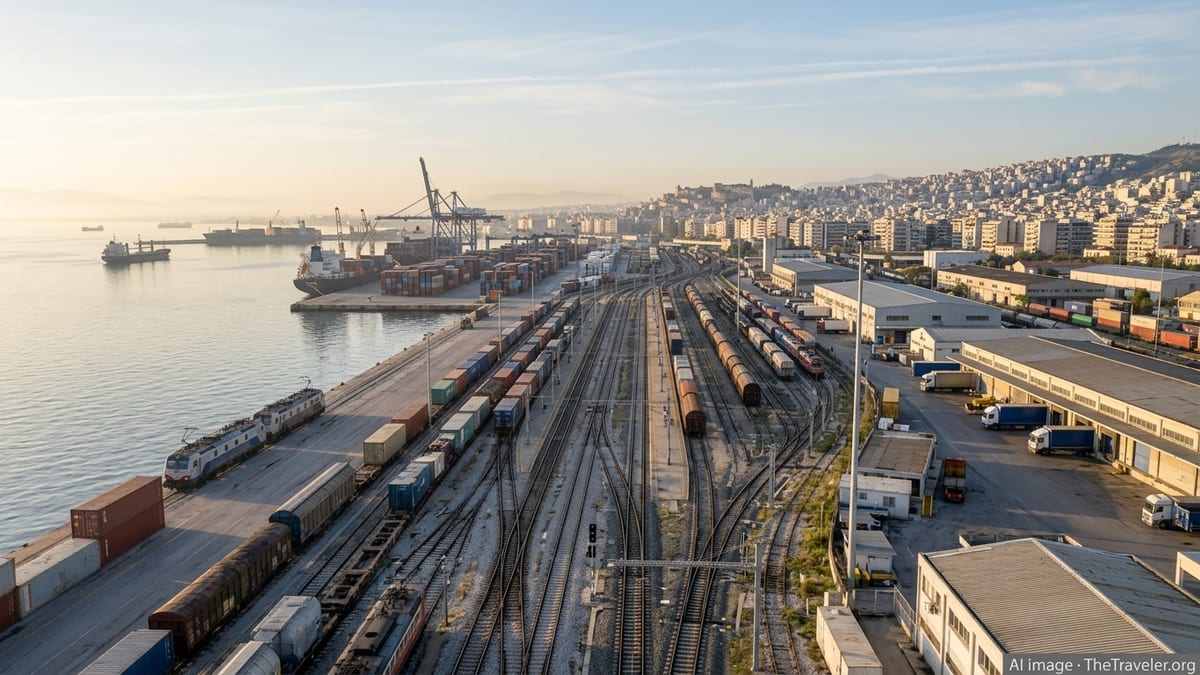
Major Rail Investments Converge on Northern Greece
Publicly available information shows that Greece is moving ahead with a cluster of new railway projects in northern Greece, many of them centered on Thessaloniki and its wider hinterland. Project data from infrastructure agencies and specialized business media indicate that at least one billion euros in new investments are being directed to upgrades of existing lines and new connections that will enhance both passenger and freight capacity in the region.
Among the flagship schemes are three new projects coordinated by ERGOSE in northern Greece, with a combined value of around one billion euros, including upgrades to key corridors that connect Thessaloniki with neighboring Balkan markets. Reports on these projects highlight goals such as modern signaling, higher operating speeds and better integration with the wider European network. Together, they are expected to bring roughly 370 kilometers of track up to contemporary European standards, significantly increasing the competitiveness of rail as a transport mode.
These investments come on top of a broader national modernization program backed by European financing instruments. Information published by the European Investment Bank and the European Commission points to substantial support for Greece’s railway reforms, particularly along the Patras–Athens–Thessaloniki–Promachonas axis, a core segment of the Trans-European Transport Network. Thessaloniki, located at the northern end of this spine, stands to benefit directly from each incremental upgrade.
Regional business analyses also point out that rail spending is part of a much larger infrastructure wave in and around Thessaloniki, estimated in recent coverage at several billion euros when port, road and urban transport projects are included. Within that wider picture, rail is seen as the connective tissue that links the port, industrial zones and cross-border corridors into a cohesive logistics ecosystem.
Port and Logistics Assets Drive Hub Ambitions
The Port of Thessaloniki is already recognized in official and corporate material as one of the main maritime gateways to Southeast and Central Europe, with direct rail and road connections into the Balkan hinterland. The port is part of the core Trans-European Transport Network and serves as a natural funnel for container and bulk cargo destined for markets such as North Macedonia, Bulgaria, Serbia and beyond. Rail infrastructure upgrades are expected to amplify this role by offering faster, more reliable hinterland connections.
Recent investment plans include the dedicated rail connection to the sixth pier of the port and the development of a western suburban rail network, projects that together represent several tens of millions of euros in spending. Publicly available project descriptions emphasize that a new one-kilometer railway bridge and additional stops in western Thessaloniki will support intermodal operations and improve access for both workers and cargo flows. By relieving bottlenecks at the port interface, these works are intended to cut turnaround times and make rail a more attractive option for shippers.
In parallel, new logistics parks are under development on the outskirts of the city, notably in former military and industrial sites with direct access to rail corridors and the national motorway network. Market insight reports describe these schemes as crucial for consolidating warehousing, distribution and value-added logistics services, effectively turning Thessaloniki into a regional consolidation point for goods moving between Asia, the Eastern Mediterranean, the Balkans and Central Europe.
Analysts note that the combination of a deep-sea port, upgraded rail infrastructure and modern logistics facilities offers Thessaloniki a competitive proposition compared with alternative routes through the Adriatic or northern European ports. Shorter maritime distances from the Suez route, coupled with improved inland rail performance, could translate into time and cost savings for supply chains serving Central European destinations.
Strengthening Cross-Border Rail Corridors
Several of the rail projects now moving forward are explicitly designed to strengthen cross-border connectivity between Greece and its northern neighbors. Published project lists under European funding frameworks such as the Connecting Europe Facility include upgrades to sections of the Thessaloniki–Promachonas line, which connects Greece to Bulgaria, as well as improvements on other northern routes that feed into pan-European corridors.
One important strand involves the broader Egnatia Railway and associated schemes that aim to link the ports of Thessaloniki, Kavala and Alexandroupolis with inland junctions and the Bulgarian network. Earlier cost estimates for the Thessaloniki–Kavala–Xanthi segment placed that project alone in the range of more than one billion euros, illustrating the scale of investment under consideration along the northern seaboard. While timelines and financing structures vary, the cumulative effect is to create a continuous, upgraded rail arc running parallel to the traditional maritime choke points.
Regional policy reports describe these initiatives as part of an emerging “Sea2Sea” concept, in which rail lines across northern Greece and southern Bulgaria provide an alternative freight route that bypasses congested straits. Thessaloniki’s upgraded rail connections position the city as a key node within this emerging corridor, particularly for cargo that can be shifted quickly from ship to train and dispatched toward Central Europe.
Cross-border improvements are not limited to infrastructure alone. Project documentation indicates that compatibility with European Train Control System standards, electrification, and digital monitoring are being prioritized so that Greek lines can operate seamlessly with networks further north. This technical interoperability is seen as essential for attracting international operators and ensuring that Thessaloniki’s rail hub functions as an integrated part of the European single market for rail services.
From National Modernisation to European Integration
The current wave of rail spending in and around Thessaloniki is closely tied to Greece’s broader effort to modernise its railway system after years of underinvestment. Publicly available information from European institutions shows that advisory support and co-financing are being directed at safety enhancements, punctuality improvements and environmental performance across the network. These objectives reflect wider European Union priorities on sustainable transport and modal shift from road to rail.
In this context, Thessaloniki’s rail upgrades serve both national and European policy goals. At the national level, better rail services are expected to support regional development in northern Greece, diversify transport options for passengers and businesses, and relieve pressure on road corridors. At the European level, enhanced capacity on the Patras–Athens–Thessaloniki–Promachonas axis and the northern coastal lines helps close gaps in core corridors linking the Eastern Mediterranean with Central and Northern Europe.
Analytical material produced by consultancies and financial institutions suggests that integrated rail, port and urban transport projects in Thessaloniki could also have wider urban and economic effects. Improved suburban rail connectivity is seen as a way to open up new areas for residential and commercial development, while better freight services can attract logistics, manufacturing and technology firms seeking efficient access to both EU and non-EU markets.
At the same time, the scale and complexity of these projects highlight ongoing challenges around delivery capacity, coordination and long-term maintenance. Observers note that sustained political commitment, robust project management and alignment with European standards will be needed to translate announced budgets into tangible performance improvements on the tracks. The next few years, as major contracts are awarded and works progress, will be critical in determining whether Thessaloniki fully realises its ambition of becoming a leading rail and logistics hub bridging Southeastern and Central Europe.