

More news on this day
Thessaloniki is moving into a new phase as a European transport gateway, with more than one billion euro in rail infrastructure upgrades set to strengthen links between Southeastern and Central Europe and deepen the city’s role as a strategic logistics hub.
Get the latest news straight to your inbox!
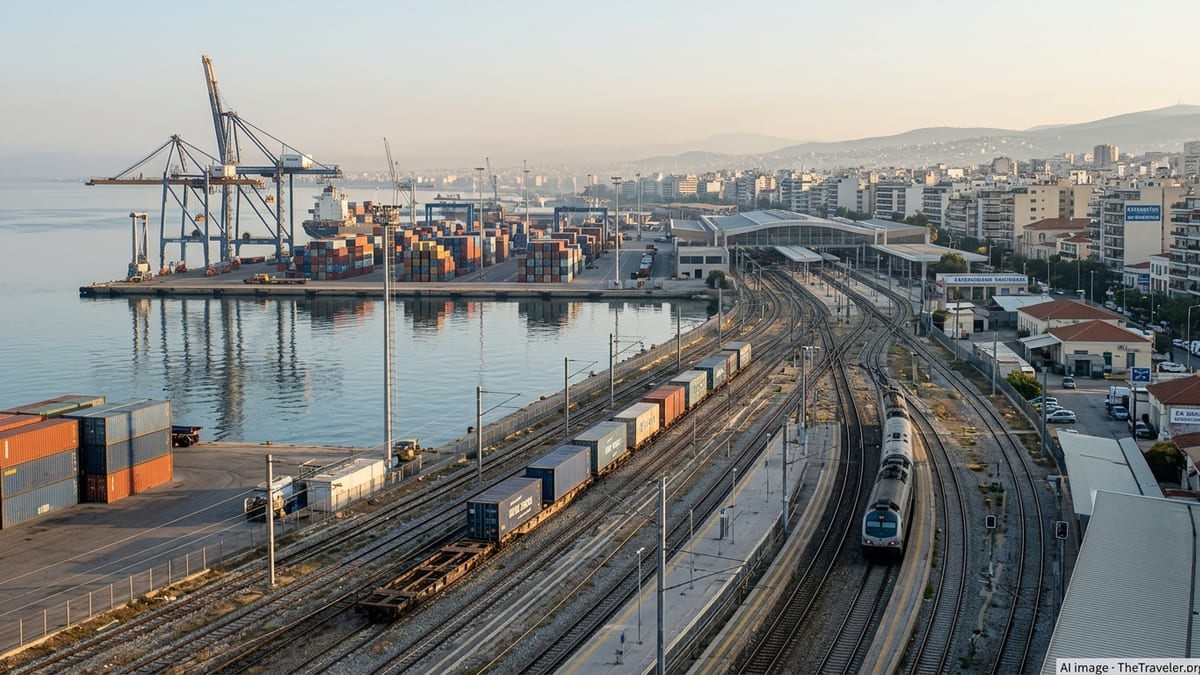
Strategic Investments Reshape Northern Greece’s Rail Map
Publicly available information shows that Greece is advancing an extensive rail investment programme in its northern regions, with Thessaloniki at the center. A series of projects along the Egnatia Railway corridor and related lines are intended to modernize infrastructure, boost capacity, and integrate the country more closely into the Trans-European Transport Network. The overall rail push, framed by national recovery and cohesion funding, is forecast to reach several billion euro in total, with more than one billion euro concentrated in key corridors that feed into Thessaloniki.
Plans for the Egnatia Railway indicate that the section connecting Thessaloniki with Kavala and Xanthi alone carries an allocated budget of around 1.68 billion euro, covering a mix of new construction and modernization on a roughly 200-kilometre route. Additional works on sections linking Thessaloniki with Alexandroupoli and other northern cities involve electrification, signaling upgrades, and alignment improvements designed to support higher speeds and heavier freight flows. Together, these works are expected to transform the performance of rail connections serving the port and wider metropolitan area.
Greek policy documents and European funding announcements describe the country’s northern rail spine as a future “backbone” for both domestic and cross-border traffic. Thessaloniki, as the largest urban center and main rail junction in the region, stands to benefit disproportionately from the improvements. With upgraded lines converging on the city from the Balkans, the Aegean coast, and the western gateway of Igoumenitsa in the coming years, the groundwork is being laid for a more resilient, multimodal transport system.
Port and Rail Synergies Aim to Capture New Freight Flows
The Port of Thessaloniki already serves as a key maritime entry point for Southeast, Central, and Eastern Europe, with established container and conventional cargo operations and direct access to national road and rail networks. Corporate materials from the port operator emphasize its location on the core Trans-European Transport Network and its role as a free zone serving regional supply chains. The wave of rail investment now underway is intended to turn these geographic advantages into faster, more reliable hinterland connections.
Upgraded rail corridors are expected to shorten transit times between the port and markets in Central Europe, including via routes north to the Balkans and east along the emerging Sea2Sea corridor that links northern Greek ports. Modern signaling and electrification are also being introduced to raise capacity and improve punctuality, making rail a more competitive option compared with long-haul road transport. Planners present these changes as essential to shifting more freight to lower-carbon modes and aligning with European climate and sustainability targets.
The combination of port expansion, improved intermodal facilities and enhanced rail links positions Thessaloniki to capture additional containerized and bulk cargo that might otherwise flow through rival hubs in the Eastern Mediterranean and Black Sea. Analysts note that companies seeking diversified supply chains and alternative gateways to Central Europe may increasingly view Thessaloniki as a viable option once the new infrastructure reaches full operation.
Cross-Border Connectivity Strengthened Along Balkan Corridors
Beyond domestic benefits, the new and upgraded lines around Thessaloniki are designed to reinforce international connectivity across the Balkans. Plans surrounding the wider Egnatia Railway and complementary routes aim to better connect Greek ports with Bulgaria, North Macedonia and other neighboring states, contributing to a more integrated north–south and east–west transport grid. This includes improvements to lines that form part of the Sea2Sea concept, which seeks to link Thessaloniki, Kavala and Alexandroupoli with ports and rail hubs further north.
Reports on regional infrastructure planning describe these corridors as vital for moving goods between the Aegean and Central European markets while offering alternative paths that avoid traditional bottlenecks. Enhanced rail capacity from Thessaloniki toward the interior of the Balkans is expected to shorten journey times and facilitate more frequent services, both for freight and, in the longer term, for passengers. The result is likely to be a denser network of connections supporting trade, manufacturing supply chains, and energy-related logistics.
At the same time, investment in cross-border rail supports wider European policy goals for cohesion and economic convergence. By improving access to peripheral regions, the Thessaloniki-centered upgrades are viewed as contributing to more balanced growth between Southeastern Europe and the continent’s traditional industrial heartlands. Observers point out that this could increase the city’s importance not only as a Greek gateway, but also as a shared regional asset.
Urban Rail and Metro Projects Reinforce Thessaloniki’s Hub Role
The transformation of Thessaloniki into a stronger transport hub is not limited to intercity lines. Within the city, substantial investment has also been directed toward the Thessaloniki Metro and related urban rail projects. The core metro network, classified as a major infrastructure scheme with a budget of more than one billion euro for its initial stages and extension to Kalamaria, is intended to significantly improve passenger mobility across the metropolitan area.
According to project summaries and national planning documents, the metro’s main line and its seafront extension represent combined costs in the range of 2.5 billion euro, funded through a mix of European and national sources. The system is planned to intersect with the new railway station and suburban rail services, creating a more integrated node that can handle growing passenger volumes arriving by train, bus, and ship. This level of intermodality is seen as crucial for a city aspiring to act as a true gateway between regions.
By easing congestion and providing reliable, high-capacity public transport, the metro network complements the long-distance rail investments and enhances Thessaloniki’s appeal for residents, visitors, and investors. The expectation among planners is that an efficient urban network will make it easier to move people to and from the upgraded mainline services and the port, thereby reinforcing the city’s broader logistical and economic functions.
Economic Prospects and Timelines for the New Rail Era
Timetables for the various northern Greek rail schemes extend over several years, with some sections already under design or tender and others progressing through environmental approvals. Project descriptions for the Thessaloniki–Kavala–Xanthi line indicate a design speed of up to 200 kilometres per hour on a mix of new track, tunnels, and bridges, with full completion expected later in the decade. Additional works along the Alexandroupoli corridor and connecting lines are advancing in parallel, backed by European Union instruments such as the Connecting Europe Facility and cohesion funds.
Economic analyses associated with these projects highlight anticipated gains in trade volumes, logistics employment, and regional investment. Reduced transport costs and better reliability are expected to attract new logistics centers, warehousing, and value-added services in and around Thessaloniki. Businesses in manufacturing, agriculture, and energy are identified as potential beneficiaries of faster and more predictable access to Central European markets and to global shipping routes via the Aegean.
There are also broader expectations that the upgraded network will help rebalance transport patterns across Greece by shifting some traffic away from congested corridors farther south. While full realization of these benefits depends on timely delivery and coordinated policy, the scale and focus of the current rail programme suggest that Thessaloniki is on track to play a significantly enlarged role in the continent’s transport system in the coming years.