

The first time I saw Hallstatt, Austria, it was not in person. It was on my phone, at 1 a.m., the village glowing on my screen like something from a snow globe: timbered houses stacked neatly along a glassy lake, church spire slicing into cotton-candy clouds. The caption called it “the most Instagrammable town in the world.” Months later, standing on the same lakeshore, jostling with tour groups for a spot at the famous viewpoint, I realized something important: the destination was real, but the version of it that lived on Instagram was not.
The Day I Met the Real Hallstatt
Hallstatt had lived in my imagination for years before I finally boarded a pre-dawn train from Salzburg. Online, the village looks like a place that exists outside time: pastel chalets reflected in a still lake, empty cobbled lanes, a single woman sipping coffee on a balcony in a white linen dress. I arrived expecting quiet, mist, and maybe the sound of church bells.
Instead, I stepped off the shuttle bus into a slow-moving river of people clutching selfie sticks. By 9 a.m., the small square was already lined with tour groups following colored flags. At the famous lakeside photo spot, a queue had formed, snaking back along the narrow street. People literally took turns standing in the exact Instagram angle, handing their phones to strangers, pausing for three or four poses before moving on so the next person could collect the same image.
This did not happen by accident. Hallstatt’s images went viral in East and Southeast Asia several years ago, and visitor numbers ballooned to the point that local authorities started discussing bus time slots and caps on daily arrivals. The village has fewer than a thousand residents, yet it receives close to a million visitors in some years. The Instagram dream of a secluded Alpine retreat never mentioned the tour bus engines idling behind the church, or the “No Drones” signs pinned to balconies.
But here is the twist: when I stayed the night instead of day-tripping, the village changed. After the last buses left, the streets emptied. Locals walked dogs. In the early morning, before 8 a.m., the lake was finally still, the church bells did their soft echo, and the only cameras were in the hands of fishermen heading out in small boats. Hallstatt taught me that the problem was not that the destination was a lie. It was that social media had edited out everything that made it real.
Positano: When a Dream Becomes a Theme Park
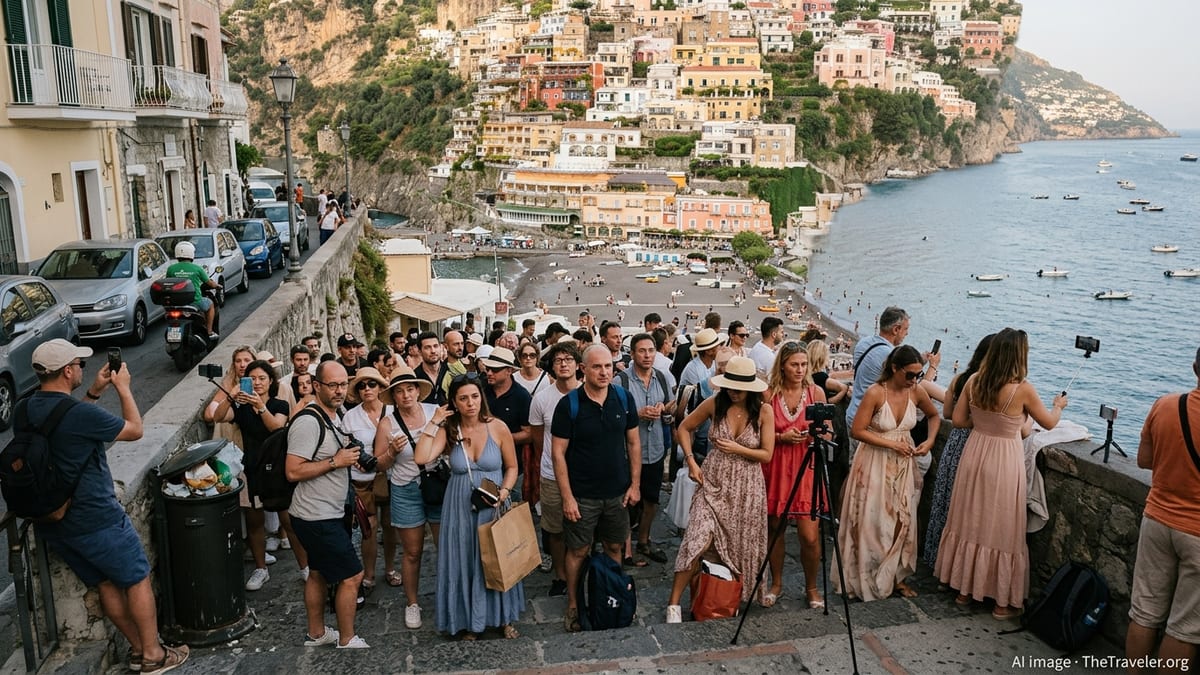
The Amalfi Coast is another place that seems custom-built for Instagram: lemon trees, sherbet-colored houses, Aperol spritz at sunset. For years, my feed was a steady drip of blue loungers and straw hats in Positano, so I went in late May, thinking I was beating the peak crowds. I was not. I spent my first hour in town in a line of rental cars backed up on the only road into the village, watching the taxi meter tick upward as scooters squeezed past.
In pictures, Positano’s main beach looks serene, dotted with perfectly spaced umbrellas. In reality, I was quoted around 40 euros for a pair of sun loungers in the front row and 25 euros in the back, prices that rise further in high summer. The “hidden” beach clubs I had saved from influencer Reels all required boat transfers or advance reservations and had minimum spend policies that could easily push a couple over 150 euros for a lazy afternoon. Walking the main pedestrian lane felt like wading into a content production line: brides in full gowns posing in front of ceramic shops, drones buzzing overhead, restaurant hosts angling for customers who wanted that one cliffside table they had seen on a viral reel.
Local hoteliers and guides describe the town now as a kind of “theme park” for a very specific fantasy. Tourism is vital to the area, but the spike in demand driven by social media has strained roads, waste systems, and housing for locals. Even Italian media and regional authorities have started promoting alternative coastal towns like Tropea in Calabria or smaller villages south of Salerno as “dupes” for Positano, hoping to ease the pressure on the cliffside icon.
Yet even on the Amalfi Coast, reality had its quiet pockets. On my third day, I dodged the Instagram-famous staircases and followed a local’s tip to a simpler beach bar west of the ferry dock. The plastic chairs were scratched, the beer was four euros instead of twelve, and there was no queue for photos. I watched sunset sitting on the breakwater with a takeaway slice of pizza, no ring light in sight. The prices, the crowds, the staged shots did not disappear, but they shrank to their proper size when I stopped chasing the image and started paying attention to the place.
Bali Swings, Blue Lagoons, and the Business of the Perfect Shot
If there is a modern symbol of Instagram tourism, it might be the Bali swing. In Ubud, rice terraces that once saw mostly local farmers are now ringed with pay-per-photo attractions: heart-shaped nests, jungle swings, glass platforms dangling over ravines. At one popular swing complex, a staff member cheerfully ran me through the menu: a basic swing ticket for around 20 to 30 US dollars, a more elaborate “photo package” that included flying dresses and drone footage, and higher prices for couples content.
From a certain angle, it is brilliant entrepreneurship. Visitors get their dramatic shot, operators get an income stream, and the swings themselves rarely last long enough to permanently scar the landscape. But the focus on the photo reshapes everything around it. At one rice terrace, the path was clogged not with walkers but with small queues at every nest: people lining up, taking turns, and then immediately reviewing their shots while staff hurried them along so the next paying customer could climb in.
The same pattern repeats from Iceland’s Blue Lagoon to the so-called “Gate of Heaven” at Lempuyang Temple, where creative photographers used a mirror to make a puddle look like a vast reflective lake. That single visual trick went so viral that visitors now wait in line, sometimes for hours, to be photographed in a spot that looks nothing like what they imagined. Many leave without exploring the actual temple complex. In 2024 and 2025, tourism boards and local residents from Spain’s Balearic Islands to Indonesia’s island temples have begun speaking more openly about the strain: higher rents, water shortages, traffic, and a sense that their homes are turning into backdrops rather than places to live.
On my last trip to Bali, I skipped the most popular swings and hired a local driver to take me to a small village market instead. The only camera out was his, when he proudly showed me photos of his kids in school uniforms. There were still tourists and still souvenirs, but there was no pre-set route, no scheduled “photo spot.” Buying a bag of mangosteens for a couple of dollars and sitting on a plastic stool to eat them felt wildly un-Instagrammable and, for that reason, exactly right.
Why Instagram’s Version of a Place Feels So Convincing
It is easy to blame influencers for all of this, but the mechanics are bigger than any one account. Instagram (and now TikTok) rewards images that are clean, dramatic, and instantly legible. A quiet side street in Naples will never perform as well as a shot of the exact Positano balcony everyone recognizes. A story about Barcelona’s overcrowded metro or rising rents will never go as viral as a drone shot of Park Güell at sunset.
Behind every dreamy shot, there is a small army of invisible edits. Crowds are cropped out by shooting early, late, or at tight angles. Laundry lines, construction cranes, and trash bins disappear with a quick swipe in an editing app. Colors are tuned so Santorini’s already bright whites glow impossibly, and the sea reads as pure turquoise even on a cloudy day. People wear flowing dresses on rocky hikes where most locals are in trail shoes and sun hats. Little by little, your sense of what is normal is recalibrated.
The effect is particularly strong in places already overwhelmed with visitors. A study of European cities identified destinations like Geneva, Paris, Rome, Naples, and Barcelona as some of the most crowded per square kilometer, a mismatch between social media popularity and physical capacity that local authorities struggle to manage. Meanwhile, residents in Barcelona, the Canary Islands, and parts of southern Spain have organized protests against what they call “touristification,” arguing that viral fame is driving up rents and hollowing out neighborhoods.
As travelers, we are not passive in this. Every time we save a “must visit” reel or comment “adding this to my list,” we help push that content forward. The good news is that the same tools can be used to change course. Accounts that show unedited crowds, talk frankly about heat waves or access limits, or highlight lesser-known neighborhoods are gaining traction too. The more we reward honesty, the less pressure creators feel to sell perfection.
How to Read Instagram Like a Travel Professional
Over time, I have learned to treat social media as a starting point, not a decision-maker. When a destination begins popping up in my feed, I ask a different set of questions than I did a decade ago. Instead of “Is this beautiful?” I ask, “What is missing from this frame?” If every shot of Santorini shows empty lanes and flowing dresses at sunset, I look deliberately for images that show midday in August, ferries arriving, or cruise passengers disembarking. If I cannot find them, I assume the reality is being carefully edited out.
Before booking a trip, I now cross-check that Instagram fantasy with more grounded sources: local news outlets, city tourism boards, or even resident forums where people discuss housing or traffic. When protests erupted in Barcelona and Mallorca in 2024 and 2025 over overtourism and short-term rentals, the social feeds of travel influencers selling “European summer” barely flickered. It was the regional media and local advocacy groups that explained why residents were taking to the streets with banners asking visitors to respect their home.
On the ground, I make small, practical adjustments that change everything. I accept that the famous viewpoint will be busy and decide whether the shot is worth the time. Often it is not. In Venice, instead of queueing on the Rialto Bridge at sunset, I took a vaporetto to a quieter stop and watched the same sky turn peach over a residential canal, surrounded by kids kicking a ball and older neighbors leaning from windows. The photo was less dramatic, but the memory is sharper.
Most of all, I go where Instagram is quiet. In Austria, I stayed an extra night in a lakeside village two stops before Hallstatt and found the same mountain-lake drama with a fraction of the people. In southern Italy, I swapped one night in Positano for a night in a Calabrian town that rarely appears on feeds. There were no famous ceramic stairs, no viral beach club, and no lines. When I posted a single photo of the harbor, no one recognized it. That anonymity felt like a gift.
The Takeaway
Instagram is not the villain of modern travel, but it is not a neutral guide either. It shows a highlight reel of places that already struggle with their own success, filters out the crowds and the costs, and trains us to want the same images in the same spots as millions of others. When we arrive and find scaffolding, heat, or human chaos, we feel cheated, as if the destination has failed us, when in fact it is the platform that kept the full story off-screen.
The real story of any place is messier and much more interesting. It lives in the off-hours in Hallstatt when the buses leave, in the backstreets above Positano where laundry flaps between balconies, in the Balinese morning markets where nobody cares about your feed. It is in the conversations with taxi drivers, waiters, and shopkeepers who will tell you candidly how tourism has changed their cities, sometimes for the better and sometimes not.
You can still visit the destinations you have dreamed about online. Go to the Amalfi Coast. Go to Santorini. Go to Bali. But go understanding that no filter can capture the full weight of a place, and no single photo is worth treating someone’s home as a theme park. Build in time to step away from the shot list. Seek places that are under less pressure. Pay to support local businesses rather than only the most Instagrammable cafe.
In the end, the trips that stay with you will not be the ones that look best on your grid. They will be the ones where you allowed the destination to surprise you, to be more complicated, more crowded, more ordinary, and more human than the square on your screen ever suggested.
FAQ
Q1. Should I avoid Instagram-famous destinations altogether?
Not necessarily. Instead of avoiding them completely, adjust your expectations, travel in shoulder seasons if possible, and combine famous spots with quieter nearby towns or neighborhoods.
Q2. How can I tell if a place is suffering from overtourism?
Look beyond Instagram: search local news for protests or resident complaints, check if authorities are limiting visitor numbers, and pay attention to headlines about housing shortages or crowd-control measures.
Q3. Are the crowds really as bad as people say in places like Positano or Santorini?
At peak times, they often are. Narrow streets, limited roads, and cruise or tour-bus arrivals can make these small towns feel overwhelmed, especially in high summer and on weekends.
Q4. What practical steps can I take to be a more responsible visitor?
Travel in the off-season, stay longer in fewer places, support local-owned businesses, respect residential areas, and avoid blocking streets or doorways for photos.
Q5. How can I use Instagram for trip planning without being misled?
Use it as inspiration, then fact-check with guidebooks, official tourism boards, local media, and recent traveler reviews that mention crowds, closures, or access restrictions.
Q6. Are there good alternatives to overcrowded hotspots?
Almost always. For every Hallstatt or Positano, there are nearby villages and regions with similar landscapes, fewer visitors, and a more relaxed pace of life.
Q7. Is it disrespectful to take photos in residential areas?
It can be if you invade privacy, block doorways, or ignore posted signs. Treat residential streets as you would your own neighborhood and keep doorsteps, windows, and private moments off-limits.
Q8. Do influencers ever show the reality behind the photos?
Some do, sharing crowded scenes, budget breakdowns, and environmental concerns. Seek out creators who talk openly about context instead of only posting flawless images.
Q9. Will traveling in the shoulder season really make a difference?
Often yes. Visiting just a few weeks before or after peak months can mean cooler weather, shorter lines, lower prices, and less strain on local infrastructure.
Q10. What should I do if I feel disappointed when reality does not match Instagram?
Let yourself feel it, then consciously put the phone away and look for unscripted moments: a side street cafe, a local market, or a quiet park where the real life of the place unfolds.