

I landed in Vienna with my shoulders already tensed. Friends had warned me about “Swiss-level prices” and “imperial tastes on an oligarch’s budget.” As the airport train hummed toward the city center, gliding past neat rows of houses and church spires, I braced for the bill. Yet over the next four days, this polished, imperial capital quietly dismantled every assumption I had about what an expensive-looking European city has to cost.
First Impressions of a City That Looks Out of My League
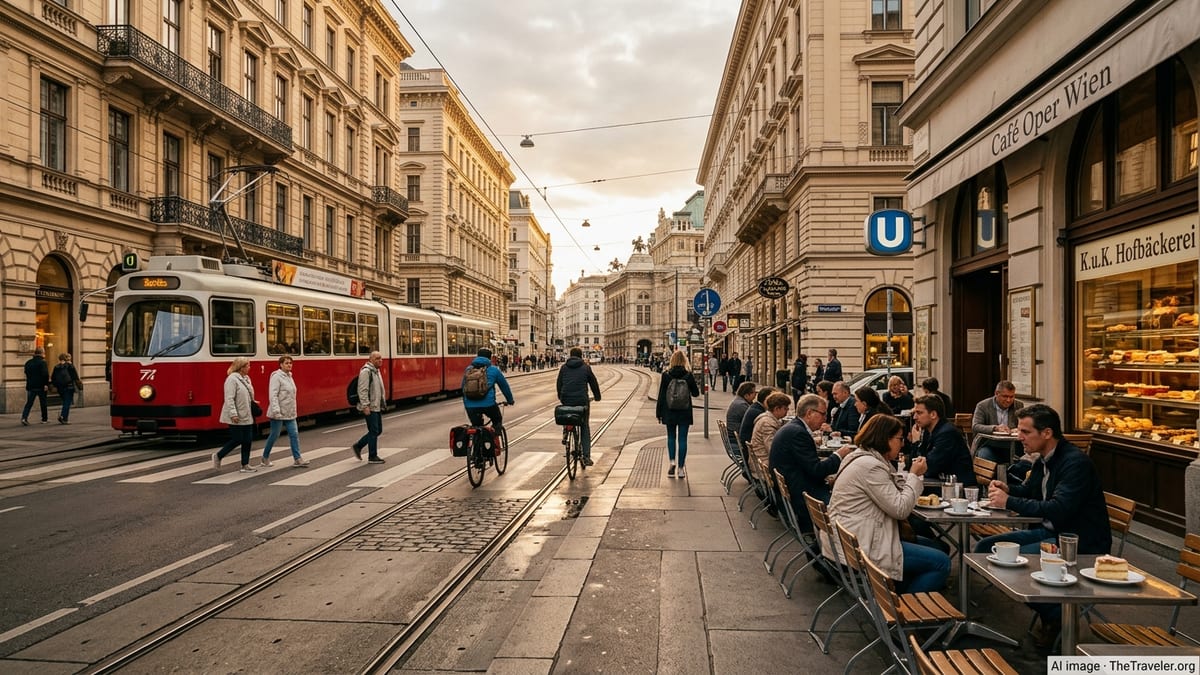
Vienna does not try to look modest. Step out at Karlsplatz and you are greeted by the State Opera, the Karlskirche dome glinting above the trees, and trams sliding by elegant facades. It is the kind of city that makes you instinctively pat your wallet. My hotel was just off the Ringstrasse, on a street lined with chandeliered lobbies and boutiques displaying evening gowns I would never have an occasion to wear. I expected the prices around me to match the marble.
My first surprise was the hotel itself. I had booked a modest but stylish pension near Naschmarkt, and at just under 120 euros a night for a spotless room with high ceilings and a generous breakfast, it already felt less painful than similar properties I had stayed in Paris or Amsterdam. In those cities, that price had bought me a shoebox. Here, it bought quiet, space, and a view over red-tiled roofs.
That evening, I walked the Ringstrasse as the sun slid behind the Rathaus spires. The city glowed in golden hour light, and the scene screamed “unaffordable”: horse-drawn carriages, opera-goers in black tie, terrace bars with white tablecloths. Yet when I finally sat down, tentative, at a low-key Beisl just off the main boulevard, the menu showed hearty mains hovering around 14 to 18 euros and a glass of decent house wine for about 4. Not cheap by Eastern European standards, but not the gouging I had braced for from a city that looks like a living museum.
When Public Transport Feels Like a Life Hack
I realized Vienna might be mispriced in my mind the moment I started looking at transit options. Locals often rave about the city’s annual public transport ticket, which works out to around one euro per day for unlimited travel across the network, even after an announced increase for 2026 that will still keep it well under two euros daily. That kind of pricing in a city that ranks among Europe’s wealthier capitals is quietly astonishing. It is the opposite of the “tourist tax” feeling you get in some big cities where every ride feels like a small penalty.
As a visitor, I opted for a 24-hour travel card instead of single tickets. For under 10 euros, I rode the clean, punctual U-Bahn and trams across the city all day. I used it to hop from the pastel houses of Spittelberg to the glassy skyline around Donau City, and then out to the Prater to ride its historic Ferris wheel. By mid-afternoon, I had taken so many journeys that in other cities I would have been doing mental currency conversions before every tap. In Vienna, I simply stopped thinking about it. The card had already paid for itself.
The efficiency and coverage made the value feel even stronger. Trains whooshed in every few minutes; platforms were clearly signed; connections were seamless. There was no “tourist version” of the system with markups. I rode the same trams as locals heading to work or school, and instead of feeling like a visitor being milked, I felt like someone who had briefly bought into a very fair deal.
Cafés, Cakes, and a Different Kind of Luxury
Vienna’s café culture is legendary, which usually translates to “you are going to overpay for coffee and cake with a view.” I picked one of the grand institutions near the Graben, where waiters in waistcoats glided between marble tables and glass counters sagged under the weight of tortes and strudels. The room looked like the sort of place where a cappuccino would cost what a decent lunch does elsewhere.
Instead, my melange came in at around 4 euros, and a generous slice of Sachertorte around 6. Prices vary from café to café, but in most of the classic houses I visited I could sit for over an hour, nursing a drink and reading, for what I might pay for a takeaway flat white in some North American cities. The value was not only in the price, but in the time. No one rushed me. The concept of “one coffee equals one hour of table time” simply did not exist. With free tap water refills and the cultural norm of lingering, that coffee became the most affordable “ticket” to old-world elegance I can imagine.
Even in less historic spots, the numbers surprised me. A quick stand-up espresso at a bakery counter rarely crossed the 2 euro mark. I grabbed a flaky Topfenstrudel for breakfast from a neighborhood bakery for around 3 euros, then settled on a bench outside the MuseumsQuartier. Around me, modern art museums and baroque palaces framed a courtyard that looked like a movie set. My entire breakfast, with that view, cost less than a grab-and-go sandwich at a chain coffee shop in many other European capitals.
Opera on a Beer Budget
Nothing about the Vienna State Opera screams “budget-friendly.” The building is a monument to opulence, all creamy stone, ornate carvings, and a lobby that looks like a palace corridor. Yet this was where my understanding of “expensive city” really cracked. I had always assumed that hearing live opera in such a venue belonged firmly to the realm of splurge trips and black-tie galas.
Then I learned about the standing-room tickets. On most performance nights, if you show up at the opera house about 80 to 90 minutes before curtain, you can buy a standing ticket for roughly the price of a coffee. The exact cost can change, but when I visited, it hovered around 15 euros for certain performances and much lower for others, especially rehearsals or special deals. That ticket buys you a spot behind the seated rows in the parterre or on a balcony with a perfectly respectable view of the stage.
I joined the queue late one afternoon, expecting a chaotic rush. Instead, the process was surprisingly orderly. A mix of students, tourists, and older locals lined up, chatting quietly as the evening light faded. Inside, I tied my scarf to the rail to mark my place, a local tip passed down like a secret handshake. Then, for the next three hours, I watched a world-class performance in a room that felt designed to intimidate, yet had let me in for less than many stadium concerts charge for the worst seats.
It is not just the State Opera, either. Smaller venues and church concerts offer classical music at prices that feel almost out of sync with the quality. In one historic church, I listened to a string quartet play Mozart by candlelight for the cost of a modest lunch. In another city, this would be a premium “experience” layered with markups; in Vienna, it felt like culture as a public service.
Eating Well Without Emptying Your Wallet
If Vienna has a price trap, it is in the glossy restaurants directly around the most visited landmarks. Sit down impulsively beside St Stephen’s Cathedral and you can easily pay over 25 euros for something ordinary. The good news is that you rarely have to walk more than a few minutes to escape that tourist tax. Side streets in neighborhoods like Neubau, Wieden, and Leopoldstadt are full of independent spots where the same money buys thoughtful cooking and generous portions.
One evening, I ducked into a busy Gasthaus in the 7th district, drawn by the blackboard menu spilling onto the sidewalk. Inside, wood-paneled walls and slightly wobbly tables signaled that this place aimed to feed locals first. I ordered Wiener schnitzel that arrived larger than the plate, with a side of potato salad and a crisp local beer. The total bill, including tip, came in under 22 euros. In many Western European capitals, a main and a drink in a comparable neighborhood restaurant would easily push past 30.
Even quick bites were more reasonable than I feared. A hefty Leberkäsesemmel from a Würstelstand, essentially a thick slice of seasoned meatloaf in a fresh roll, set me back around 4 euros. A bowl of goulash at a casual spot near the Danube Canal hovered around 10 to 12. Supermarket prepared foods were cheaper still. One night, I assembled a picnic of dark bread, local cheese, cured meat, and a bottle of drinkable Austrian wine from a chain supermarket. For just over 12 euros, I had dinner for two on a bench overlooking the lit-up skyline reflected in the Danube.
The Hidden Economy of Free and Almost-Free
What really tipped Vienna from “surprisingly reasonable” into “actually great value” was how much I could do without paying anything at all. Walking itself felt like a major attraction. I spent an entire morning wandering the Hofburg complex, threading my way past the Spanish Riding School and the imperial apartments. Much of the palace area can be admired simply by strolling, without ever buying a ticket.
Parks offered similar gifts. In the Stadtpark, locals picnicked beneath the gilded Johann Strauss monument. In the Volksgarten, I wandered among rose bushes framed by views of the Parliament and City Hall. All free, all surrounded by architecture that looks as if it came straight from an oil painting. On another day, I rode a tram up into the hills of Grinzing and Nussdorf, where vineyard paths and heuriger wine taverns awaited. A glass of young local wine there often cost less than a cocktail in a trendy bar elsewhere in Europe, and the view back over the city was included at no extra charge.
Museums, too, offered unexpected bargains. Many of Vienna’s major institutions have specific days or times when entry is discounted or free for certain categories of visitors, and several smaller museums charge modest fees year-round. I spent a rainy afternoon in a museum dedicated to clockmaking for less than the cost of a cinema ticket in my home city. The experience felt tailored, niche, and oddly luxurious in its own quiet way.
The Takeaway
By the time I rolled my suitcase back to the airport train, my tension had been replaced by something rarer: the sense that a city had given me more than I had paid for. Vienna is not “cheap” in the way some Eastern or Southern European cities can be. You will still have moments when bills sting, especially if you gravitate toward the most polished corners of the Innere Stadt. Hotels can spike around peak holidays, and fine dining here plays in the same league as other wealthy capitals.
Yet for a city that looks this expensive at first glance, Vienna delivers a surprising amount of value. Its secret is that many of its best experiences are woven into everyday life rather than locked behind premium pricing. Public transport that feels like a public right rather than a luxury. Culture that is accessible with a little patience and a willingness to stand. Coffee and cake served with enough time and space to feel extravagant, even when the receipt does not.
As I watched the last views of the city slide past the train window, I thought back to the warnings I had heard before coming. They had not been entirely wrong: Vienna belongs in conversations about Europe’s affluent hubs. But it also belongs in another conversation, one about places where careful planning and a bit of local knowledge unlock a lifestyle that looks far pricier than it is. If you have been putting it off because it “looks too expensive,” you might be as pleasantly shocked as I was.
FAQ
Q1. Is Vienna really more affordable than it looks?
Yes, especially compared with other Western European capitals of similar polish. Accommodation and restaurants can be midrange, but public transport, café culture, and many cultural experiences offer strong value.
Q2. How much should I budget per day in Vienna?
A moderate traveler who stays in a midrange hotel, uses public transport, eats at casual restaurants, and includes one paid attraction per day can often manage on roughly 100 to 150 euros daily, excluding flights.
Q3. Is public transport in Vienna cheap for visitors?
Yes. Day passes are usually under 10 euros and cover trams, buses, and the U-Bahn. If you ride several times a day, they quickly become more economical than individual tickets.
Q4. Can I experience the opera without spending a lot?
Yes. Standing-room tickets at the Vienna State Opera and other venues are much cheaper than regular seats and still offer an excellent view and sound, especially if you arrive early to choose a good spot.
Q5. Are food and drinks expensive in Vienna?
They can be in touristy areas, but local bakeries, markets, neighborhood Gasthäuser, and supermarkets offer satisfying meals and snacks at reasonable prices. Avoiding the most obvious hotspots helps a lot.
Q6. When is the best time to visit Vienna on a budget?
Visiting in shoulder seasons such as late spring and early autumn usually brings better hotel rates and fewer crowds than high summer or the Christmas market period, while still offering pleasant weather.
Q7. Is Vienna a good choice for solo budget travelers?
Yes. The city is safe, walkable, and full of low-cost or free activities. Hostels and budget hotels, plus the efficient transit system, make it manageable even for solo travelers watching their spending.
Q8. How can I save on museum and attraction tickets?
Look for city cards that bundle public transport with discounted or free entry to attractions, check for reduced evening or specific-day pricing, and consider focusing on a few key museums rather than trying to see everything.
Q9. Are there many free things to do in Vienna?
Absolutely. Walking the historic center, enjoying parks and gardens, exploring markets, or visiting churches and certain exhibitions can fill entire days without admission fees.
Q10. Is tipping expected in Vienna, and how much?
Yes, tipping is customary but moderate. Rounding up the bill or adding about 5 to 10 percent in restaurants and cafés is typical if you are satisfied with the service.