

The first time I drove the coast road between Otranto and Santa Maria di Leuca, on the heel of Italy’s boot, it felt like I had taken a wrong turn into an earlier decade. The sea was the improbable turquoise you see on postcards from the Maldives, but the parking lots were half empty, the cliff paths were quiet, and the loudest sound on a July afternoon was the clink of espresso cups in a bar overlooking the harbor. Salento, the southern tip of Puglia, has all the ingredients of Europe’s next blockbuster destination, yet it still behaves like a place that has not quite realized how beautiful it is.
The Moment Before the Rush
If you spend enough time talking to people in the travel world, you start to recognize the pattern. First come the early adopters: food writers raving about rustic pastas in Lecce, divers whispering about sea caves near Castro Marina, photographers sharing moody sunrise shots from the lighthouse at Punta Palascia. Then the booking data and search trends catch up. Several recent industry reports on 2025 and 2026 travel have highlighted a shift away from overtouristed hubs like Barcelona and Dubrovnik and toward smaller coastal regions that offer strong value, space, and a sense of discovery. Salento keeps popping up in that conversation as “the next place on the Adriatic you should see before everyone else does.”
On the ground, you already feel the change. When I first visited ten years ago, you could show up in late June and find a simple seafront room in towns like Santa Cesarea Terme for under 60 euros a night, booked the day before. This past summer, the same guesthouses were filling up weeks in advance, and double rooms in mid-range boutique hotels hovered closer to 110–150 euros in peak season, especially along the coveted Adriatic stretch between Otranto and Tricase Porto. Restaurant reservations, once almost unheard of outside August, are starting to feel prudent even on a random Tuesday night.
And yet, compared with Italy’s celebrity coasts, Salento still feels surprisingly accessible. A plate of orecchiette with cime di rapa and a carafe of house wine on a side street in Otranto is often under 20 euros. A day at a lido, with two sunbeds and an umbrella on the Ionian side near Porto Cesareo, might run 30–40 euros for two instead of the 60-plus that travelers routinely report paying in better-known corners of the Mediterranean. There is a narrow window, right now, when Salento offers the charm and prices of an unpolished sanctuary, even as it edges visibly toward the mainstream.
Where the Cliffs Fall Into the Sea
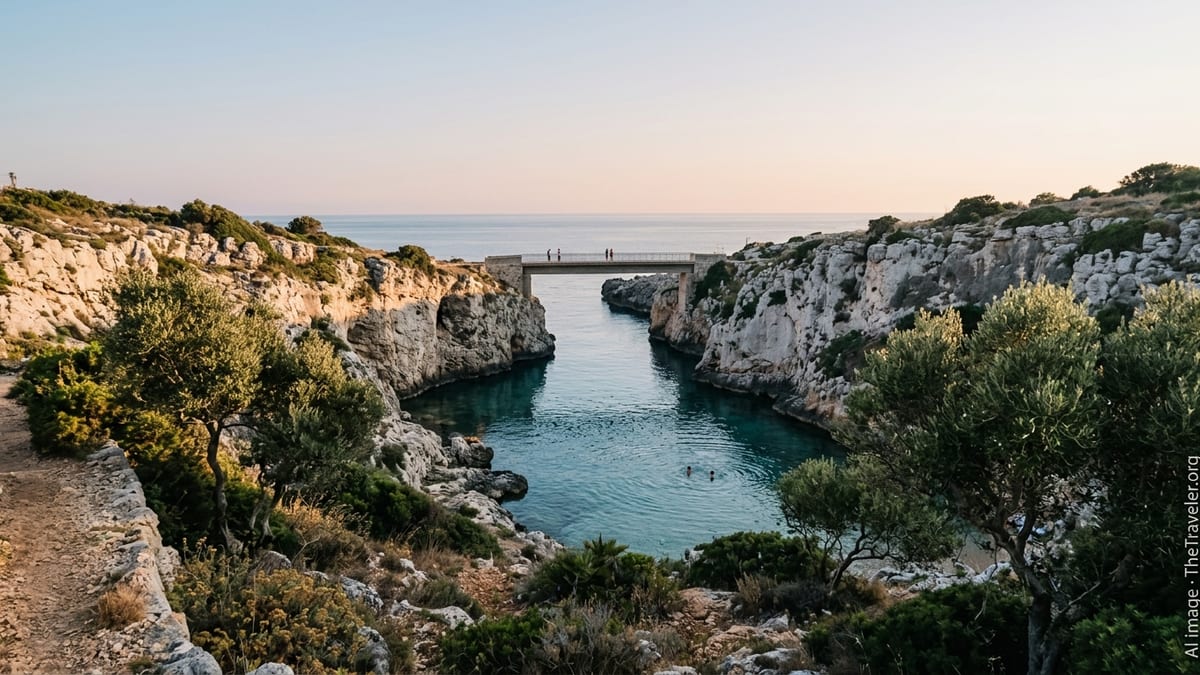
Most Italian seaside fantasies are built on soft sand and pastel umbrellas. The Adriatic face of Salento tells a different story. Here the land ends in jagged limestone, plunging into ink-blue water cleaved by narrow inlets and sea caves. One of the most dramatic spots is Il Ciolo, a deep gorge carved into the coast near Gagliano del Capo, protected today as part of the Costa Otranto–Santa Maria di Leuca regional park. Standing on the bridge, you look down into a slash of water so clear you can count individual rocks on the seabed, twenty meters below, while local teenagers fling themselves from the cliffs with enviable nonchalance.
That bridge, and the narrow staircase carved into the rock beneath it, encapsulate why Salento feels like a “hidden gem” that is not going to stay hidden. On a weekday morning in late June, I shared the water with perhaps a dozen other swimmers. There were no cruise ship excursion groups, no ticket booths, no queue of coaches inching up the access road. Yet the infrastructure is just polished enough to welcome a growing international audience: a small kiosk selling coffee and panini, a railing along the most vertiginous stretches of path, updated signage that recognizes the inlet’s environmental value. It is the kind of balance many travelers now seek instinctively.
Drive a little farther north and you reach spots like Grotta della Poesia, a natural sea pool near Roca Vecchia that has already had a taste of viral fame. A decade ago it was known mostly to locals and a scattering of adventurous foreigners; today, it appears regularly in glossy roundups of “Europe’s most beautiful natural swimming holes.” When I last visited, there was a security guard limiting jumps during the busy hours and a modest entrance fee, but if you came early in the morning, the experience was still unexpectedly intimate: a handful of people, the slap of water against rock, the warm rush of realizing you had beaten the day’s first tour bus.
Slow Towns and Late Dinners
Beyond the coastline, Salento’s inland towns are where you feel most clearly how early we still are in its popularity arc. A place like Nardò, fifteen minutes from the Ionian shore, could easily become the next “it” base for style-conscious travelers. Its historic center centers on Piazza Salandra, a Baroque square that looks stage-ready for an Italian period drama, yet on a warm May evening you might share that space with little more than children on bicycles and a few groups of locals nursing spritzes outside the same café their grandparents once favored.
In recent years, small design-forward guesthouses have begun opening behind those ornate facades. When I stayed in Nardò, my “palazzo” room was a former family home converted into four suites around a stone courtyard draped in bougainvillea. Breakfast was served at a single communal table, with still-warm pasticciotti from the town bakery and figs from the owner’s cousin’s farm. The nightly rate, under 130 euros in shoulder season, would be almost unthinkable in somewhere like Positano or the Cinque Terre for this level of space and character.
Then there is Lecce, often called the “Florence of the South,” but with a different tempo entirely. Its old town is a honeycomb of golden limestone streets that glow at dusk. Over the last few years I have watched the hospitality scene here evolve quickly: third-wave coffee bars serving single-origin espresso alongside pasticceria that have been using the same custard recipes for generations, wine bars pouring natural negroamaro next to old men playing cards under the arches. A five-minute walk can take you from a contemporary gallery showing local ceramics into a frescoed church where the only sound is the shuffling of a caretaker’s broom.
The Economics of a Hidden Gem
Part of the reason Salento is being spoken of as “about to blow up” has less to do with the region itself and more to do with what is happening elsewhere. Across southern Europe, anti-overtourism protests and rising accommodation costs in big-name locations have nudged both travelers and tour operators to look more seriously at second-tier destinations. As nightly rates for a simple double room in central Barcelona or Santorini edge toward the 250–300 euro mark in peak months, value hunters scan the map for places where their money still buys time and quality.
Salento fits that brief almost too perfectly. Flights into nearby Brindisi and Bari have quietly increased, especially from northern Europe, and low-cost carriers now connect the region with major hubs that once required awkward connections. Car rental prices, while subject to the usual summer inflation, are generally lower than what you would see on, say, the Amalfi Coast, making it realistic for a family to pick up a compact car for around 45–60 euros per day in June rather than the 80–100 that have become common in the most saturated resorts. Once you arrive, daily life is gentle on the wallet: espresso is still around 1.30 euros at a neighborhood bar, and gelato rarely creeps past 3 euros for a generous two-scoop cup.
Those prices, coupled with the region’s high-quality local produce, are already attracting a wave of food-focused travelers and remote workers seeking longer stays. In small towns a short drive from the sea, I met couples from Berlin and Toronto paying roughly 700–900 euros per month for simple long-term rentals in renovated stone houses, using them as bases for a month at a time. That is roughly what a weekend can cost in some of Europe’s hottest coastal cities in high summer. As more people discover those calculations, and as social media surfaces more images of Salento’s rust-red cliffs and olive groves, the pressure on prices and availability is likely to build.
How to Experience Salento Before Everyone Else
For now, the magic lies in traveling just slightly off the assumptions. The majority of Italian families still descend in August, when school holidays funnel visitors to the coasts and even Salento’s quieter coves can feel frenetic. Time your visit for late May, June, or September, and a different personality emerges. Sea temperatures are swimmable, daytime highs hover in the mid-twenties Celsius, and you can still find a parking space within a short walk of some of the most scenic spots without circling for half an hour behind a convoy of camper vans.
Where you base yourself can tip the balance between feeling like a pioneer and feeling like you have arrived a year too late. The big names, like Gallipoli and Otranto, deserve their fame and are worth at least a night. But for a more intimate base, consider smaller harbor towns such as Tricase Porto or Castro. In Castro, I woke up each morning to the sound of fishing boats returning to the tiny harbor, then walked five minutes uphill to a bar with plastic tables and a million-euro view for a cappuccino that cost less than two euros. In the evenings, instead of jostling for a table on a promenade, I sat on the low wall overlooking the sea, eating paper-wrapped frittura mista bought from a takeaway that appeared to do most of its business serving locals.
Taking the coast road slowly is essential. It is less than 60 kilometers from Otranto to Santa Maria di Leuca, where the Adriatic meets the Ionian, but that distance can comfortably fill a full day if you stop to swim at inlets you spot from the roadside, to wander through hilltop hamlets, or simply to pull over and stare at the colors of the water. A typical traveler’s mistake is to treat Salento as an add-on day trip from somewhere else in Puglia. In reality, it rewards at least four or five nights on its own, particularly if you want to balance the pull of the sea with evenings in the piazzas of places like Specchia or Maglie, where the presence of international visitors is still noticeable but not yet overwhelming.
Being a Good Guest in an Emerging Hotspot
With any destination on the cusp of wider fame comes an uncomfortable question: what is our responsibility as visitors not to love it to death? Across Spain and other Mediterranean countries, local frustration with overtourism has already spilled into street protests in the last few years, and many of the factors driving visitors to Salento are exactly those that have strained other regions: more short-term rentals in historic centers, rising property prices, crowded roads, and beaches that feel more like backdrops than community spaces.
Salento has a chance to learn from those examples, and travelers do, too. Choosing locally owned accommodations, whether an agriturismo among olive trees or a small B&B in a town center, directly supports residents instead of extracting value into distant corporate headquarters. Traveling outside the absolute peak weeks spreads economic benefit and reduces pressure on infrastructure. Using the region’s still-functional public transit where possible, even just for a day trip between Lecce and coastal towns, keeps a few more cars off narrow roads that were never designed for high season traffic.
Small, thoughtful choices add up. When you visit sea caves by boat, booking with operators who cap group sizes and avoid crowding the most fragile swimming spots preserves the very magic you came for. When you photograph quiet corners of a village, it is worth pausing before geotagging every hidden courtyard or wild cove in real time. “Hidden gem” is an intoxicating phrase, but what many locals want is not secrecy; it is a pace of growth that allows their communities to remain livable after the trend has moved on.
The Takeaway
Every travel generation has its “I remember when” destinations. For some, it was Lisbon before the wave of digital nomads, or Iceland before the cheap transatlantic stopovers. For many younger travelers, Salento will be that place: the corner of Italy they recall discovering “before it was everywhere.” Already, you can feel the movie trailer building. Boutique hotels are renovating old palazzi, airlines are adding seasonal routes, and glossy magazines are beginning to feature the region in “where to go next” lists.
But today, if you land in Brindisi on a sleepy Monday in early June and drive south, Salento still feels disarmingly real. Grandmothers sit in doorways in tiny towns hand-rolling pasta. Fishermen mend nets on low stone quays as teenagers scroll through their phones. The coastal road curves along cliffs where goats graze above water so bright it looks edited, and yet the only soundtrack is cicadas and the distant hum of a scooter. It feels like a secret that an entire continent is about to share.
If you go now, you will see Salento in a rare, delicate moment: a hidden gem on the threshold of its own legend. The trick, for all of us, will be to leave it not quite as polished as the travel brochures will soon make it look, but every bit as alive.
FAQ
Q1. Where exactly is Salento, and how do I get there?
Salento is the southern tip of Puglia in Italy, the heel of the boot-shaped peninsula. Most travelers fly into Brindisi or Bari, then continue by rental car, bus, or train toward towns like Lecce, Otranto, or Gallipoli.
Q2. When is the best time to visit before it gets too crowded?
The sweet spots are late May to early July and September. You avoid the crowds and higher August prices, but still enjoy warm weather and swimmable seas.
Q3. Do I need a car to explore the region properly?
Public transport connects larger hubs, but a car gives you far more freedom to reach small coves, inland villages, and rural agriturismo stays on your own schedule.
Q4. Is Salento much cheaper than other famous Italian coasts?
In general, yes. Daily costs for food, coffee, simple accommodation, and beach services are often noticeably lower than on the Amalfi Coast, Cinque Terre, or parts of Sardinia, especially outside August.
Q5. Which town should I choose as a base for a first visit?
Lecce works well if you like culture and nightlife with day trips to the sea. For a quieter coastal base, consider Otranto, Castro, or Tricase Porto, then explore by car.
Q6. Are the beaches sandy or rocky in Salento?
Both. The Adriatic side is famous for cliffs, rocky inlets, and sea caves, while the Ionian side, especially near Porto Cesareo and Pescoluse, offers long sandy beaches with shallow water.
Q7. Is Salento suitable for families with children?
Yes, particularly on the Ionian coast where beaches are sandy and shallow. Inland towns are relaxed, and many agriturismi welcome children with open space and simple local food.
Q8. How many days do I need to experience the area properly?
Plan on at least four or five nights. That allows time for both coasts, one or two inland towns, and a couple of unhurried days simply following the coastal road and stopping when a view catches your eye.
Q9. Do people speak English widely in Salento?
In larger towns and tourist-facing businesses, you will usually find some English, but in smaller villages Italian is more common. A few basic Italian phrases go a long way in daily interactions.
Q10. How can I be a responsible traveler as Salento becomes more popular?
Travel outside the peak weeks when possible, stay in locally owned places, support small businesses, follow local rules at beaches and nature sites, and be thoughtful about how you share locations online so the region can grow at a sustainable pace.