

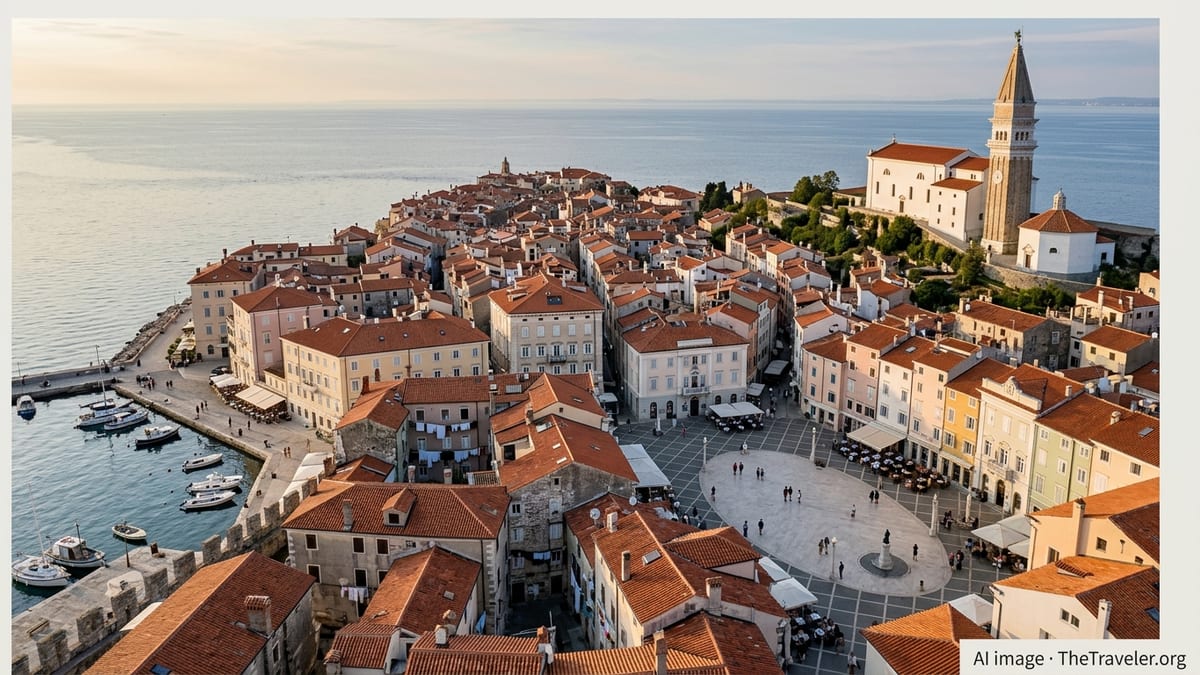
The first time I saw Piran from the bus window, I thought there had been a mistake. Out there on the Adriatic, a wedge of terracotta roofs pushed into the sea, crowned by a campanile that looked like it had been borrowed from Venice and misplaced in Slovenia. Laundry fluttered between stone houses, church bells rolled over the water, and somewhere below the hill a radio was playing an old Italian love song. It felt like I had been dropped into Italy as it existed two decades ago: unhurried, sun-faded, quietly going about its business while the rest of Europe sprinted toward modernity.
A Venetian Ghost Just Outside Italy
Piran sits on a small peninsula in southwestern Slovenia, roughly two hours by bus from Ljubljana and less than an hour from Trieste across the border in Italy. On paper, it is Slovenian. On the streets, the story is more layered. Street signs appear in both Slovene and Italian. Elderly men chat in one language and switch mid-sentence to the other. Menus list gnocchi and fuži pasta alongside jota, the local bean and sauerkraut stew. It is the kind of easy, everyday bilingualism that once defined many Italian coastal towns before mass tourism turned them into weekend showcases.
Historically, Piran spent centuries under Venetian rule, and it shows. The old town is a tight knot of medieval alleys that twist up from the harbour to St. George’s Church, past weathered Venetian Gothic windows and pastel facades capped with red tiles. The winged lion of St. Mark still peers down from stone corners if you know where to look. Yet there is none of the crush that now defines Venice or even popular Italian resorts like Cinque Terre. When I visited in late May, I walked from one side of the peninsula to the other in under fifteen minutes and passed more cats stretched in doorways than tour groups.
Slovenia’s short coastline has long been overshadowed by Italy and Croatia, but that has also been Piran’s quiet blessing. Local guesthouses still advertise handwritten "sobe" signs in the windows. Small family hotels cluster around the harbour, where fishermen unload plastic crates of gleaming sardines and scampi in the early morning. It feels like the Adriatic before social media turned every pastel wall into a backdrop.
Mornings That Feel Borrowed From Another Decade
I realized how different Piran felt on my first morning, walking down from my rented attic room above Tartini Square. It was just after 8 a.m. The square, once an inner harbour and now the town’s marble-paved heart, was almost empty. A delivery van idled outside the grocery, a single child cycled lazy circles around the statue of Giuseppe Tartini, and the café chairs were only beginning to fill. No line of selfie sticks, no rumble of rolling suitcases. The town seemed to stretch and wake at its own pace.
At Café Teater on the edge of the square, an espresso cost less than many Italian train station bars, and came with a glass of water and a quiet good morning in Italian-accented Slovene. Locals lingered over tiny white cups and still-warm croissants, reading newspapers instead of phones. An elderly woman at the next table greeted half the people who walked past. In that hour, Piran felt like every small Italian town I visited in the early 2000s, before takeaway cappuccinos and QR-code menus became standard.
From the square, I followed a side alley down to the waterfront promenade. A stone ledge runs along the sea, functioning as both sidewalk and, later in the day, as a sunbathing platform. A few early swimmers eased into the water by the metal ladders, towels folded neatly on the rocks. Across the gulf, the hazy outlines of Trieste and the Italian coast were just visible, a reminder that the border here is more administrative than cultural.
Walking the Old Walls, Hearing Italian Echoes
To really see how compact Piran is, you climb. A narrow lane leads you up from the centre to the surviving medieval town walls that still crown the hillside. The entrance fee is only a few euros, paid in cash to a caretaker who seems in no rush at all. From the top of the ramparts, the view is a textbook of old-world Adriatic living: terracotta roofs piled together like scales, church towers puncturing the skyline, and the peninsula tapering to a rocky point at Cape Madona where locals fish in the evenings.
Up there, I could hear the sounds of the town rising through the heat: a bicycle bell, a dog barking, the clink of plates in someone’s kitchen, the melodic rise and fall of Italian. Although many Italian speakers left after the Second World War, you still hear Italian in bakeries, in the market, and in the shouted greetings between balconies. It is not polished textbook Italian but the everyday dialect of a community that has shared this shore for generations.
The architecture beneath those walls underlines just how intertwined Piran’s story is with its Italian neighbours. Tartini Square is framed by elegant facades, including the 19th-century town hall and the Venetian House, its Gothic windows and red exterior standing out like a souvenir from across the sea. Behind them, alleys barely wider than outstretched arms climb sharply, their stone steps worn smooth in the centre by centuries of feet. It is easy to imagine the same scenes 20 or 30 years ago, before budget airlines, when these streets felt like the far edge of Europe rather than a weekend escape.
Seafood, Salt, and Simple Pleasures
On my second day, I walked to the small open-air market where a handful of stalls sold whatever the fields and sea had given up that morning: crates of tomatoes perfumed with sunshine, glossy eggplants, peaches still carrying the dust of the road, and shimmering local anchovies. Prices were closer to inland Slovenia than to the fashionable Italian Riviera. A paper bag of cherries cost only a few euros, a bunch of basil less than a bus fare. The vendors switched between Slovene and Italian depending on who was at the table, gossiping about the weather and the football scores.
Piran’s restaurants still feel family-run rather than concept-driven. Along the promenade and in the lanes behind it, blackboards announced simple daily menus: spaghetti alle vongole, grilled branzino, risotto with local cuttlefish ink, and plates of pršut ham with young sheep cheese. At a small konoba tucked into a side street, I ordered grilled sardines and a carafe of house white for a price that would barely cover a glass in more famous Italian resorts. The owner’s mother brought out a plate of fried dough dusted with sugar "just to try," speaking in Italian, while her son translated into English.
A short walk from town, the Sečovlje salt pans stretch out in geometric patterns, a reminder that this coast was built on salt long before it was built on tourism. You can visit the museum area, learn about traditional salt harvesting, and then soak in the briny air that softens the harshness of the midday sun. It feels old-fashioned in the best possible way: fewer tour groups, more families cycling past with picnic baskets.
Afternoons of Swimming and Doing Almost Nothing
Afternoons in Piran belong to the sea. With no sandy beach in the old town itself, everyone simply claims a spot on the rocks or the concrete ledge of the promenade. Teenagers spread towels under the shade of the church walls, parents sit on folding chairs with paperback novels, and older couples in wide-brimmed hats lower themselves by the ladders into glass-clear water. There are no private beach clubs with daybed fees or velvet ropes, just a democratic strip of shoreline where your only admission is the courage to jump.
On a late June afternoon, I walked the length of the promenade and counted only a handful of foreign languages. The dominant soundtrack was still local: Italian laughter, Slovene conversations, the soft clink of spoons against gelato cups from the kiosk near the harbour. Gelato here is not a lifestyle statement but a simple treat, scooped into small paper cups for a couple of euros. Flavours lean classic: pistachio, stracciatella, lemon, dark chocolate, sometimes a seasonal fig.
As the sun swung west, I followed the slope up to St. George’s Church. Its white facade and freestanding bell tower, reminiscent of the campanile in Venice, command the highest point of the peninsula. From the grassy terrace around it, you can see three countries at once on a clear day: Slovenia beneath your feet, Croatia stretching to the south, and Italy just across the water. Yet even with that strategic view, there were only a few other people scattered on the benches, mostly locals walking their dogs. It felt radically different from equivalent viewpoints in Italy, where ticket booths and security lines now mediate every panorama.
Evenings Lit by Old Streetlamps, Not Screens
Night in Piran arrives softly. The sun falls behind the hills above Trieste, the water turns dark blue, and the town’s yellow streetlamps blink to life one by one. Tartini Square fills slowly, not with rowdy nightlife but with an easy, communal loitering. Children chase pigeons across the smooth paving, couples stroll arm in arm, and a busker with a violin takes advantage of the natural acoustics.
On one evening, I sat outside a wine bar that poured local Malvazija and Refošk by the glass at prices that would make a Roman enoteca blush. At the neighbouring table, a group of friends in their fifties, half speaking Italian and half Slovene, were debating politics. On the other side, a pair of German cyclists pored over a paper map. Phones appeared only occasionally, mostly to take a quick photo of the sky as it flared pink, then slipped back into pockets. For all the conveniences of modern travel, that relative absence of screens gave the evening a texture I remembered from small Italian towns years ago.
There is nightlife in Piran, but it tends to be small-scale: a bar with live jazz on weekends, a beach café in nearby Portorož with DJ sets in high summer, a cultural event in the Minorite Monastery cloister. The town still feels like a place where people live first and holiday second. Supermarkets close early, church bells mark the hours, and the loudest sound after midnight is usually the sea.
Why Piran Has Stayed Under the Radar
Part of the reason Piran feels like Italy 20 years ago is purely practical. Slovenia has only about 47 kilometres of coastline, and Piran shares that narrow strip with the larger resort of Portorož and the industrial port of Koper. There are no international airports on the coast, no cruise ships docking in front of the old town. Most visitors arrive by regional bus or by car from nearby Italy, Austria, or inland Slovenia. The journey filters out some of the mass tourism that has reshaped so many Mediterranean towns.
Tourism here is present, but it is still woven around daily life rather than the other way around. Many guesthouses are converted family homes where grandmothers hang laundry from the balcony above your breakfast terrace. Apartments are advertised on local noticeboards as often as on booking platforms. Even in peak summer, you are more likely to share a restaurant with Slovenian families on holiday than with a sea of short-stay visitors.
There is also an element of national identity at work. Piran is proud of its Venetian heritage, but equally proud to be Slovenian. That balanced pride has kept development in check. New hotels cluster mostly outside the old town, leaving the peninsula itself largely intact: no glass towers, no oversized billboards, just stone alleys, low-rise houses, and the occasional freshly painted shutter.
Planning Your Own Step-Back-in-Time Escape
If Piran sounds like the Italy you remember, or the one you wish you had seen before the crowds, it is not difficult to experience that feeling yourself. Trains and buses connect Ljubljana to the coast, often with a change in Koper, in around two to three hours. From Trieste in Italy, regional buses and cross-border shuttles make the hop in roughly an hour. Once you arrive, cars are pushed to the margins. The old town is largely pedestrian, with parking available in garages above the centre and a small shuttle bus bringing visitors down to Tartini Square.
Accommodation ranges from simple rooms in family homes to small boutique hotels overlooking the harbour. In shoulder seasons such as May, June, September, and early October, you can still find double rooms in the old town at prices that would be unthinkable in comparable Italian resorts on the same sea. Outside of the July and August peak, restaurants rarely require reservations, and the promenade never feels packed.
Spend at least two nights if you can. Use one day to wander Piran itself slowly: up to the walls, into St. George’s Church, along the harbour, and around the point to the lighthouse. Dedicate another to the salt pans, the nearby resort town of Portorož, or a coastal hike in the Strunjan Nature Reserve, where cliffs drop steeply into clear water. If you crave a more explicitly Italian experience, Trieste and even Venice are possible as long day trips, but most visitors find that once they settle into Piran’s pace, the desire to rush elsewhere fades.
FAQ
Q1. Where exactly is Piran, and how close is it to Italy?
Piran is on Slovenia’s short Adriatic coastline, on a small peninsula south of Trieste. It is roughly an hour by road from Trieste in Italy and a few hours from Venice by a combination of road and regional connections.
Q2. Why does Piran feel so similar to Italy?
Piran spent centuries under Venetian rule, which left a strong mark on its architecture, language, and food. Today you still see Venetian-style buildings, hear Italian spoken in the streets, and find Italian dishes alongside Slovenian specialties.
Q3. Is Piran less crowded than popular Italian seaside towns?
Yes. While Piran attracts visitors, it does not see the same volume of tourism as places like Cinque Terre or the Amalfi Coast. Outside the peak months of July and August, the streets and waterfront feel relaxed and rarely overcrowded.
Q4. What time of year best captures that “Italy 20 years ago” atmosphere?
The shoulder seasons of May, June, September, and early October are ideal. The weather is usually warm enough for swimming, most businesses are open, but the pace remains slow and local life is easy to see.
Q5. Do people in Piran speak Italian?
Yes, to varying degrees. Street signs are often bilingual, and many locals, especially older residents and those working in tourism, speak both Slovene and Italian. English is also commonly spoken, so communication is straightforward.
Q6. How expensive is Piran compared with coastal Italy?
Overall, Piran tends to be more affordable than many well-known Italian coastal destinations. Coffee, gelato, and simple restaurant meals are often noticeably cheaper, and mid-range accommodation can offer good value outside the absolute high season.
Q7. Are there beaches in Piran?
Piran itself does not have long sandy beaches. Instead, people swim from rocky terraces and concrete platforms along the promenade. Sandy and pebble beaches are available nearby in places like Portorož, a short walk or bus ride away.
Q8. Is Piran suitable for travelers without a car?
Very much so. The old town is compact and largely car-free, and regional buses link Piran with Koper, Ljubljana, and Trieste. Once you arrive, almost everything is within walking distance, and local buses or taxis can handle trips to nearby sights.
Q9. What are the must-see highlights for a short stay?
For a brief visit, focus on Tartini Square, the climb to St. George’s Church, a walk along the medieval town walls, a sunset stroll around the peninsula to the lighthouse, and at least one seafood meal by the harbour or on a side street terrace.
Q10. How long should I stay in Piran to really appreciate it?
A single day trip offers a good taste, but two or three nights allow you to slip into the slower rhythm, enjoy quiet mornings and late swims, and explore nearby salt pans or coastal trails without rushing.