

More news on this day
Tens of thousands of Israelis have been stranded across the globe after the sudden closure of Israeli and regional airspace triggered cascading flight cancellations, exposing how quickly geopolitical shocks can paralyze modern travel networks.
Get the latest news straight to your inbox!
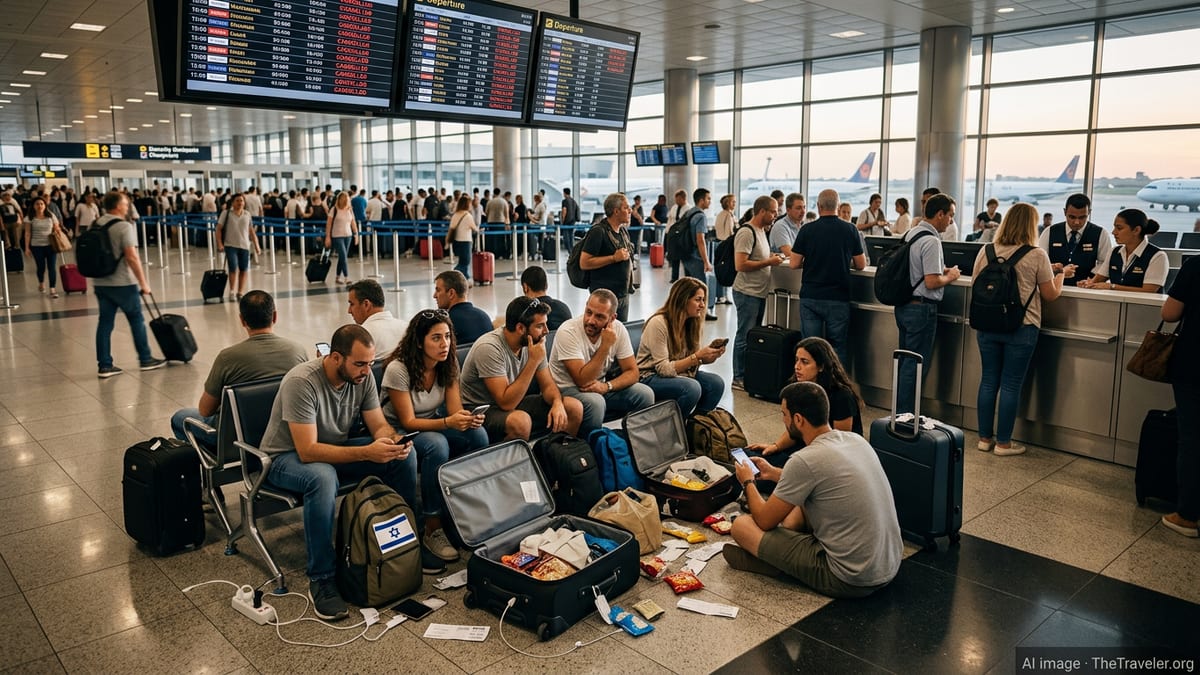
War With Iran Sends Shockwaves Through Global Skies
The travel disruption began on February 28, 2026, when coordinated U.S. and Israeli strikes on Iranian targets prompted Iran and several neighboring states to close their skies. Within hours, Israel, Qatar, Kuwait, Bahrain and parts of the United Arab Emirates and Iraq also restricted or halted civilian flights, forcing airlines to divert or cancel thousands of services on key transcontinental routes.
For Israelis abroad, the most dramatic effect came when Israel sealed its own airspace to commercial traffic, effectively cutting off direct access to Ben Gurion International Airport. The Transportation Ministry has said that nearly 300,000 Israelis had flown overseas in the preceding three months, and around 120,000 of them were abroad and seeking to return when the war erupted. As commercial schedules collapsed, that pool of would-be returnees quickly turned into a patchwork of stranded families, students and business travelers scattered from New York to Dubai and Bangkok.
Airlines from Europe, Asia and North America reacted cautiously, with many suspending flights to Tel Aviv and choosing long detours to avoid the eastern Mediterranean and Gulf air corridors. For global travelers, this meant extended flight times, unplanned technical stops in European hubs and, in many cases, outright cancellations when crew and aircraft could not be repositioned. What began as a regional security precaution rapidly evolved into a worldwide air travel crisis.
Travel industry analysts say the sudden loss of multiple Middle Eastern airspaces simultaneously has few precedents in modern aviation. Major hubs such as Dubai, Abu Dhabi and Doha had long served as linchpins connecting Europe, Africa, Asia and Australasia. With these hubs curtailed or partially offline and Israel’s skies closed for days, airlines faced a complex chessboard of rerouting decisions that left many passengers with no viable way home.
Tens of Thousands of Israelis Still Waiting to Get Home
As of early March, Israeli officials estimate that tens of thousands of citizens remain abroad, many of them with tickets on flights that were canceled multiple times as carriers adjusted to changing security assessments. On March 5, the Transportation Ministry said more than 20,000 Israelis had managed to return since the conflict began, but roughly 120,000 still wanted to come home, underscoring the scale of the backlog.
Some of those stranded found themselves in transit limbo at major hubs when airspace closures took effect mid-journey. Passengers bound for Tel Aviv were rerouted to European or Mediterranean cities, then left to negotiate their own accommodation while waiting for updates. Social media groups of Israelis stuck in cities such as New York, London and Istanbul have become informal information exchanges, sharing tips on airlines honoring tickets, insurance claims and possible overland alternatives via Jordan or Egypt once those borders are accessible.
Elsewhere, Israelis vacationing in regional hotspots like the United Arab Emirates were caught by both the shutdown at Ben Gurion and periodic disruptions at Gulf airports themselves. In Dubai and Abu Dhabi, evacuation flights began operating in recent days, but demand far outstrips supply. Many travelers report spending hours in call center queues, monitoring airline apps and lining up at ticket counters in the hope of securing a scarce seat on a repatriation service.
Travel insurers and consumer advocates warn that not all passengers will receive the same treatment. While most carriers have offered refunds, rebooking or vouchers, the extraordinary circumstances and rapidly shifting regulatory environment mean some travelers face out-of-pocket costs for hotels, meals and replacement tickets as they wait for clearer guidance on compensation rules.
Emergency Airlift Struggles Against Capacity and Security Limits
Facing growing public pressure, Israel’s government has authorized a rolling program of repatriation flights operated primarily by domestic carriers El Al, Arkia and Israir. Since limited reopening of the skies began in early March, these airlines have mounted dozens of special rotations, focusing first on large concentrations of stranded citizens in Europe, North America and the Gulf.
Officials acknowledge, however, that the airlift is constrained by strict security protocols and the ongoing risk of additional missile attacks. Ben Gurion is operating in a highly restricted format, with tight caps on the number of arrivals and departures per hour and priority given to inbound rescue flights. Many aircraft are landing full and departing nearly empty so they can quickly return abroad to collect more passengers, an arrangement that eases the immediate humanitarian pressure but slows the normalization of regular commercial schedules.
Military coordination has also become a central factor in civil aviation planning. Routes for repatriation flights must thread through a patchwork of partially open or tightly controlled airspaces, often at specific altitudes and time windows agreed with multiple air traffic authorities. Aviation experts say this choreography limits how many aircraft can safely operate simultaneously, even as demand among stranded Israelis remains enormous.
There are growing calls within Israel for clearer prioritization criteria, with debate over whether students, medical cases, families with young children or reservists should be given first access to seats on rescue flights. Officials insist that they are trying to balance humanitarian need, operational safety and fairness, but acknowledge publicly that many citizens will likely face days or weeks of continued uncertainty before they can return.
Global Airlines Grapple With Reroutes and Prolonged Uncertainty
The ripple effects of the closures reach far beyond Israeli travelers. Airlines from India, Europe and North America have either suspended flights to Israel entirely or reconfigured their networks to skirt conflict zones, leading to increased costs and logistical headaches. Carriers that normally rely on Middle Eastern overflight rights for the shortest routes between Asia and Europe are now dispatching flights on longer arcs over Central Asia or southern Africa, burning more fuel and tying up aircraft and crews for extended periods.
Several major airlines have publicly warned of schedule reductions and ongoing disruption through at least early March as they reassess risk and await more stable conditions. Industry observers note that while some carriers are experienced at avoiding limited danger zones, the simultaneous volatility in multiple countries has pushed contingency planning to its limits. For travelers with itineraries that do not involve Israel, the result can still be significant: longer journey times, missed connections and tighter capacity on alternative routes.
Travel booking platforms and metasearch engines report a surge in demand for real-time flight status and route information, as well as a spike in customer service interactions from passengers seeking to understand whether their flights traverse restricted airspace. Some airlines have introduced temporary flexibility policies, allowing free date or destination changes for tickets touching the wider Middle East region, though these measures vary widely by carrier.
Airport operators, particularly in Europe and the eastern Mediterranean, are also feeling the strain as diverted flights crowd already busy terminals. Ground handling teams report increased workloads managing unexpected arrivals and rebooked passengers, while security agencies monitor for potential spillover protests or tensions linked to the conflict.
What Travelers Need to Know as the Crisis Continues
For Israelis and other travelers with upcoming trips involving Israel or regional hubs, the picture remains fluid. Officials in Jerusalem say they expect a gradual expansion of flight capacity in the coming days if the security situation does not deteriorate further, but warn that schedules may change with little notice. Travelers are being urged to stay closely in touch with their airlines, avoid heading to airports without confirmed bookings and be prepared for last-minute adjustments.
Travel advisers recommend that passengers keep all documentation related to canceled flights, including booking confirmations, cancellation notices and receipts for any additional expenses, to support future claims with airlines, insurers or credit card companies. Those still abroad are encouraged to register with Israeli consular services where possible so that embassies can share information about repatriation opportunities and local conditions.
The crisis has also reignited debates about overreliance on a handful of mega-hubs and narrow air corridors that can be shut almost instantly by geopolitical shocks. Aviation planners and policy makers are likely to study the 2026 airspace closures as a case study in systemic vulnerability, from the exposure of global supply chains to the personal strain experienced by stranded tourists and migrant workers.
For now, the focus remains on getting Israelis and other affected travelers home safely. As special flights shuttle back and forth under tight security, every plane that lands at Ben Gurion brings visible relief to anxious families waiting in the arrivals hall, even as tens of thousands more passengers around the world continue to scan departure boards and phone screens for any sign that the skies are truly opening again.