

More news on this day
Thousands of travelers across Europe faced a day of severe disruption on Thursday as a wave of flight cancellations and delays hit major hubs in Italy, France, the United Kingdom, Spain, Germany and Portugal, snarling operations for carriers including easyJet, ITA Airways, Ryanair, Finnair and SAS and leaving passengers stranded in Milan, Rome, Paris, London, Munich, Lisbon and beyond.
Strike Action and Operational Strain Hit Key European Hubs
In Italy, a nationwide air transport strike targeting both cabin crew and ground staff triggered hundreds of cancellations and widespread delays at Rome Fiumicino and Ciampino, Milan Linate and Malpensa, and other regional airports. ITA Airways and easyJet bore the brunt as unions reported exceptionally high participation among workers, severely reducing the capacity of airlines to run scheduled services.
The walkout, centered on disputes over contract renewals and working conditions, coincided with a broader pattern of operational strain in European aviation. Airports in Paris, London, Munich, Lisbon and other cities reported mounting backlogs as rotations slipped, aircraft and crews went out of position and connecting banks of flights began to unravel through the day.
Across the continent, data from flight tracking and passenger rights platforms indicated at least 164 cancellations and more than 1,200 delays tied to the latest wave of disruption. While weather and air traffic control constraints played a role in some regions, labor action and staffing pressures at airlines and handling companies were the dominant drivers.
The knock-on effects were quickly felt by travelers heading into and out of Europe’s busiest metropolitan areas. At Milan and Rome, early morning cancellations cascaded into missed connections for passengers bound for Paris, London, Munich and Lisbon, amplifying the disruption far beyond Italy’s borders.
Airlines From Low-Cost Giants to Legacy Carriers Affected
The disruption cut across market segments, hitting low-cost and full-service carriers alike. easyJet, already under pressure from recent winter weather and chronic congestion at several of its bases, saw large parts of its Italian schedule wiped out or heavily delayed, with ripple effects spreading to its operations in France, the UK, Germany, Spain and Portugal.
ITA Airways, Italy’s flag carrier, was forced to cancel scores of domestic and short-haul European flights, particularly on trunk routes linking Rome and Milan with Paris, London and Munich. The loss of these feeder services left long-haul passengers without onward connections, compounding crowding at rebooking desks and call centers.
Ryanair, which maintains substantial operations in Italy, Spain, Germany and Portugal, also reported disruption as ground handling bottlenecks and congested airspace translated into late arrivals and departures. Nordic operator Finnair and Scandinavian carrier SAS, already navigating a tight winter schedule between Northern and Western Europe, saw their own rotations affected when flights into key hubs such as London and Paris were delayed or forced into extended ground holds.
Industry analysts noted that European networks remain highly susceptible to shock events. A large-scale strike or weather system in one country can quickly spill across borders, as aircraft and crews scheduled to operate onward sectors fail to reach airports in time, magnifying the impact on airlines and passengers in unrelated markets.
Scenes of Confusion and Long Queues for Stranded Passengers
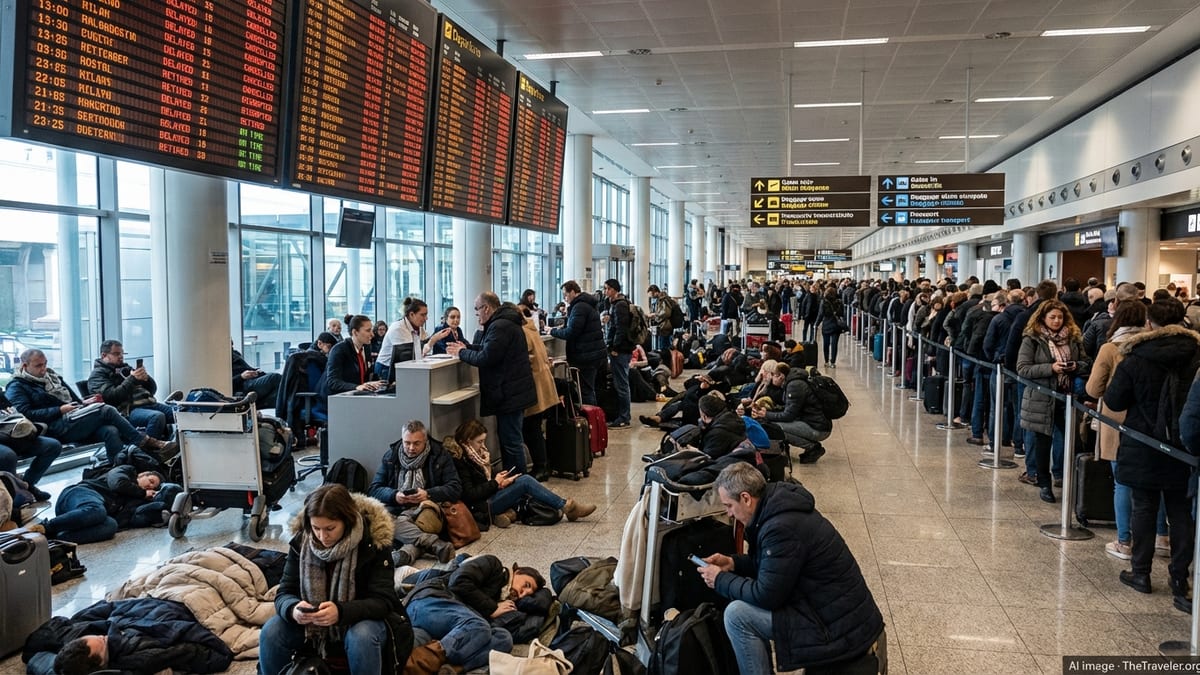
At terminals from Lisbon to London and Munich to Paris, passengers awoke to departure boards filled with red and amber notices as airline apps and airport screens showed a growing tally of cancellations and long delays. Many travelers arriving for early flights discovered services already scrubbed overnight, with limited rebooking options remaining for the same day.
In Milan and Rome, lines quickly formed at airline service counters as frustrated passengers sought rerouting, hotel vouchers and meal assistance. With ground staff also part of the industrial action in Italy, response capacity at some airports was stretched, leaving travelers waiting for hours to speak to an agent or receive updated information about their rights.
At London and Paris, where flights to and from Italy connect with services across Europe and beyond, confusion mounted as inbound cancellations broke itineraries mid-journey. Families returning from winter holidays and business travelers on tight schedules scrambled to secure scarce seats on alternative flights, train services or long-distance buses.
Social media channels filled with images of crowded departure halls, passengers sleeping on the floor and long check-in and security queues. Travel advisory groups urged affected customers to document their expenses and keep all boarding passes and booking confirmations, noting that, in many cases, European air passenger protections could entitle them to care, refunds or compensation depending on the cause and timing of the disruption.
Airlines Offer Rebooking as Disruption Ripples Through Schedules
As the scale of the disruption became clear, major carriers activated contingency plans. ITA Airways and easyJet offered free changes or refunds for customers booked on canceled or heavily delayed flights, encouraging travelers to move journeys to later dates where possible to ease capacity constraints on the day of the strike.
Ryanair, Finnair, SAS and other affected airlines issued operational alerts and pushed notifications through their mobile apps, urging passengers to check flight status before heading to the airport. Some carriers attempted to consolidate services by switching to larger aircraft on remaining departures, though tight fleet and crew availability limited how much capacity could be recovered at short notice.
Airports in Milan, Rome, Paris, London, Munich and Lisbon opened additional customer assistance desks and deployed extra staff where available to manage crowding and provide basic information on delays, baggage handling and onward connections. However, continuing constraints in security, ground handling and air traffic control meant that recovery was expected to take into the following day, with late-arriving aircraft disrupting early morning departures.
Travel specialists warned that even passengers whose flights were still listed as operating should be prepared for longer processing times and potential last-minute schedule changes. They advised arriving well ahead of departure, traveling with carry-on luggage where feasible, and maintaining flexible plans in case of rolling delays.
What Travelers Should Do If Their Flight Is Affected
Passenger rights experts stressed that travelers facing cancellations in Europe are generally entitled to a choice between a refund and rerouting at the earliest opportunity, along with care such as meals and accommodation when waiting for a replacement flight. Eligibility for financial compensation depends on the cause of the disruption and the specific circumstances of each case.
For those stranded at airports in Milan, Rome, Paris, London, Munich or Lisbon, immediate steps include contacting the airline through its app or website to confirm rebooking options, rather than relying solely on crowded airport counters. Keeping digital copies of booking confirmations, receipts for food, transport and hotels, and written or screenshot evidence of delays can be vital later when submitting claims.
Travelers with imminent departures to or within Europe have been urged to monitor conditions closely over the coming days. With labor tensions unresolved in parts of the aviation sector and winter weather still affecting Northern and Central Europe, further localized disruption remains possible, especially on short-haul routes served by easyJet, Ryanair, Finnair, SAS and other carriers that operate dense schedules through the affected hubs.
Industry observers say the latest wave of disruption underscores the fragility of Europe’s busy air corridors during peak periods. For passengers, that means building extra margin into travel plans, considering alternative routes and being prepared for last-minute changes when crossing the continent by air.