

More news on this day
Thousands of passengers across the United States faced lengthy waits, missed connections, and overnight airport stays as a fresh wave of cancellations and more than 3,000 delays swept through major hubs including Atlanta, Houston, Chicago, Orlando, New York, San Francisco, and Philadelphia.
Get the latest news straight to your inbox!
Wave of Disruptions Hits Major U.S. Gateways
Publicly available flight tracking data for early April indicate a severe spike in operational disruption, with more than 3,000 delayed departures and at least 63 cancellations recorded across the domestic network in a single day. The disruption has concentrated around some of the country’s busiest hubs, amplifying the impact on passengers attempting to connect between flights or reach smaller regional airports.
Airports serving Atlanta, Houston, Chicago, Orlando, New York, San Francisco, and Philadelphia have all reported elevated disruption levels, with ripple effects extending to additional cities such as Boston, Los Angeles, Seattle, and Newark. Reports from aviation data providers show these hubs collectively shouldering the bulk of delays as tightly scheduled aircraft and crews fall out of position.
Low cost and full service carriers alike have been affected. Spirit, American, Southwest, United, and JetBlue feature prominently in disruption figures, alongside other major brands that rely on the same congested airspace and high-demand routes. With multiple large carriers struggling simultaneously, stranded travelers have faced fewer available seats on alternative flights, lengthening recovery times.
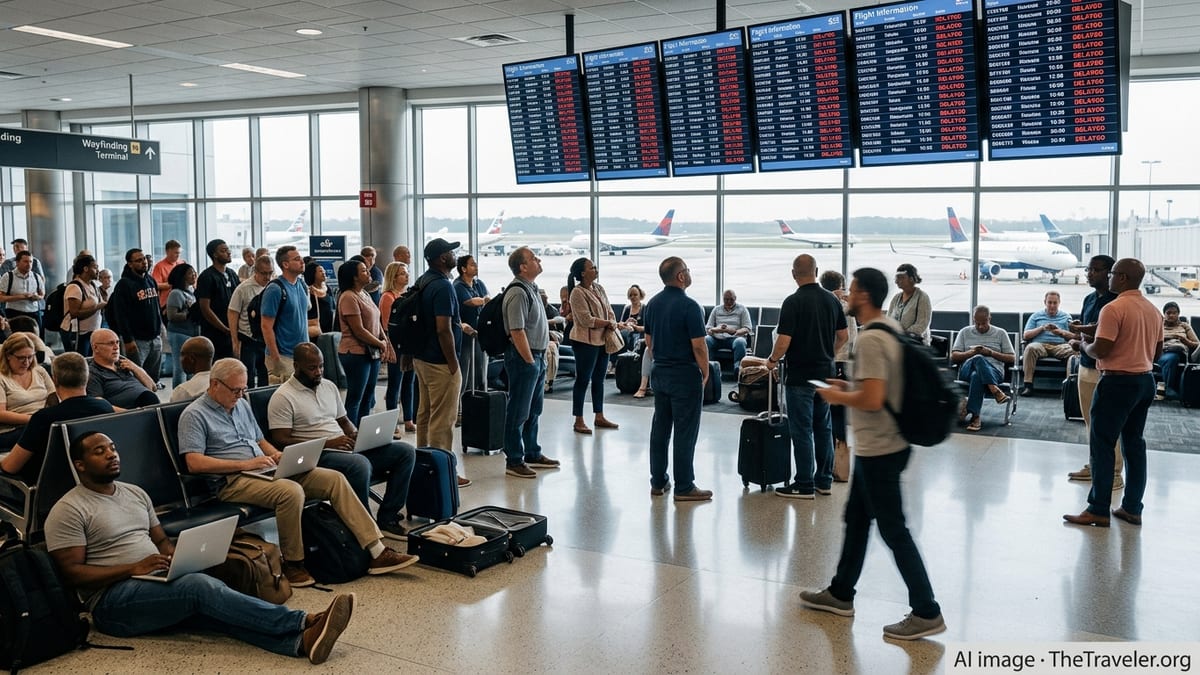
Recent coverage from travel and aviation outlets portrays crowded departure halls, long customer service queues, and passengers camped out at gate areas as airlines work to rebuild schedules. While the majority of flights are still operating, the concentration of delays has proven enough to displace thousands of itineraries in a matter of hours.
Weather, Congested Airspace, and Tight Schedules Converge
Analysis of recent patterns suggests the latest disruption is not the result of a single failure but a convergence of challenging conditions. Spring weather systems have moved through key regions, bringing thunderstorms to Florida and the Southeast and unsettled conditions to parts of the Northeast and Midwest. When storms or low visibility reduce arrival rates into major hubs, air traffic managers typically apply flow restrictions that quickly ripple through airline networks.
These atmospheric bottlenecks arrive at a time when airline schedules remain tightly wound. Industry performance data for March in North America indicate that overall on time arrival rates have come under pressure, with some carriers seeing notable dips in punctuality and rising numbers of late arrivals feeding into subsequent delays. In this environment, even short-lived weather events can create backlogs that take most of a day to clear.
Observers of airline operations point to high aircraft utilization and complex crew rotations as additional stress points. Modern airline networks are designed to maximize efficiency, with aircraft cycling between multiple cities per day and crews assigned sequences that leave little room for extended disruptions. When an early flight into a hub runs significantly late, it can delay several subsequent departures as the same plane and crew are needed elsewhere.
Publicly available commentary from aviation analysts notes that such conditions are increasingly common during peak travel seasons. With April bringing both lingering winter weather in some regions and heavy leisure demand around school breaks, the ingredients for large scale delay events are firmly in place.
Airlines Struggle to Rebook Amid Limited Capacity
For travelers caught in the middle of the disruption, the most visible consequence is the difficulty of securing timely alternatives. Reports from recent high impact days describe passengers in Atlanta, Houston, Chicago, Orlando, and New York being rebooked onto flights departing many hours or even a full day later, particularly on heavily traveled routes where remaining seats were already scarce.
Publicly accessible flight data and media coverage indicate that cancellations remain relatively modest compared with the surge in delays, but even limited cancellations can displace hundreds of travelers per flight when wide body or high frequency routes are involved. With multiple carriers experiencing irregular operations at once, the traditional safety valve of switching to a different airline has, in many cases, offered limited relief.
Travel industry reporting highlights how previous large scale events, including severe winter storms and technology outages, have demonstrated the difficulty airlines face in rapidly restoring normal operations. Once aircraft and crews are out of position, recovery commonly takes more than a day, especially when the disruption overlaps with peak travel periods when most seats are already sold.
In the latest episode, the presence of delays at several of the country’s most important connecting hubs has compounded the problem. Missed connections in cities such as Chicago, Atlanta, and Houston often strand travelers far from home or final destinations, creating surges in demand for hotel rooms and ground transport around the airports.
Most Affected Carriers and Routes
Within the broader nationwide disruption, certain carriers and corridors appear to be bearing a disproportionate share of the strain. Spring performance figures show that some low cost operators, including Spirit, have recently reported weaker on time metrics compared with earlier months, leaving customers more exposed when conditions deteriorate. JetBlue has seen a more mixed pattern, with pockets of improved punctuality but continued vulnerability on weather sensitive East Coast routes.
Major network airlines such as American, Southwest, and United have also featured heavily in delay and cancellation tallies across recent days, largely due to their extensive presence at the affected hubs. High frequency shuttle routes in the Northeast corridor, transcontinental links to and from New York and San Francisco, and Florida bound leisure flights from the Midwest and Northeast all appear repeatedly in disruption summaries from flight data aggregators.
Coverage from travel news outlets notes that Orlando continues to function as a key pressure point this spring. Thunderstorms and heavy traffic around the Central Florida gateway have triggered ground delay programs and airborne holding patterns, which in turn restrict the number of arrivals per hour and send knock on effects into connecting banks at other airports. When these restrictions coincide with operational challenges in the Northeast or Midwest, performance can degrade quickly across large portions of the domestic network.
Routes connecting New York, Boston, and Washington to Florida and the Gulf Coast, as well as cross country services linking the East Coast to California, are particularly exposed during such events. Passengers on these routes have seen some of the longest delays and most frequent rebookings, as airlines prioritize restoring core hub operations and maintaining long haul departures once conditions begin to stabilize.
What Travelers Can Expect in the Days Ahead
Looking beyond the immediate chaos, available data and recent trends suggest that elevated disruption levels may persist through the coming days as airlines work through backlogs and position aircraft and crews for future departures. Even after the day with 63 cancellations and more than 3,000 delays, residual effects such as aircraft arriving late at overnight stations can set the stage for another round of schedule adjustments the following morning.
Travel and aviation analysts have repeatedly warned that the combination of strong demand, limited spare capacity, and increasingly volatile weather patterns leaves little margin for error. When several bottlenecks align, the system’s interconnected nature ensures that disruptions are not confined to a single region. Passengers departing from smaller cities, including those far from the original weather event, may still experience delays if their aircraft or crews are coming from an affected hub.
Public guidance from consumer advocates and travel publications continues to emphasize preparation and flexibility. Recommendations commonly include booking earlier flights in the day, allowing longer connection times when possible, monitoring flight status closely, and keeping essential items in carry on luggage in case of unexpected overnight stays. While such steps cannot prevent cancellations or lengthy ground holds, they can reduce the risk of becoming stranded without options when irregular operations spread across multiple airlines.
For now, the latest round of disruption serves as another reminder of how quickly the U.S. air travel system can move from routine operations to widespread delays when weather, demand, and tight scheduling collide. With the busy summer season approaching, travelers and airlines alike are watching closely to see whether these early spring challenges are a preview of more turbulent months ahead.