

More news on this day
Thousands of air passengers across the United States are facing major disruption as more than 4,400 flights are delayed and over 250 cancelled in a single day, with Chicago, New York, Los Angeles, Houston and Denver among the hardest hit hubs and carriers including Delta Air Lines, American Airlines, United, SkyWest, Republic and Spirit confronting widespread operational knock-on effects.
Get the latest news straight to your inbox!
Major Hubs Buckle Under Wave of Delays
Publicly available flight tracking data shows that a combined total of 4,458 delays and 257 cancellations have rippled through the US network, concentrating heavily at a handful of major hubs. Chicago, New York, Los Angeles, Houston and Denver have all reported significant operational strain as airlines struggle to move aircraft and crews into position for subsequent departures.
At Chicago O’Hare International Airport, one of the nation’s busiest connecting points, reports indicate well over a thousand delays alongside a substantial number of cancellations, disrupting routes across the Midwest, East Coast, and international markets. New York area airports, including LaGuardia, have also logged hundreds of delayed departures and arrivals, with knock-on congestion building throughout the day.
Los Angeles International, Denver International and Houston George Bush Intercontinental are each managing dozens to hundreds of late-running flights, compounding pressure on already tight schedules. As aircraft depart behind schedule from these hubs, secondary airports across the domestic network experience rolling timetable changes, extending the disruption far beyond the primary cities.
With multiple major hubs affected at once, the scale of the disruption has made it difficult for carriers to recover quickly. Even flights that remain scheduled to operate have frequently been assigned later departure times, lengthening queues at gates and leaving travelers uncertain about when they will actually take off.
Leading Carriers Face Network-Wide Strain
The disruption is not limited to one or two airlines. Operational data indicates that a broad cross-section of US carriers has been affected, including large network airlines and regional operators. Delta Air Lines, American Airlines and United Airlines have all recorded elevated numbers of delayed and cancelled flights, reflecting their heavy presence at the hardest hit hubs.
Regional partners such as SkyWest and Republic, which operate many feeder flights under major airline brands, are also experiencing high disruption rates. When these operators cancel or significantly delay short-haul segments, passengers may miss onward connections on larger aircraft, amplifying the number of people stranded or forced to rebook.
Low cost and leisure-focused carriers such as Spirit Airlines are likewise caught in the ripple effect. Even modest schedule interruptions can quickly cascade for point-to-point airlines, as aircraft scheduled for multiple tightly timed turns fall behind. Once a single rotation is delayed or cancelled, subsequent departures using the same aircraft are vulnerable to further disruption.
Recent performance analyses of US airlines have highlighted how even normally reliable carriers can see punctuality erode rapidly during days of concentrated strain. Higher on-time performers such as Delta and American may still complete the majority of their schedules, but they can face large absolute numbers of delayed flights when disruption strikes heavily trafficked hubs.
Weather, Congestion and Operational Complexity
Published coverage of US aviation performance and federal transportation reports have long identified a combination of weather, airspace congestion and airline operational factors as key drivers of widespread delays. Even when extreme weather is limited to certain regions, less severe conditions such as low clouds, heavy rain or strong winds can trigger air traffic flow restrictions, reducing the number of flights that can land or depart in a given period.
In addition, the complexity of hub-and-spoke scheduling means that a localized disruption can quickly spread. When one airport reduces arrival rates, inbound flights may be held on the ground at their origin, pushed back in the departure queue or rerouted. As those aircraft arrive late, the next flights using the same crews and planes are pushed behind schedule, leading to a chain reaction across the airline’s network.
Regional carriers like SkyWest and Republic, which operate dense schedules on smaller jets, are particularly exposed to such ripple effects. Their flights often feed passengers into large banks of connections at major hubs. If those feeder flights are delayed or cancelled, airlines can be forced to re-accommodate large numbers of travelers, sometimes over multiple days when seat availability is tight.
Industry and government reports note that air carrier delays, national aviation system congestion, and late arriving aircraft together account for a significant share of disruptions, with weather acting as a frequent trigger. On days with heavy disruption like this one, all of these factors tend to interact, magnifying the impact on travelers.
Passengers Face Long Waits and Limited Options
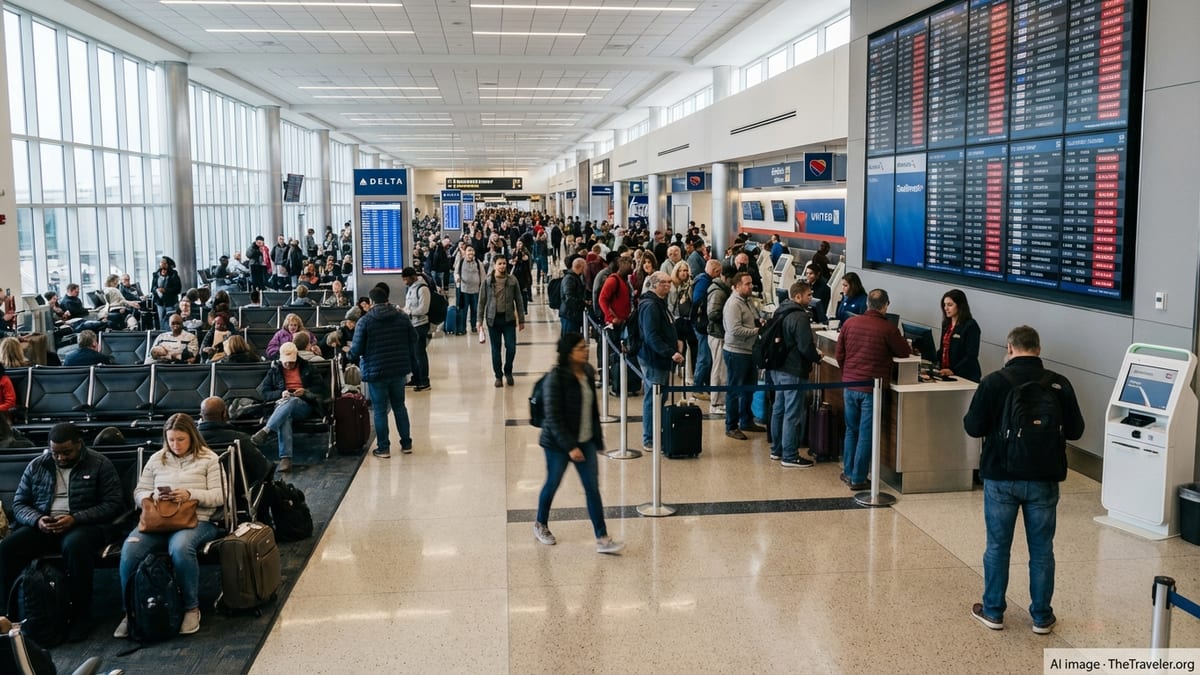
For passengers caught in the middle of the disruption, the result has been long queues at check-in counters and customer service desks, crowded gate areas and uncertainty about when they will reach their destinations. Social media posts and local news images from airports such as Chicago O’Hare and New York’s LaGuardia show busy terminals and departure boards filled with delayed flights.
Publicly available guidance from consumer advocates and transportation agencies suggests that travelers experiencing delays or cancellations should monitor airline apps and airport information screens for real-time updates, rather than relying solely on original booking confirmations. Many carriers allow same-day changes or rebooking through digital channels, which can reduce time spent in line.
Travel experts consistently advise passengers to document the disruption, retain receipts for any additional expenses and review airline policies on meal vouchers, hotel accommodation and rebooking. While US regulations do not mandate compensation for delays in the same way as some other regions, airlines often provide support on a case-by-case basis when the disruption is within their control.
Those with onward connections, international itineraries or time-sensitive events are among the most affected. Missed cruises, tours or business meetings can lead to additional financial losses that are not automatically covered by flight refunds alone, prompting continued interest in comprehensive travel insurance among frequent flyers.
What the Disruption Signals for the Busy Travel Year
The latest wave of delays and cancellations arrives during a period of sustained high demand for air travel in the United States. Industry data and recent media coverage point to robust passenger volumes, with many airports approaching or surpassing pre-pandemic traffic levels on peak days. This growth places additional pressure on infrastructure, staffing and airspace capacity.
Episodes involving thousands of delayed flights in a single day underscore the fragility of tightly optimized schedules. With little slack built into daily operations, any combination of adverse weather, staffing challenges or system issues can quickly overwhelm airport and airline resources.
Aviation analysts have noted that chronic congestion at major hubs such as Chicago, New York and Los Angeles remains a persistent challenge. As airlines continue to rebuild international and domestic networks, maintaining resilience against such large-scale disruption will likely remain a central focus for operational planners, regulators and airport authorities throughout the year.
For travelers, the current events serve as another reminder to build flexibility into plans, allow extra time for connections and stay informed about real-time conditions across departure and arrival airports, particularly when flying through busy hubs that are more susceptible to cascading delays.