

More news on this day
Thousands of air travelers across the United States are facing extended disruptions as major carriers including American, United, Delta, Spirit, Southwest, and others cancel 126 flights and delay more than 3,500 services across key hubs such as Chicago, New York, Orlando, Boston, Newark, and San Francisco.
Get the latest news straight to your inbox!
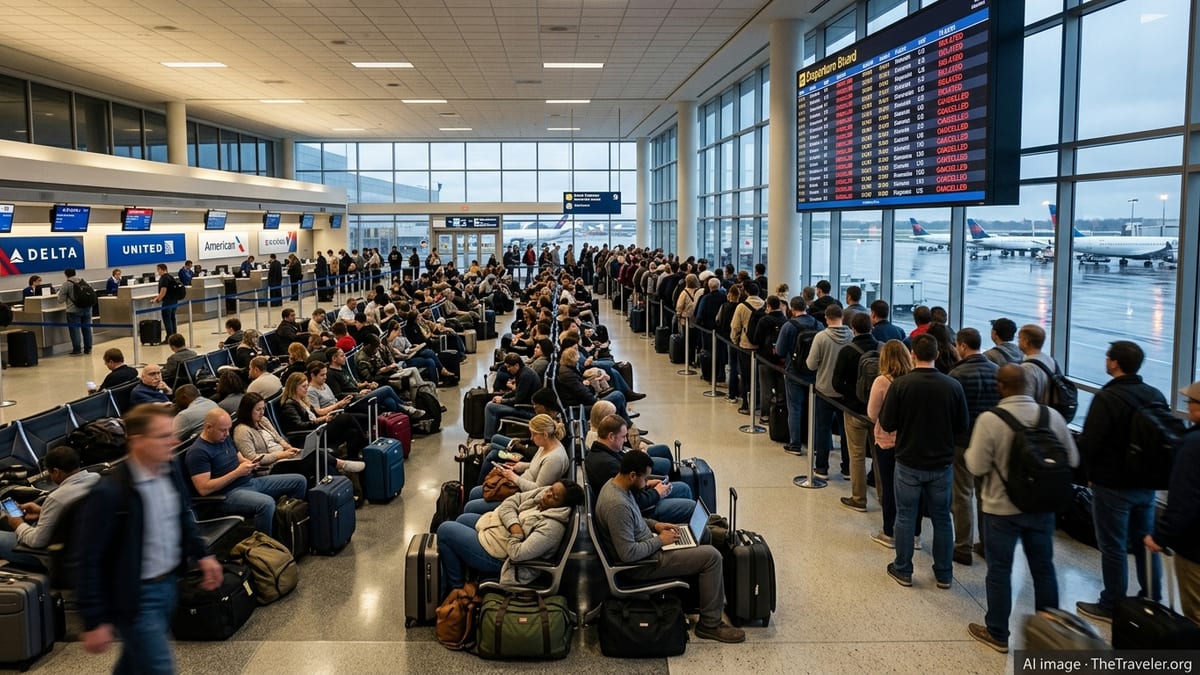
Widespread Disruptions Across Major U.S. Hubs
Publicly available tracking data shows a severe spike in same-day operational problems, with 126 flights canceled and approximately 3,598 delayed nationwide. The impact is concentrated at some of the country’s busiest airports, including Chicago O’Hare, New York area airports, Orlando, Boston Logan, Newark Liberty, and San Francisco International, where ripple effects are compounding throughout the day.
The pattern reflects how vulnerable the U.S. air network remains to sudden pressure on capacity. Even a relatively modest number of outright cancellations can destabilize tightly timed schedules, creating a growing backlog of delayed departures and arrivals as aircraft and crews fall out of place.
Reports indicate that at several of the affected hubs, departures banks are experiencing rolling delays of 30 minutes to well over two hours, as ground operations work through congested departure queues and inbound aircraft arriving off schedule. The result is a patchwork of gate holds, missed connections, and last-minute rebookings that is stranding passengers across the country.
Because many of these hubs function as critical connection points for domestic and international itineraries, the disruption is not limited to origin and destination travelers. Flyers en route between smaller regional airports and long-haul international services are also becoming stuck mid-journey as missed connections cascade through the day’s schedule.
American, United, Delta, Spirit, Southwest And Others Under Strain
The latest data indicates that the disruption spans the U.S. airline landscape, touching full-service and low-cost carriers alike. American Airlines, United Airlines, and Delta Air Lines are all registering elevated levels of delayed operations, particularly at their key hubs and coastal gateways. At the same time, low-cost and ultra-low-cost carriers such as Spirit Airlines and Southwest Airlines are confronting their own operational bottlenecks as aircraft and crews struggle to stay on schedule.
Network carriers are particularly exposed at their primary hubs, where a single problematic arrival or departure bank can stall large portions of the day’s operation. When flights arrive late into a hub like Chicago or Newark, the aircraft and crews assigned to subsequent legs quickly fall behind, leading to rolling delays that spread across the route map.
For point-to-point carriers such as Southwest and Spirit, dense schedules with short turn times and heavy reliance on specific aircraft types heighten the impact of even localized issues. A single aircraft taken out of rotation for maintenance, weather, or air traffic flow restrictions can affect several flights in a single day, especially on popular leisure routes into and out of Orlando and other sun destinations.
Overall, the breadth of carriers affected underscores how intertwined operations are across the U.S. system. Even when individual airlines avoid the brunt of cancellations, shared airspace, common airport infrastructure, and regional weather or congestion patterns mean that few operators are left untouched by a major day of disruption.
Weather, Congestion And Knock-On Effects
Available meteorological and aviation reports point to a combination of adverse weather and airspace congestion as key contributors to the current situation. Periodic storms and low visibility around several major hubs have triggered ground stops and flow-control programs at various points, limiting the rate at which aircraft can land and depart and forcing airlines to revise schedules in real time.
When airports such as Chicago, New York, and Boston reduce arrival and departure rates, even temporarily, the effect is felt far beyond the immediate region. Flights inbound from other parts of the country are slowed or held at origin, while departing aircraft may remain at gates awaiting release times. Each of these tactical responses helps maintain safety margins but also pushes flights outside their scheduled windows.
Air traffic management measures can also lead to last-minute cancellations when delays become too long for an aircraft and crew to complete all planned legs within legal and operational limits. In those cases, airlines may choose to cancel specific segments in order to reset aircraft and crew rotations for later in the day or the following morning, trading short-term inconvenience for longer-term network stability.
These dynamics are particularly visible at coastal hubs and high-frequency corridors, where dense schedules leave little slack. Once disruption takes hold, the accumulated delays can persist for many hours, even after the initial weather or traffic trigger has eased.
Impact On Passengers Across The Country
For travelers, the immediate reality of 126 cancellations and thousands of delays is a day marked by uncertainty, long waits, and rapidly changing plans. Social media posts and traveler reports describe crowded terminals at multiple airports, with passengers lined up at service desks and clustered around departure boards as departure times shift repeatedly.
Missed connections are a particular challenge on days with widespread delays. A late inbound flight into a hub such as Newark or San Francisco can mean travelers lose their onward connection by minutes, with later flights already booked or heavily oversubscribed. In such cases, passengers may be rebooked on itineraries that require overnight stays or extended layovers in intermediate cities.
Families traveling with children and older passengers appear especially affected at major vacation gateways like Orlando, where full flights and limited spare capacity leave few easy alternatives. Some travelers are choosing to switch to ground transportation for regional trips, especially in the busy Northeast corridor, to avoid the risk of additional interruptions.
Travel industry observers note that these disruptions also have knock-on effects for hotels, rideshare services, and local tourism operators. Unexpected overnight stays, missed cruise departures, and altered tour schedules can all stem from a single missed flight connection, magnifying the economic and logistical footprint of a day of cancellations and delays.
What Travelers Can Expect Next
Operational histories from previous disruption events suggest that, while the majority of same-day cancellations have already been registered, delays may continue to reverberate into the evening and early next day. Airlines typically work through backlogs by adjusting aircraft assignments, adding limited extra sections on high-demand routes where possible, and prioritizing flights that reconnect disrupted passengers with their final destinations.
Publicly available airline and airport updates indicate that some carriers are activating flexible travel policies on affected routes, allowing travelers to adjust dates or times without standard change penalties. These measures are often time-limited and apply to tickets touching specific airports or date ranges, reflecting the localized but intense nature of the disruption.
Travel analysts note that recovery times depend heavily on how quickly weather and airspace conditions stabilize at the most constrained hubs. If skies clear and traffic rates normalize, airlines can gradually realign aircraft and crews over several schedule banks. However, if additional storms or operational constraints emerge at key airports such as Chicago, New York, or Boston, the schedule could remain fragile for another cycle.
For now, passengers are being advised through public-facing channels to monitor flight status frequently, arrive early at the airport, and be prepared for potential last-minute changes. With cancellations relatively contained but delays widespread, the overarching message is that most flights are still operating, but far fewer are operating on time.