

More news on this day
Thousands of travelers across the United States are stranded or facing marathon airport waits as major carriers including United, Delta, Southwest and American cancel hundreds of flights and delay thousands more at key hubs from New York and Philadelphia to Chicago, Denver, Atlanta and Los Angeles.
Get the latest news straight to your inbox!
Nationwide Disruptions Hit Major Airline Hubs
The latest wave of disruption has rippled through the busiest nodes of the U.S. air network, snarling operations at New York area airports, Philadelphia, Chicago O’Hare, Denver, Atlanta and Los Angeles. According to flight tracking data, airlines have collectively canceled hundreds of departures while delaying several thousand additional flights, leaving aircraft, crews and passengers out of position and overwhelming terminal facilities.
United Airlines, Delta Air Lines, Southwest Airlines and American Airlines have been among the hardest hit, with their tightly scheduled hub-and-spoke networks amplifying the impact of each cancellation. Smaller and regional carriers feeding into those hubs have also been forced to adjust, compounding the disruption for travelers attempting to connect between cities.
At some airports, lengthy ground stops and flow control measures have forced planes to wait for departure slots, triggering rolling delays that extend deep into the evening. Passengers who do make it into the air are often finding their arrival gates occupied, further slowing the system as aircraft wait on taxiways for space to open at the terminal.
Airport officials say they are working closely with airlines and federal air traffic managers to sequence departures and arrivals more efficiently, but they warn that the sheer volume of delayed flights means residual disruption is likely to persist even after the worst of the operational crunch eases.
Weather, Congestion and Staffing Combine to Choke the System
Industry analysts point to a familiar and volatile mix of triggers behind the latest meltdown: fast changing weather systems crossing multiple regions, congested airspace near major hubs, and lingering staffing constraints in both airline operations centers and federal air traffic control facilities. When storms or low visibility move over tightly scheduled hubs, the margin for error rapidly disappears.
At New York’s airports, as well as at hubs like Chicago and Denver, even brief bands of thunderstorms or low clouds can sharply cut arrival and departure rates. Once those rates are reduced, the backlog builds quickly. Airlines may decide to preemptively cancel flights to keep later operations manageable, but those decisions still translate into thousands of passengers losing their trips or facing significant delays.
Air traffic control staffing, while improved from the worst of the pandemic-era shortages, remains under pressure at key facilities that manage dense corridors along the East Coast and into the Midwest. When controllers are stretched, the Federal Aviation Administration typically slows traffic flows to maintain safety margins, reducing the number of flights that can move through crowded sectors and forcing airlines to hold or reroute aircraft.
Operational complexity at the airlines themselves adds another layer of vulnerability. Tight aircraft rotations, lean crew scheduling and heavy reliance on connecting traffic mean that a disruption in one region can reverberate across the network for days. Once crews time out under duty rules, carriers must scramble to reposition staff, often with limited options during peak travel periods.
Scenes of Frustration and Fatigue in Terminals Nationwide
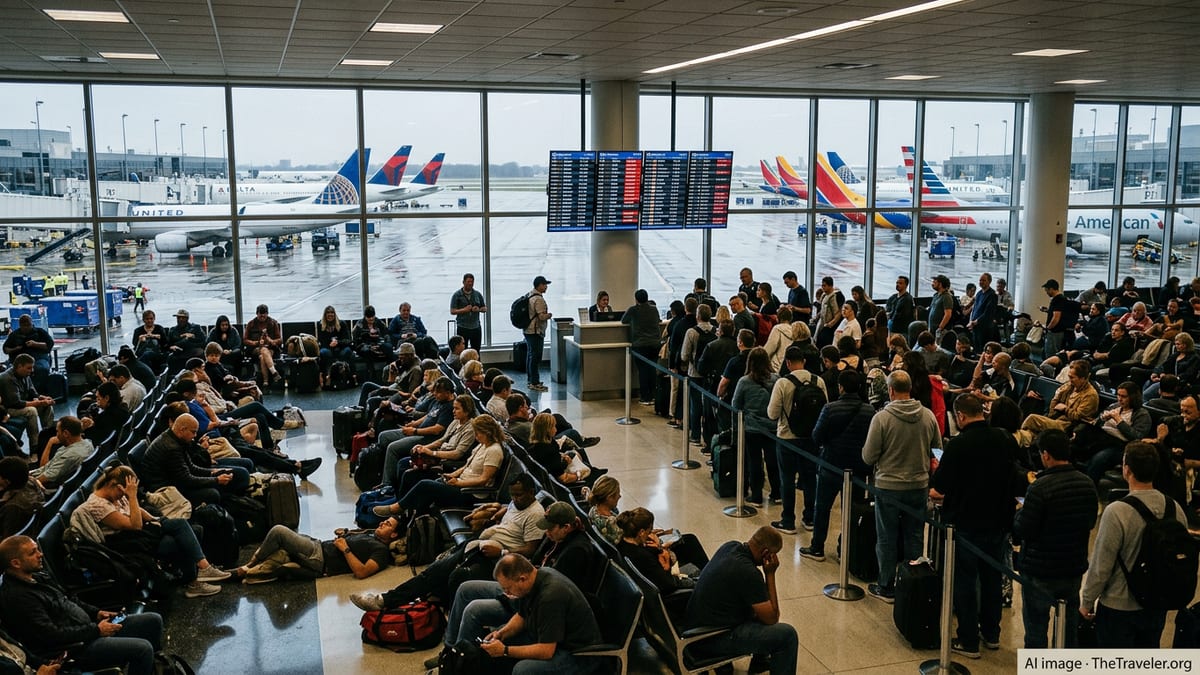
Inside terminals from LaGuardia and Newark to Atlanta and Los Angeles, the impact of the cancellations and rolling delays has been immediate and highly visible. Long lines snake through customer service desks as travelers seek new itineraries, while gate areas fill with passengers refreshing airline apps, searching for scarce power outlets and competing for seats in crowded waiting zones.
In some cities, hotels near the airport have quickly sold out, forcing stranded travelers to spend the night in terminal seating or on the floor. Families traveling with young children and older passengers with limited mobility have been especially affected, as they juggle fatigue and uncertainty along with the logistics of rebooking and accessing medications, food and basic necessities.
Social media has filled with images of departure boards dominated by red “canceled” and “delayed” notices and with accounts of missed weddings, vacations and business meetings. While many passengers acknowledge that safety must come first when weather or operational risks rise, the lack of timely and clear communication from some carriers has become a particular flashpoint for frustration.
Airport customer experience teams and volunteer ambassadors have stepped in where possible, distributing water, toiletries and information, but they acknowledge that their efforts can only partially ease the strain when so many travelers are affected at once.
How Airlines Are Responding and What Passengers Can Expect
Major carriers have activated irregular operations playbooks in an effort to stabilize schedules. Measures include consolidating lightly booked flights, prioritizing the movement of aircraft and crews toward the most heavily disrupted hubs, and offering flexible rebooking policies that allow passengers to shift travel dates or routings without change fees.
In some cases, airlines are proactively trimming upcoming schedules to create more buffer for recovery, sacrificing short term capacity to reduce the risk of cascading disruptions. That can mean fewer available seats on popular routes in the coming days, but analysts say it may lead to more reliable operations once the current wave of cancellations has been absorbed.
Travelers whose flights are canceled are generally being offered a choice between rebooking at no additional cost or receiving a refund, while those facing long delays may receive meal vouchers or hotel accommodations depending on airline policy and local availability. However, as demand for alternate flights spikes, many customers are finding that the next available seat can be days away, particularly for long haul routes or journeys involving multiple connections.
Industry observers note that the latest episode reinforces the importance of robust contingency planning and investment in technology that can help airlines predict and respond to disruption more effectively. Tools that provide real time visibility into aircraft positioning, crew availability and weather patterns are increasingly central to keeping complex networks functioning under stress.
Practical Advice for Travelers Caught in the Chaos
For passengers already en route or scheduled to travel in the coming days, preparation and flexibility remain essential. Travel advisors recommend monitoring flight status early and often through airline apps, which typically update more quickly than airport displays and can offer self service rebooking options that bypass long customer service queues.
Passengers are also urged to build extra time into connections, particularly when routing through weather sensitive hubs like New York, Chicago, Denver and Atlanta. Booking earlier flights in the day can improve the odds of same day recovery if a disruption occurs, as later departures are more vulnerable once delays accumulate across the system.
Where possible, travelers may want to travel with carry on luggage only, reducing the risk of being separated from bags if they are forced to change flights or routings at short notice. Keeping medications, chargers, a change of clothes and basic toiletries in hand luggage can make unexpected overnight stays significantly less stressful.
While the latest surge in cancellations and delays serves as another reminder of the fragility of the U.S. air travel system under strain, aviation experts stress that the vast majority of flights are still operating safely. For now, though, thousands of travelers will continue to navigate packed terminals and unpredictable departure boards as airlines work to bring their networks back on schedule.