

More news on this day
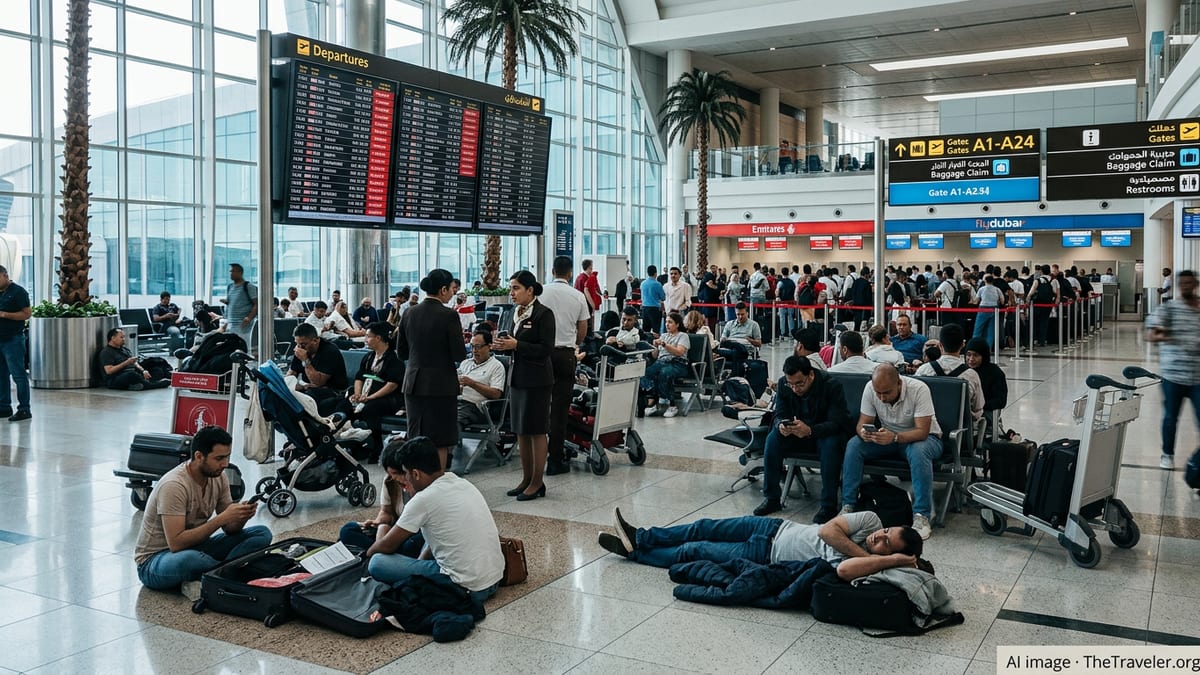
Thousands of travellers remain stranded across the United Arab Emirates as ongoing Middle East airspace disruptions trigger hundreds of delays and cancellations at Dubai, Abu Dhabi and Sharjah airports, with major carriers warning that schedules will remain volatile for days.
Airspace Restrictions Ripple Through Gulf Hubs
The latest wave of disruption follows sweeping airspace controls introduced across parts of the Gulf after a sharp escalation in regional conflict at the end of February. Authorities in the UAE have kept significant restrictions in place around key flight corridors, forcing airlines to thin schedules, reroute services and ground aircraft while military risk assessments continue.
Operational data compiled by regional aviation analysts show that across Dubai International, Abu Dhabi International and Sharjah International alone, at least 312 flights have been delayed and 277 cancelled over recent days as airlines struggle to work around the bottlenecks. Airport officials describe a constantly shifting operating environment in which routes are being approved or withdrawn on short notice, leaving schedules in flux even for services that appear on departure boards.
The impact has been magnified by the role of UAE airports as major global connection points between Europe, Asia, Africa and Oceania. With long-haul corridors severed or diverted, passengers who would normally spend just a couple of hours in transit are instead being forced into extended stopovers, uncertain rebookings or emergency accommodation arrangements as carriers attempt to rethread their networks.
The UAE’s General Civil Aviation Authority has confirmed that airspace is reopening only gradually, under tight coordination with military and security agencies. Officials say safety remains the overriding priority, but acknowledge that the phased return to normal traffic will be measured in days rather than hours.
Major Airlines Slash and Reshuffle Schedules
The disruption has hit the region’s biggest carriers particularly hard. Emirates, flydubai and Etihad Airways, which together handle tens of thousands of connecting passengers each day through Dubai and Abu Dhabi, have cancelled or rescheduled large portions of their timetables in recent days, adding to the tally of 312 delays and 277 cancellations across UAE hubs.
Emirates has suspended many regularly scheduled services while operating a patchwork of ad hoc departures aimed at repositioning aircraft and repatriating stranded travellers. Etihad Airways has followed a similar pattern out of Abu Dhabi, running limited outbound flights on specific long-haul routes while warning that further changes remain likely with little notice.
Low-cost carrier flydubai, a key operator for regional and secondary destinations, has cancelled multiple rotations and reduced frequencies, affecting passengers across the Middle East, North Africa and the Indian subcontinent. Indian budget airline IndiGo, which relies heavily on Gulf routes, continues to adjust its schedule from Dubai, Abu Dhabi and Sharjah, operating additional special services on some days while dropping others altogether.
Qatar Airways, which has faced parallel airspace constraints from its Doha hub, has also trimmed operations involving the UAE and neighbouring states, compounding the difficulties for travellers trying to move between Gulf cities or secure onward connections. Industry trackers say other regional and international airlines, including Air Arabia, Saudia and several European and Asian carriers, have joined the cutbacks as they weigh security advice and insurance requirements.
Travellers Face Long Queues, Uncertain Itineraries
Inside the terminals at Dubai, Abu Dhabi and Sharjah, the human impact of the disruption has been on stark display. Passengers report long queues at transfer desks and airline offices as they seek rebooking options, refunds or basic information about when they might be able to leave. Many have already spent days in airport hotels or makeshift accommodation while waiting for a confirmed seat.
Families returning from holidays, migrant workers on tight visa timelines and business travellers with critical meetings scheduled have all been caught up in the chaos. Some passengers have described repeatedly receiving boarding passes for flights that were later cancelled, or being rebooked onto itineraries involving multiple extra stops via Saudi Arabia, Egypt or Turkey as airlines attempt to circumnavigate restricted airspace.
Travel advisers note that capacity on alternative routes is already stretched. With other Gulf and regional airports also managing heavy disruption, options for same-week departures are limited on many long-haul corridors. Fares on remaining seats have spiked on some routes, though several airlines have issued fee waivers and fare caps for affected customers in an attempt to soften the blow.
Airport operators in the UAE have urged passengers not to travel to terminals without a confirmed departure time, stressing that walk-in rebooking is unlikely to secure faster travel than working directly with airlines online or via call centres. Ground staff say that limiting crowding is essential both for safety and to ensure those with imminent departures can reach their gates.
Gradual Reopening Offers Hope, but No Quick Fix
Despite the scale of ongoing disruption, there are early signs that operations are starting to stabilise. The UAE’s aviation authorities have authorised a controlled increase in movements through key corridors, and airlines report that they are now able to plan a slightly larger number of flights each day than at the height of the shutdown.
Emirates and Etihad have both begun restoring services on selected trunk routes, particularly to major European and Asian capitals, while maintaining temporary reductions on others. IndiGo and other Indian carriers have announced phased resumptions of flights between UAE airports and key Indian cities, often using additional aircraft and crew to move stranded passengers home.
Nevertheless, industry analysts caution that the backlog created by days of cancellations will take significant time to clear. Even as more aircraft return to service, crews and planes remain out of position around the globe after days of diversions and unscheduled overnight stops. Many passengers currently stranded in the UAE may face waits of several more days before they can secure confirmed seats, especially during peak travel windows.
Airlines are warning customers to expect rolling schedule updates as military activity and airspace advisories evolve. Pilots are still navigating longer routings around no-fly zones, which reduces daily utilisation of aircraft and limits the number of flights that can be operated safely within crew duty limits.
Advice for Passengers Caught in the Disruption
Travel experts say the most important step for affected passengers is to maintain close contact with their airline and avoid making assumptions based on historical schedules. With flight times and routings changing rapidly, even services that appear confirmed can still be altered or cancelled if security conditions shift.
Airlines are urging customers to use official apps and online portals rather than relying on third-party booking sites or general airport information screens. Many carriers have introduced temporary change-fee waivers and flexible rebooking policies, allowing travellers to move their journeys to later dates or different routings without penalty, subject to seat availability.
Passengers with flexible plans are being encouraged to accept rebookings several days into the future or routings via alternative hubs in Saudi Arabia, Egypt or Europe, which can free up scarce near-term capacity for those with urgent medical, family or work commitments. Those whose visas or residence permits are expiring are advised to contact local immigration authorities or embassies, as several governments have signalled a willingness to show flexibility for travellers delayed by the airspace crisis.
For now, the message from both regulators and airlines in the UAE is one of cautious optimism mixed with realism. While the reopening of additional airspace and the gradual restoration of schedules should eventually bring relief, the scale of the backlog and the fragility of the regional security situation mean that thousands of travellers will likely remain stranded in Dubai, Abu Dhabi and Sharjah in the days ahead.