

More news on this day
Thousands of holidaymakers expecting sun-drenched Gulf itineraries have instead found themselves trapped aboard cruise ships in the United Arab Emirates, as a fast-escalating conflict involving Iran, the United States and Israel shuts down airspace, chokes key sea lanes and freezes much of the Arabian Gulf’s once-booming cruise season.
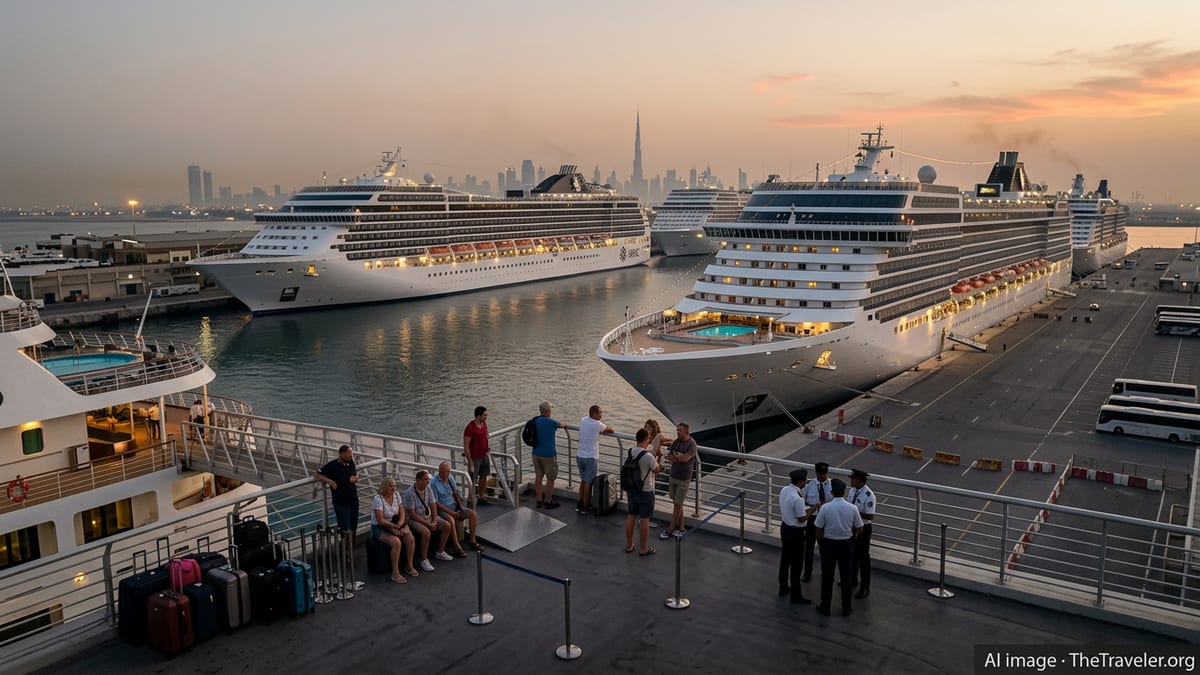
Cruise Holidays Turn Into Floating Waiting Rooms
What began as routine seven-night sailings out of Dubai and Abu Dhabi has, in a matter of days, turned into an unprecedented logistical and emotional ordeal for passengers and crew. With the Strait of Hormuz classified as a high-risk zone and civilian airspace across swathes of the Middle East either closed or heavily restricted, multiple cruise lines have been ordered to remain in port with guests kept on board.
Ships operated by MSC Cruises, Celestyal, Aroya Cruises and European tour brands remain docked in Dubai and Abu Dhabi, while others are stranded in Doha and Bahrain, effectively functioning as stationary hotels. Security restrictions imposed by local authorities mean passengers on some vessels are barred from disembarking except in tightly controlled, escorted movements, even when ships are tied up just a few hundred meters from glittering city skylines.
The Joint Maritime Information Centre and regional military authorities have raised their risk assessments to the highest level, warning that an attack on commercial shipping in the Gulf is now considered almost certain. Cruise companies say they are complying with official guidance, describing the port stays as a safety precaution rather than a detention, but for many guests the distinction feels academic as days at sea turn into days at anchor.
Inside the ships, restaurants, entertainment venues and pools remain open, and crew have been instructed to maintain as normal a program as possible. Yet conversations in bars and atriums now revolve less around shore excursions and more around embassy hotlines, insurance clauses and how, or when, anyone will be able to go home.
Airspace Closures Leave Tourists With No Easy Way Out
The immediate trigger for the disruption was a barrage of Iranian missile and drone strikes launched after joint United States and Israeli attacks on targets inside Iran at the end of February. In response, authorities in the United Arab Emirates, Qatar, Bahrain, Kuwait and several neighboring states moved quickly to shut or severely curtail civilian airspace, while maritime agencies warned vessels to avoid large sections of the Strait of Hormuz.
The resulting squeeze has reverberated through every part of the region’s tightly choreographed “fly-cruise” model, in which travelers arrive by air to embark on weeklong sailings around the Gulf. Aviation analytics firms report thousands of flight cancellations into and out of the Middle East since March 2, leaving cruise lines scrambling to secure scarce seats on the limited evacuation flights now operating from Dubai and Abu Dhabi.
For many of those on board, the problem is not just getting off the ship but finding a way out of the country once they do. Some passengers who managed to disembark and reach airports in Dubai and Abu Dhabi found themselves waiting for more than ten hours before being turned back when flights were cancelled at short notice or their transit connections further afield collapsed.
Diplomats are now working with cruise lines to prioritize the most vulnerable travelers for repatriation: the elderly, those with urgent medical needs and families with young children. But embassies acknowledge that with air corridors constrained and security risks elevated, the process is likely to be slow and uneven, leaving many tourists in limbo for days, and potentially weeks.
Cruise Lines Cancel Gulf Seasons and Pivot to Repatriation
Facing a rapidly deteriorating security picture and no clear timeline for the reopening of sea lanes, several major operators have effectively written off the remainder of their Gulf seasons. MSC Cruises has cancelled its winter program from Dubai for the flagship MSC Euribia and is now focused on turning what was supposed to be a turnaround voyage into a complex global repatriation effort.
In statements to guests, the company has said it is working with airlines and charter providers to organize special flights from Dubai, Abu Dhabi and Muscat, while also offering full refunds or future cruise credits for affected sailings. Similar measures have been announced by Celestyal, which confirmed that its Arabian Gulf deployments would end early, and by regional newcomer Aroya Cruises, whose Aroya Manara is currently laid up in Dubai with its published itineraries suspended through at least May.
Behind the scenes, cruise executives are grappling with a tangle of operational and financial challenges, from securing berths for ships that can no longer follow their scheduled routes to negotiating skyrocketing war risk insurance premiums. Each additional day in port carries costs for fuel, provisions and staffing, even as revenue dries up with the cancellation of shore excursions, casino operations in certain jurisdictions and future bookings.
Industry analysts say the sudden shutdown will prompt a strategic rethink of the Gulf’s role in winter cruise calendars. The region has been one of the sector’s fastest-growing markets over the past decade, catering to European sun-seekers and rapidly expanding source markets in India and East Asia. Now, operators will have to weigh that potential against heightened geopolitical volatility and the risk of prolonged corridor closures in both the Strait of Hormuz and the Red Sea.
Passengers Juggle Safety Concerns, Cabin Fever and Uncertain Rights
For those watching events unfold from their balcony cabins, the abstract calculus of risk management feels intensely personal. Social media posts from ships in Dubai and Abu Dhabi describe a surreal mix of poolside trivia contests and emergency briefings, as travelers try to balance reassurances from cruise directors with grim news footage from nearby ports and oil facilities.
Some passengers say they feel reasonably safe on board, noting the visible presence of security personnel at terminals and the relative calm in downtown districts beyond the port fences. Others speak of sleepless nights spent tracking news on their phones, worried about the possibility of missile or drone strikes and frustrated by what they describe as limited or inconsistent communication from their cruise lines.
The situation has also raised questions about guests’ legal rights when itineraries are canceled for reasons beyond a company’s control. Consumer advocates point out that cruise contracts typically contain broad force majeure clauses covering war and civil unrest, which can limit liability to refunds or future credits rather than additional compensation for distress or unexpected expenses. Travel insurers vary widely in how they treat acts of war, leaving some passengers facing the prospect of claims being denied.
On board, however, many travelers say their most pressing concern is simply the lack of reliable information. With port authorities, cruise lines, airlines and foreign ministries all issuing overlapping advisories that change by the hour, even seasoned globetrotters are finding it difficult to make informed decisions about whether to stay put, attempt to reroute via alternative airports, or wait for a government-organized evacuation.
Blow to Gulf Tourism and the Region’s Cruise Ambitions
The crisis comes at a particularly painful moment for Gulf tourism boards, which have poured billions into new cruise terminals, visitor attractions and destination marketing over the past decade. Dubai, Abu Dhabi and Doha have been vying to position themselves as marquee winter cruise hubs, offering easy air access, modern infrastructure and itineraries that combine desert landscapes with futuristic skylines and cultural excursions.
Local businesses that depend on cruise calls, from tour operators and guides to restaurants and souk vendors, are now facing an abrupt halt in visitor flows at the height of the season. Many had already been contending with disruptions to Red Sea traffic due to attacks on shipping, which forced some repositioning voyages to divert around Africa even before the latest escalation in the Gulf.
In the longer term, regional officials insist that the disruption is temporary and that cruise tourism will rebound once security conditions stabilize. Yet the images now circulating worldwide of ships idling at Dubai’s Port Rashid and Abu Dhabi’s cruise terminal, filled with anxious tourists unable to disembark or fly home, threaten to undercut years of carefully cultivated branding that has cast the Gulf as a safe and seamless gateway to the wider Middle East.
For the thousands of travelers currently stranded, that reputational debate is secondary to a more basic wish: to step off their floating resorts, clear immigration and finally board a flight out. Until air corridors reopen and insurers lower their threat assessments, the paradise they signed up for remains tantalizingly close, but just out of reach.