

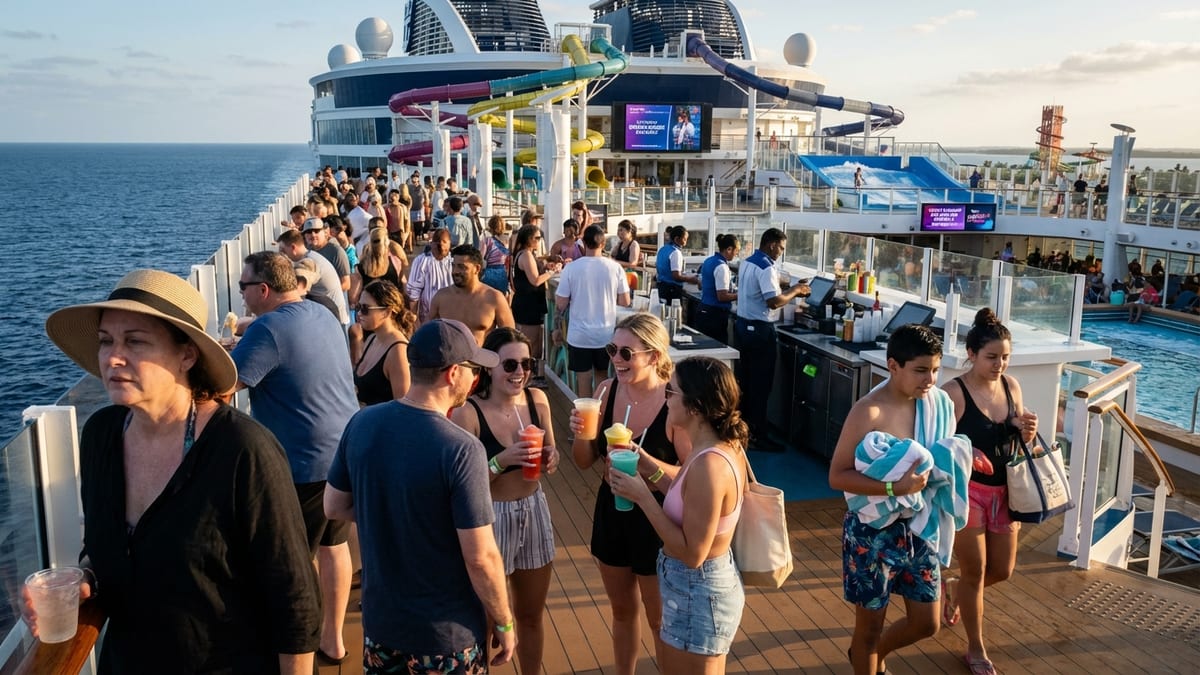
I sailed Utopia of the Seas on a short Bahamas run out of Port Canaveral, a three-night itinerary that has quickly become one of Royal Caribbean’s high-intensity, high-revenue playgrounds. I went in fully aware that this was not going to be a quiet, contemplative ocean crossing, but I was still surprised by how compressed, crowded and deliberately high-energy the whole experience felt in reality.
There were moments when the ship absolutely delivered: smart design, fun shows, and a genuinely impressive day at Perfect Day at CocoCay. There were also times when I felt nickel-and-dimed, boxed in by crowds and schedules, and more stressed than I like to be on vacation. Here is how it actually felt, day by day and space by space.
Booking, Pricing Shock and Pre-Cruise Expectations
I booked Utopia of the Seas specifically because it was new, because it fit into a long weekend, and because I was curious whether these big, short itineraries were worth the hype. The first reality check came before I ever got near the port: the base fare was only the start. Once I added taxes, port fees and a modest cabin upgrade, the price crept up quickly for such a short sailing. Then came the add-ons. The Royal Caribbean Cruise Planner pushed drink packages, dining packages and CocoCay extras at every turn, often at prices that felt more like a Vegas weekend than a quick Bahamas hop.
I went for the standard drink package and skipped the Unlimited Dining Package because the math did not work for a three-night cruise. Even so, between the drink package, Wi-Fi and a CocoCay water park pass, my total spend before boarding was already approaching what I would normally pay for a full week on a more modest ship. I had gone in expecting some upsell pressure, but the intensity and pricing escalations definitely changed my mindset. I started the trip thinking, “This had better feel special,” which is not always the healthiest way to board a ship.
On the plus side, pre-cruise check-in through the Royal Caribbean app was efficient. Uploading documents, doing the safety briefing elements and selecting an arrival window took minutes. I appreciated how clear the app was about terminal times in Port Canaveral and the staggered arrival system did make me hopeful that embarkation would not be a free-for-all. I wish that same clean logic and transparency carried through to everything else during the trip. It did not.
Embarkation at Port Canaveral and First Impressions
Embarkation day in Port Canaveral was well organized on paper, but the human reality was that thousands of people all seemed to show up at once, especially those on the shorter three-night itineraries. There was a visible distinction between the suite and priority guests and everyone else, and while that is standard practice, on a ship this size it felt particularly sharp. My check-in time was late morning. Security moved quickly enough, but there were definite bottlenecks at the check-in desks and in the gangway queue.
Once I stepped on board, my first impression was something between awe and sensory overload. The Royal Promenade was buzzing almost immediately, with embarkation-day sales tables, bar music and families dragging carry-ons toward elevators. The ship is enormous but carefully compartmentalized, with neighborhoods like Central Park and the Boardwalk that are meant to spread people out. In practice, for most of that first afternoon, the central indoor areas felt like a very busy shopping mall on a holiday weekend. I had to remind myself that every cruise starts like this, with people exploring and finding their bearings. Still, if you are sensitive to crowds, this is not the calm, champagne-sipping boarding that some marketing imagery suggests.
I did appreciate how early cabins were made available. Mine opened around 1:00 p.m., which gave me a place to drop a day bag before heading to the buffet. The safety drill was done largely through the app, with just a quick in-person muster check-in. That part was painless and a huge improvement over the old mass-assembly drills. It is one of the few areas where technology genuinely simplified rather than complicated the experience.
Cabin Comfort and Noise Trade-offs
My stateroom was a standard balcony cabin, one of the ocean-facing options. The design clearly benefits from the latest iteration of Oasis-class thinking: better storage, lots of outlets and USB ports, a decent-sized TV and a bathroom that, while still compact, felt efficiently laid out. The décor is clean and contemporary without being flashy. I never felt cramped when I was alone in the room, and even with a second person I think it would have been workable for a short itinerary like this.
Where the cabin disappointed me was noise. Part of that is the nature of a high-energy, three-night party cruise, but I could hear hallway traffic well into the early morning, including groups returning from late-night venues and kids running up and down the corridor. Balcony time was a mixed bag. When the ship was under way and I was facing the open ocean, it was wonderfully peaceful. When we were docked, especially in Nassau, music from nearby public decks sometimes bled into my space. It was not unbearable, but it was not the cocoon I had hoped for, and it made me appreciate that on a ship like this, cabin location and deck placement really matter.
My cabin steward was a highlight. He introduced himself on day one, learned my name and actually remembered it, and somehow managed to refresh the room twice a day without ever feeling intrusive. I did not have any major issues that required intervention, but the small touches were there: extra towels without asking, ice in the bucket before dinner, and the occasional towel animal. In a trip that sometimes felt like a money machine, those human interactions reminded me that cruise hospitality, at its best, is still very much alive.
Food, Drink and the Reality of “Unlimited” Options
Food options on Utopia of the Seas are abundant, but “abundant” does not always mean “good” or “easy to access.” On embarkation day, I made the rookie mistake of going straight to the Windjammer buffet during peak hours. It was wall-to-wall people circling the stations, hunting for tables and juggling plates. I eventually found a spot and the food itself was fine: typical cruise buffet fare, nothing inedible, nothing especially memorable. On subsequent days, I gravitated to smaller venues like the Solarium Bistro and Park Café, where it was easier to find a seat and the atmosphere was calmer.
The Main Dining Room on Utopia is a big production. I opted for set-time dining and was generally seated within a few minutes of arrival. Service ranged from efficient and warm to slightly rushed, depending on the night. Menus were at least varied enough that I did not feel like I was repeating the same meal patterns over three nights, though there were some misses. One entrée arrived lukewarm, and a dessert that sounded decadent on the menu tasted a bit factory-made. It was not a disaster, but it also did not feel like a strong culinary highlight to justify the dressier setting.
I tried one specialty venue during my sailing: a steakhouse dinner that I booked à la carte before boarding. The difference in quality from the Main Dining Room was noticeable, especially in the meat and wine pairings, but the upcharge stung given the already high vacation bill. It felt more like something I would do once to experience it than a must-repeat, especially on a short itinerary where each evening is precious. Between the cover charge and gratuities, it quickly becomes a splurge on par with a solid land-based restaurant back home.
The drink package was convenient but not flawless. On the positive side, I never had trouble using it at any bar and bartenders did not make me feel like I was being a nuisance for ordering within the included range. On the negative side, certain frozen and signature cocktails increasingly felt standardized and overly sweet, more like pre-mixed slush than crafted drinks. I also had a couple of moments at busy pool bars where the wait for service was long enough that I questioned the value of the package. For someone who drinks regularly throughout the day it might still make financial sense, but I would be honest: you are paying a premium for convenience and predictability rather than superior quality.
Onboard Atmosphere, Activities and Crowd Management
Utopia of the Seas is designed as a floating entertainment complex, and the daily schedule reflects that. From early morning fitness classes to late-night silent discos, trivia sessions, ice shows, water slides, dry slides and laser tag, there is always something happening. I loved having that variety. I never felt bored. What I did feel, frequently, was that everything required planning and sometimes lining up. The most popular attractions, such as the Ultimate Abyss slide, FlowRider surf simulators and certain shows, drew long queues or required reservations that disappeared quickly.
I had mixed experiences with show reservations. Booking through the app mostly worked, but some time slots for headliner performances were fully booked earlier than I expected, especially on the sea day. When I did get into the main theater and the ice show venue, the productions were impressive. The stage tech and choreography are meaningful steps up from older ships. Still, the need to guard your evening with one eye on the clock and another on the app took away some of the spontaneity that I enjoy on vacation.
Pool deck life on Utopia is exactly what you would expect from a mega-ship on a short Bahamas cruise: loud music, a constant DJ presence, plenty of drinking, and very few truly quiet corners during peak hours. Chair hogging was alive and well, despite posted rules. If I came up after breakfast on the sea day, the shaded loungers were essentially gone. The adults-only Solarium helped a bit with crowd control and noise, and it became my go-to during the day. Even there, though, it was rarely truly serene. If your idea of a cruise is reading quietly by the pool with only the sound of water beneath you, this ship and itinerary will likely frustrate you.
On the other hand, families and groups looked like they were genuinely having a great time. The energy was high, kids had endless options and the vibe was closer to a resort weekend than a traditional seagoing voyage. That is neither inherently good nor bad, but it is important to understand. Utopia of the Seas, on these short runs, is engineered to be a social, high-octane party and activity platform. If you go in expecting that, the crowds and constant noise feel like part of the deal rather than a flaw. If you are hoping for balance between stimulation and genuine downtime, you will need to work harder to carve that out.
Perfect Day at CocoCay and Nassau: Port Reality vs Hype
The marquee port on my itinerary was Perfect Day at CocoCay, Royal Caribbean’s private island in the Bahamas. We arrived early in the morning and had a full day there. I had pre-purchased a water park pass, which is very expensive for what is essentially a single-day slide and pool experience. The slides themselves were fun and well run, but wait times grew longer as the day progressed, especially for the biggest attractions. The included food on the island was similar in quality to onboard buffet options, and I appreciated that drinks from the onboard package carried over ashore, which made the bar situation simpler than I expected.
Outside the water park, CocoCay is beautifully landscaped and meticulously controlled. The beaches are clean, the lagoon is inviting and there are plenty of loungers if you move away from the busiest central areas. What took some of the shine off for me was the very curated, almost theme-park-like feeling. There is no sense of local life or culture, no interesting streets to wander. It is pure leisure consumption: bars, pools, slides and Instagram-friendly backdrops. That is exactly what many people want from a day stop and, to be fair, Royal Caribbean delivers that product very well. Personally, after a few hours, I wanted something a bit more textured and real than I could find there.
Nassau was the second port on my route and it remains a mixed experience. The day’s schedule was typical for this itinerary, with an arrival mid-morning and departure in the late afternoon. The revitalized port area is more pleasant than in years past, with improved infrastructure and some safer-feeling walking areas. However, the immediate surroundings are still dominated by souvenir shops and tour hawkers. I walked a bit, did a short independent excursion to get away from the port cluster, and then returned to the quieter areas of the ship in the afternoon while many passengers stayed ashore.
If you have the flexibility and curiosity to organize your own Nassau day, you can still find more authentic experiences, but on a compressed itinerary like this, it is easy to default to the path of least resistance and either stick near the terminal or stay on the ship. That is ultimately what I felt: these ports, on this schedule, are secondary to the shipboard experience. Utopia of the Seas is marketed as the destination, and the ports are there to justify the motion rather than to be meaningful cultural stops.
Service, Technology and Operational Quirks
Service across Utopia of the Seas was generally strong and sometimes excellent, particularly at the cabin level and in some of the smaller bars and cafés. Staff were dealing with very high passenger volumes and, on the whole, maintained patience and friendliness. I noticed some fatigue and rushed interactions in the busiest venues, which is understandable. This is not the intimate service model you might find on a smaller, more premium line, but it also is not indifferent mass processing. It lands somewhere in between, with flashes of warmth and personal attention when the pace allowed.
The Royal Caribbean app is the nervous system of the experience. It handled check-in, bookings, daily schedules and onboard charges. When it worked, it was incredibly useful. I liked being able to see my account balance in real time and to adjust plans on the fly. When it glitched, which did happen a couple of times, it became a source of frustration. At one point, my show reservations disappeared and reappeared an hour later. On another occasion, dining reservations did not sync between my app and the restaurant’s list, requiring a bit of back-and-forth at the host stand. None of these issues ruined my cruise, but they ate up mental bandwidth.
Operationally, the ship runs like a city. Elevators are a good example. During peak times, especially just before and after shows or when people were moving en masse to and from ports, waits were long and cabins crammed. Stairs became the faster, if more tiring, option, and I found myself walking up and down more flights than I had planned. If mobility is an issue for you, factor this into your expectations. The ship is accessible, but the reality of thousands of people using the same vertical arteries at the same time is hard to escape.
One area that did surprise me positively was embarkation and disembarkation timing at ports. Despite the ship’s enormous capacity, getting off at CocoCay and Nassau was faster than I expected, with gangway operations running efficiently. Returning to the ship in the late afternoon was also smoother than I have experienced on some smaller ships. Credit where it is due: Royal Caribbean has clearly invested a lot in these logistics and, at least on my sailing, it showed.
The Takeaway
By the time I wheeled my bag down the gangway back in Port Canaveral, I felt like I had packed a week’s worth of stimulation into three nights. Utopia of the Seas is impressive, no question. The engineering, the design, the entertainment infrastructure and the sheer ambition of the ship are all remarkable. I had genuinely fun moments: standing at the rail at night with the wind in my face, laughing at a game show in the theater, feeling the rush of a water slide at CocoCay, and savoring a perfectly cooked steak in the specialty restaurant. Those highs were real.
At the same time, I left with a clear sense that this kind of cruise is not ideal for every traveler or every mood. The constant upsell, the crowded public areas and the need to micromanage reservations and time slots chipped away at my sense of relaxation. Food in included venues was acceptable but rarely impressive. The ports felt more like an extension of the brand ecosystem than destinations in their own right. If I did it again, I would either choose a longer itinerary on Utopia to give myself more breathing room or opt for a smaller, less intense ship for the same number of nights.
So, who is Utopia of the Seas worth it for, and under what conditions? If you are a family or group of friends who want a high-energy, resort-style escape where the ship itself is the main attraction, and you are comfortable budgeting extra for packages and specialty experiences, Utopia can deliver an exciting, memorable long weekend. If you love activities, shows, slides and a lively pool scene, and you view crowds as part of the fun rather than a downside, you will likely leave happy. On the other hand, if you value quiet sea days, intimate service, culinary depth and a stronger sense of place in ports, this particular ship and itinerary will probably feel like the wrong tool for the job.
For me personally, I am glad I went. It answered my curiosity about what these new mega-ships are really like on short Caribbean runs. I do not regret the experience, but I would not repeat it in exactly the same way. Next time I book Utopia of the Seas, it will be with a clearer understanding of what it does best: deliver a concentrated dose of modern, branded fun to as many people as possible in as little time as possible. If I match my expectations to that reality, I suspect I will enjoy it more. And if I want a quieter, more reflective cruise, I will look elsewhere.
FAQ
Q1. Is Utopia of the Seas too crowded on a three- or four-night cruise?
In my experience, yes, it often felt crowded, especially in the Royal Promenade, pool decks and during prime-time activities. The ship is designed to handle large numbers of people, but short itineraries attract high-energy groups and families, so you should expect lines and busy venues rather than a calm atmosphere.
Q2. How was the food quality in the included venues?
I found the food in the buffet and Main Dining Room to be generally acceptable but not remarkable. There were a few standout dishes, but also some misses, such as lukewarm entrées and desserts that tasted mass-produced. Specialty dining offered a noticeable upgrade, but at a cost that adds up quickly on a short cruise.
Q3. Is the drink package worth buying on Utopia of the Seas?
For me, the drink package was convenient but only marginally worth the price. If you drink several alcoholic beverages a day, including coffees and sodas, it can make sense financially. However, some cocktails felt overly sweet and standardized, and at busy bars the wait times sometimes undercut the value of “unlimited” access.
Q4. How does Perfect Day at CocoCay compare to other cruise line private islands?
Perfect Day at CocoCay is extremely polished and activity-focused, with big water slides, pools and well-maintained beaches. It is fantastic if you want a resort-style playground and do not care about local culture. If you prefer quieter, more natural-feeling islands or a sense of Bahamian life, it may feel too curated and commercial.
Q5. What cabin type would you choose next time on Utopia of the Seas?
I stayed in a standard ocean-view balcony, which was comfortable but a bit noisy at times. Next time, I would pay closer attention to deck location and what is above and below the cabin. If budget allowed, I might consider a cabin in a quieter section or a neighborhood that feels slightly more insulated from late-night traffic.
Q6. Are the shows and onboard entertainment actually worth planning around?
Yes, the major shows are high quality and one of the real strengths of the ship. The main theater and ice productions are produced to a very high standard. I would absolutely recommend making reservations in advance through the app and building your evenings around the shows that appeal most to you.
Q7. How family-friendly is Utopia of the Seas?
Utopia is extremely family-friendly. There are kids’ clubs, water slides, pools and family activities from morning to late evening. Children and teens seemed to have a lot to do and looked happy. Just be aware that the family focus and short itineraries contribute to the overall noise and energy level on board.
Q8. Did you feel nickel-and-dimed during the cruise?
To a degree, yes. Many of the most appealing extras, from specialty dining to certain CocoCay experiences, come with additional fees. While you can stick to included options, the constant marketing of upgrades and packages made it hard to ignore the sense that the cruise was structured around maximizing onboard spending.
Q9. How well did the Royal Caribbean app work on Utopia of the Seas?
The app was essential and mostly effective. It handled check-in, reservations, the daily schedule and account tracking well. However, I did encounter occasional glitches, such as disappearing reservations and delays in updating. Those issues were annoying but not trip-ending, and staff were generally able to help when something did not match up.
Q10. Would you recommend Utopia of the Seas for someone seeking a relaxing, quiet cruise?
Not on the short Bahamas itineraries I experienced. While there are quieter areas like the Solarium and some tucked-away lounges, the overall vibe is lively and busy. If relaxation and quiet are your top priorities, I would suggest a smaller or less entertainment-driven ship, or at least a longer itinerary where the pace might feel less compressed.