

More news on this day
Thrust Flight, a fast-growing professional flight school based at Addison Airport near Dallas, is adding cutting-edge aerobatic and upset recovery training to its programs, giving Texas aviation students a high-flying edge as demand for skilled, safety-focused pilots continues to climb.
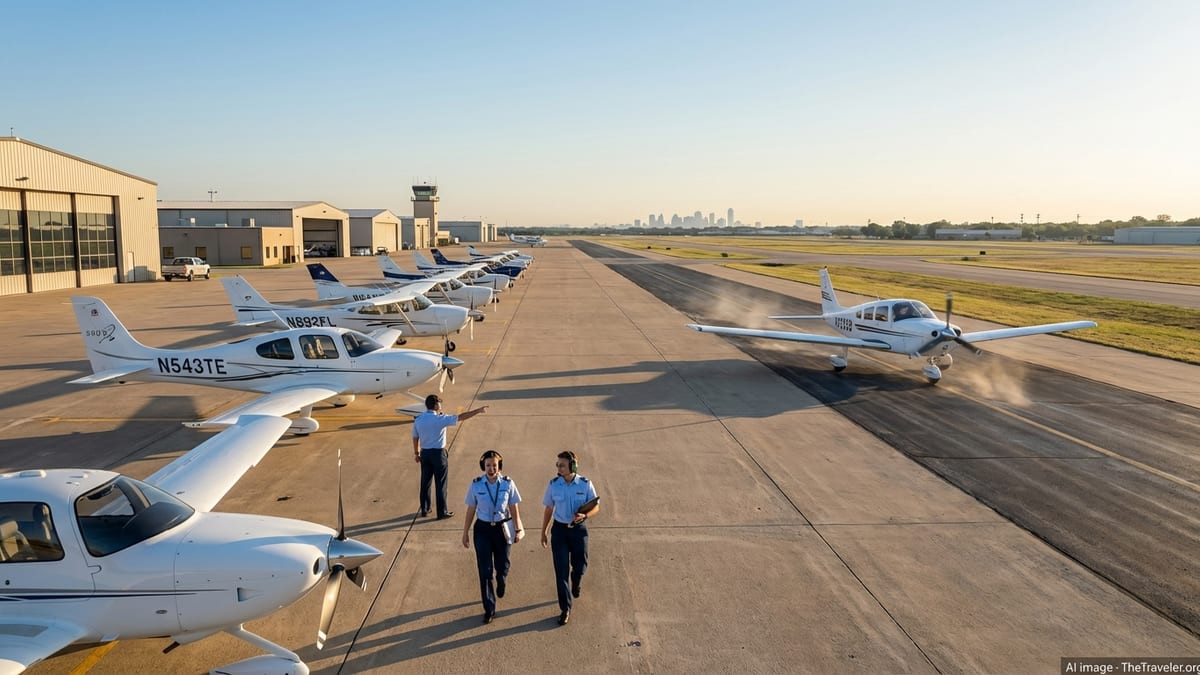
A New Chapter for Pilot Training in the Texas Skies
The expansion into aerobatic and upset recovery training marks a notable evolution for Thrust Flight, which has built its reputation around accelerated pathways from zero flight time to airline-ready pilot. Headquartered at Addison Airport, with satellite campuses in Denison and Conroe and a newer location in Mesa, Arizona, the academy is positioning advanced maneuver and energy-management skills as a core part of its offering rather than a niche add-on for thrill-seekers.
Industry observers say the move aligns with a broader shift in professional pilot training, where airlines increasingly value real-world handling skills and scenario-based instruction over minimum-hour checkride preparation. For students training in Texas, that means access to structured aerobatic and upset prevention and recovery content that is integrated into a career-focused curriculum, rather than pursued separately at specialized aerobatic schools.
Thrust Flight leaders frame the initiative as a response to both student demand and safety trends. With Texas already one of the busiest general aviation states in the country, the school sees an opportunity to differentiate itself in a competitive flight-training market while also addressing long-standing concerns about loss-of-control events, which remain a leading factor in serious aviation accidents.
While specific syllabus details and equipment configurations are still rolling out across locations, the strategy is clear: take the rigor of airline-oriented training and extend it into the kinds of high-attitude, high-stress situations that conventional private and commercial curricula often treat only in theory.
Why Aerobatics and Upset Recovery Matter for Future Airline Pilots
Aerobatic and upset recovery training has long been associated with airshow performers and competitive aerobatic pilots, but regulators and safety investigators have increasingly highlighted its value for mainstream aviation. Upset Prevention and Recovery Training, or UPRT, focuses on teaching pilots to recognize and safely recover from uncommanded or extreme attitudes, stalls, spins, and other scenarios that can quickly escalate if mishandled.
For students on a professional track, that training goes beyond spectacle. It is about building calm, disciplined responses under pressure, deepening understanding of aerodynamics at the edges of the flight envelope, and learning to manage energy, G loads, and spatial orientation. In a modern airline context characterized by powerful automation and complex procedures, instructors say those hand-flying skills can form a critical backstop when equipment fails or conditions deteriorate suddenly.
Texas-based instructors point out that while simulators can replicate many emergencies, only real-world aerobatic maneuvers and properly supervised upsets expose students to the physical sensations and disorientation that accompany rapid attitude changes. By giving students this experience early in their training, Thrust Flight aims to cultivate a generation of pilots who are more resilient when facing turbulent weather, wake encounters, or rare but serious aircraft malfunctions.
The school’s emphasis dovetails with evolving global training philosophies that place greater weight on scenario-based learning and evidence-based training. Instead of treating aerobatics as an optional extra, Thrust Flight’s approach suggests that mastering the extremes of flight can directly support safer, more confident operations in everyday airline flying.
Inside Thrust Flight’s Texas Training Ecosystem
Thrust Flight’s decision to expand aerobatic and upset recovery content is being layered onto an already sizable training footprint in Texas. The flagship Addison campus sits in the middle of one of the most active aviation corridors in the United States, sharing airspace with Dallas–Fort Worth International and Dallas Love Field, and exposing students to a constant flow of real-world traffic and air traffic control interaction.
The school’s core Zero Time to Airline program is built around new Piper Archer TX and Seminole aircraft equipped with modern Garmin glass cockpits, autopilots, and air conditioning, reflecting a push to train in equipment similar to what students will encounter in advanced aircraft. That fleet-centric approach allows the academy to standardize procedures across locations, while its examining authority and in-house designated pilot examiners give it control over scheduling and checkride throughput.
Beyond Addison, Thrust Flight operates from North Texas Regional Airport near Denison and from Conroe-North Houston Regional Airport, extending its reach to students in far North Texas, Oklahoma, and the Houston metropolitan area. Each campus serves as a gateway to airline careers, supported by a maintenance arm and an aviation maintenance technician school that trains future mechanics on contemporary tools and techniques.
Adding aerobatic and upset recovery elements into this ecosystem is expected to give Texas students a more comprehensive skill set without requiring them to leave the state or pause their accelerated timelines. For many, the draw is the ability to combine a nationally ranked professional pilot pathway with advanced handling skills that are still uncommon at many large-scale academies.
Competitive Edge in a Crowded Texas Flight-Training Market
Texas has rapidly become a magnet for flight schools, with brands ranging from large national providers to boutique academies setting up shop at airports around Dallas–Fort Worth, Houston, and other regional hubs. At Addison alone, multiple professional schools now compete for aspiring airline pilots, each promising efficient training and strong airline connections.
In that environment, Thrust Flight’s push into aerobatic-style training is as much a strategic decision as an instructional one. While other schools emphasize financing packages, flexible pacing, or specific aircraft types, Thrust Flight is betting that differentiated safety and performance training will resonate with students who are looking beyond the bare minimum. For domestic and international students alike, the prospect of logging advanced maneuver and upset recovery experience alongside core ratings could become a deciding factor when choosing a program.
Local aviation businesses say the presence of multiple high-caliber schools at a single airport also benefits the broader community, drawing in aspiring pilots from around the country and overseas. Hotels, housing providers, and ancillary aviation services have all reported increased interest as more students relocate to North Texas to pursue professional training, and the addition of new training modules such as aerobatics is likely to deepen that trend.
For Thrust Flight, the challenge will be to maintain throughput and consistency while adding specialized content. The company has made a name for itself with its tightly structured timelines, and weaving high-intensity maneuver training into those schedules will test both curriculum design and instructor staffing. School officials acknowledge that careful sequencing and safety oversight will be critical as the program scales.
Safety Culture and the Push Beyond Minimum Standards
Behind the marketing appeal of aerobatic training lies a deeper conversation about safety culture in modern pilot education. Industry regulators and accident investigators have repeatedly identified loss of control as a leading cause of fatal accidents in both general aviation and airline contexts, fueling calls to move beyond rote memorization and minimal maneuver practice.
Thrust Flight’s leadership has signaled that its aerobatic and upset recovery component is intended to embed safety thinking across the training pipeline. That includes more thorough briefings on aerodynamics near the stall, spin awareness, G tolerance, and human factors, as well as structured debriefings that help students translate extreme-maneuver lessons into everyday operational decision-making.
Students are expected to come away not only with the technical ability to recover from unusual attitudes, but also with a better understanding of risk management, including when not to push an aircraft or a situation to its limits. Instructors emphasize that the goal is not to produce airshow performers, but to create airline and corporate pilots who are less likely to be surprised and more likely to respond correctly when the unexpected occurs.
By integrating maintenance training and dispatcher education under the broader Thrust Academy umbrella, the organization is also working to foster a shared culture of safety across pilot, mechanic, and ground operations disciplines. The introduction of cutting-edge maneuver training is being framed as one more layer in a multi-faceted effort to reduce risk and improve professionalism throughout the operation.
Student Experience: From First Solo to High-Energy Maneuvers
For students arriving in Addison, Conroe, or Denison, the pathway from first discovery flight to advanced maneuver training is designed to be progressive. Early stages focus on core airmanship, basic instrument skills, and navigation, largely flown in Piper Archer trainers that balance modern avionics with forgiving handling characteristics. Only once foundational competencies are solid does the syllabus begin to introduce more demanding scenarios.
As students advance into commercial and instructor-level courses, they can expect greater emphasis on energy management, steep turns, accelerated stalls, and unusual attitude recoveries, both in simulators and in aircraft configured for higher-performance maneuvers. Instructors stress that the transition is managed carefully, with extensive preflight briefings and gradual exposure to higher G loads and more aggressive control inputs.
Student feedback from Thrust Flight locations in Texas has often highlighted the intensity of the accelerated schedules, which can take motivated candidates from zero experience to certified flight instructor in under a year. Adding aerobatic and upset recovery content raises the bar further, and applicants are being advised to arrive prepared for a demanding environment that requires disciplined study habits, physical readiness, and a strong focus on safety.
For many, though, the payoff is substantial: the chance to graduate with not only the licenses and ratings that airlines require, but also logged experience in advanced scenarios that may never appear on a standard checkride yet can be decisive in a real-world emergency.
How Advanced Training Aligns With Airline Hiring Trends
Airlines recruiting in Texas and across the United States are facing an ongoing need to replenish pilot ranks, even as they raise expectations around training quality and safety culture. Regional carriers and low-cost airlines have been particularly active in building partnerships with flight schools that can deliver competent, well-rounded pilots on predictable timelines.
Thrust Flight has cultivated such relationships through its Zero Time to Airline program, and the addition of advanced aerobatic and upset recovery training may further strengthen its appeal to hiring managers. Recruiters consistently point to hand-flying proficiency, situational awareness, and composure under stress as attributes that set standout candidates apart, especially as glass cockpits and automation become the norm even in entry-level aircraft.
By giving students exposure to controlled extremes of flight in the Texas training environment, the school argues that graduates will arrive at airline training centers with a more robust mental model of aircraft behavior and a greater willingness to intervene manually when required. That narrative echoes broader industry themes around preventing automation complacency and ensuring that crews are ready to take decisive control when systems do not behave as expected.
As more airlines expand their recruiting outreach across Texas, programs that blend fast-track progression with deeper skills training may gain an edge. For students comparing options, the prospect of stepping into airline interviews with aerobatic and upset recovery experience on their résumés could prove a significant differentiator.
Positioning Texas as a Hub for High-End Aviation Training
The arrival of advanced aerobatic and upset recovery training at Thrust Flight’s Texas campuses also reinforces the state’s emergence as a national hub for aviation education. From Addison to Houston’s northern suburbs and the cross-border catchment around Denison, the region now offers a spectrum of professional programs that rival long-established training centers in Florida, Arizona, and California.
Local economic development officials have taken note of the trend, citing aviation education as a growing contributor to regional employment and investment. Flight schools bring not only instructors and support staff, but also a steady stream of students who rent housing, buy local goods and services, and often remain in the area as they transition into airline or corporate flight departments.
With Thrust Flight investing in both advanced pilot training and a pipeline of aircraft maintenance technicians and dispatchers, Texas stands to deepen its role in the broader aviation workforce ecosystem. The introduction of aerobatic and upset recovery content is expected to attract a subset of highly motivated candidates who might otherwise have looked to specialized schools out of state.
As the new training elements come online, all eyes will be on how well the academy balances its accelerated timelines with the demands of intensive maneuver training. If successful, Thrust Flight’s approach could help redefine what it means to offer comprehensive, airline-oriented pilot education in the Lone Star State, giving students a genuine high-flying edge as they launch their careers.