

More news on this day
Severe thunderstorms and flash flooding across multiple regions of the United States on March 31, 2026 triggered 3,141 flight delays and 117 cancellations, seizing up the aviation grid at some of the country’s busiest hubs and stranding thousands of travelers nationwide.
Get the latest news straight to your inbox!
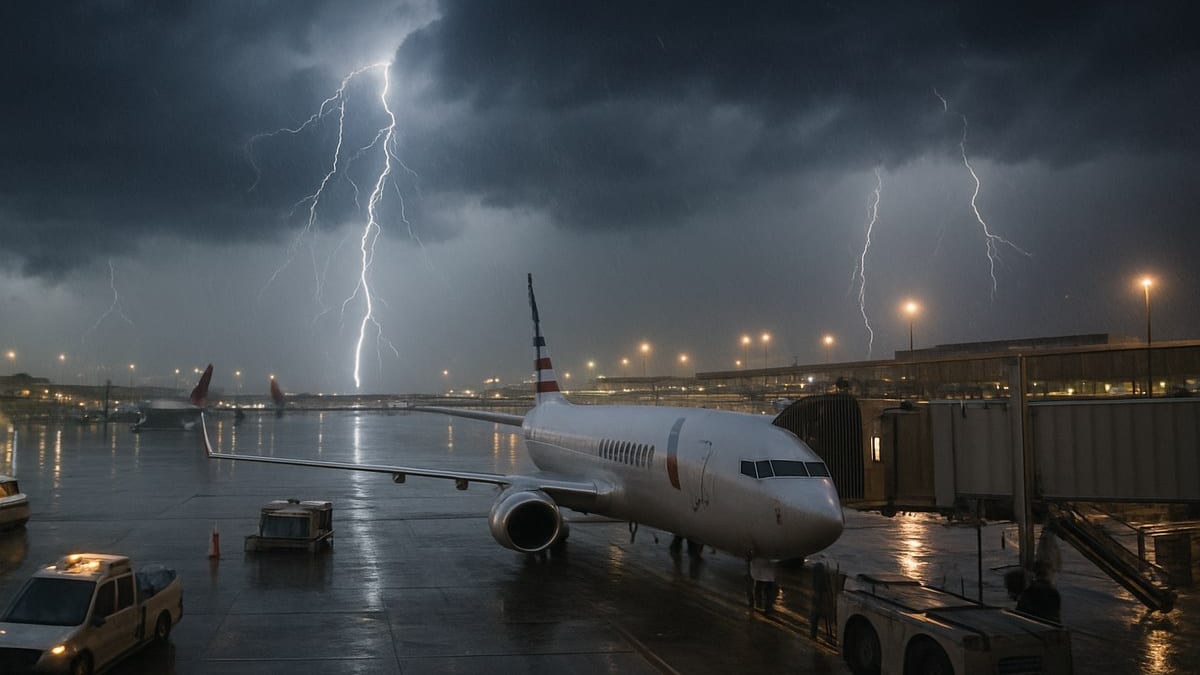
Image by nomadlawyer.org
Storm Cells Converge on Key Hubs
Publicly available aviation data and weather reports indicate that a volatile mix of slow-moving thunderstorms and torrential rain concentrated over the Midwest and Northeast, with Chicago, Boston and New Orleans among the hardest-hit cities. The storms arrived during peak travel windows, compounding congestion as aircraft and crews struggled to move through the system.
In Chicago, a ground stop and subsequent ground delay program at O’Hare International and Midway International limited arrivals for much of Tuesday as lightning, low visibility and heavy rain reduced runway capacity. Similar weather patterns affected airports in the Ohio Valley and along the Gulf Coast, where flash flood warnings were issued as drainage systems were overwhelmed.
Coverage from national and regional outlets shows that carriers including American, United and Southwest faced large numbers of late departures and arrivals at their key hubs, even as they kept cancellation totals relatively low compared with prior major winter storms. The result was a day dominated by creeping delays that rippled through evening schedules rather than a short, sharp shutdown.
Weather maps from federal and local meteorological agencies showed repeated thunderstorm redevelopment along the same corridors, a pattern sometimes described as “training” cells. That setup increased the risk of localized flooding near airports and along approach paths, adding another layer of caution to already stretched air-traffic operations.
3,141 Delays, 117 Cancellations and a Grid Under Strain
Flight-tracking tallies compiled late on March 31 pointed to 3,141 delays within, into or out of the United States and 117 outright cancellations for the day. While modest compared with historic disruption events during major winter storms, the concentration of delays at hub airports meant that missed connections and rolling schedule changes affected a large share of connecting passengers.
Published aviation analytics breakdowns suggest that mainline airlines bore the brunt of the delay totals. United and American each recorded several hundred delayed flights, while Southwest and other large domestic carriers also posted significant disruption figures. Smaller regional operators such as Envoy and Horizon, which feed passengers into larger networks, faced a disproportionate impact when key spoke routes were slowed by storms.
Industry data and recent research into delay propagation in the US network show that even moderate weather events can have outsized effects once they intersect with tight aircraft rotations and high load factors. When aircraft arrive late into constrained hubs, subsequent departures are pushed back, crew duty-time limits are tested and individual cancellations begin to appear late in the day as schedules can no longer be recovered.
Observers noted that the 117 cancellations on March 31 followed several other high-disruption days in March involving severe weather, ground stops and infrastructure issues at major facilities. That sequence has left airlines with limited slack in aircraft and crew positioning, making the system more vulnerable to additional shocks.
Thunderstorms, Flash Floods and the Geography of Disruption
Meteorological assessments of the event highlight the role of unusually moist air feeding into a strong frontal boundary, fueling thunderstorms capable of producing both intense lightning and sudden rainfall totals. Where those storms intersected with urban infrastructure, reports pointed to standing water on access roads, flooded underpasses and slower ground transport for workers and travelers heading to airports.
Flash flood alerts were in effect across parts of the central Gulf Coast and lower Mississippi Valley, including low-lying neighborhoods near airports in New Orleans and other regional cities. In some locations, the combination of saturated soils, high river levels from recent rain and new downpours increased runoff, raising concerns about drainage around runways and taxiways.
According to recent analyses of weather-related aviation impacts, convective storms such as those seen on March 31 account for a substantial share of warm-season delays, particularly at large hub airports where high-frequency operations leave little margin for holding patterns or reroutes. When multiple hubs along key east–west and north–south corridors are affected at once, passengers far from the original weather zone can experience disruptions as aircraft and crews fail to arrive on time.
The geographic spread of Tuesday’s storms meant that airports in the Midwest, the Mid-Atlantic and the Gulf Coast all saw periods of reduced arrival rates, making it harder for airlines to use alternative routings to avoid the worst-affected airspace. That interconnectedness helped turn localized thunderstorms into a national-scale aviation challenge.
Travelers Confront Long Waits and Limited Options
At terminal departure boards across affected airports, passengers faced a familiar pattern of successive schedule changes, rolling delays and gate shifts. Public information from airport and airline status pages showed some flights pushed back in 30-minute increments throughout the day as carriers waited for updated weather windows and air-traffic slots.
For travelers with connections, even small initial delays created significant complications. A late inbound arrival to a hub such as Chicago or Boston could leave only a narrow window for passengers to reach onward flights, many of which were already operating with high load factors following a busy spring travel period. Missed connections in turn triggered additional rebookings, adding pressure to customer service channels and available seat inventory.
Consumer advocates and transportation analysts frequently advise that weather-related disruptions place legal obligations on airlines primarily around refunds when flights are cancelled, rather than around hotel stays or meal vouchers. In practice, responses vary by carrier and by the nature of the disruption. On March 31, publicly available policy information showed that some airlines encouraged customers to use mobile apps and websites to self-service rebookings and check real-time status rather than queuing at airport counters.
Travel insurance providers and passenger-rights organizations have increasingly pointed to these kinds of multi-day, weather-driven disruptions as a reason for travelers to build additional time into itineraries, particularly when important events or cruise departures are involved. The latest wave of delays is likely to reinforce that message for frequent flyers and occasional travelers alike.
Persistent Weather Volatility Tests Airline Resilience
The March 31 disruption comes against a backdrop of repeated weather shocks to the US aviation system in 2026. A historic winter storm in late January produced one of the largest single-day totals of cancellations on record, and subsequent blizzards, severe thunderstorm outbreaks and tornado events have all contributed to elevated delay and cancellation statistics.
Industry reports and academic work examining on-time performance trends suggest that while airlines have invested heavily in operational technology, schedule planning and crew management tools, the structure of the modern hub-and-spoke network still leaves carriers exposed when multiple hubs encounter adverse weather at once. High aircraft utilization, lean staffing and strong passenger demand mean there is less spare capacity available to absorb shocks.
Weather and aviation specialists note that the kinds of intense, localized storms that drove Tuesday’s flash flood risk are becoming more frequent in some regions, adding to questions about how airports and airlines will adapt infrastructure, scheduling and passenger communication practices. Upgrades to drainage, runway lighting, de-icing equipment and real-time data sharing are all seen as potential tools to reduce the severity of future disruptions.
For travelers, the numbers recorded on March 31 serve as another reminder that even outside the traditional winter storm season, the US aviation grid is highly sensitive to fast-changing weather. As spring and summer thunderstorm patterns become more active, similar days of widespread delays and pockets of cancellations are likely to remain a recurring feature of the travel landscape.