

More news on this day
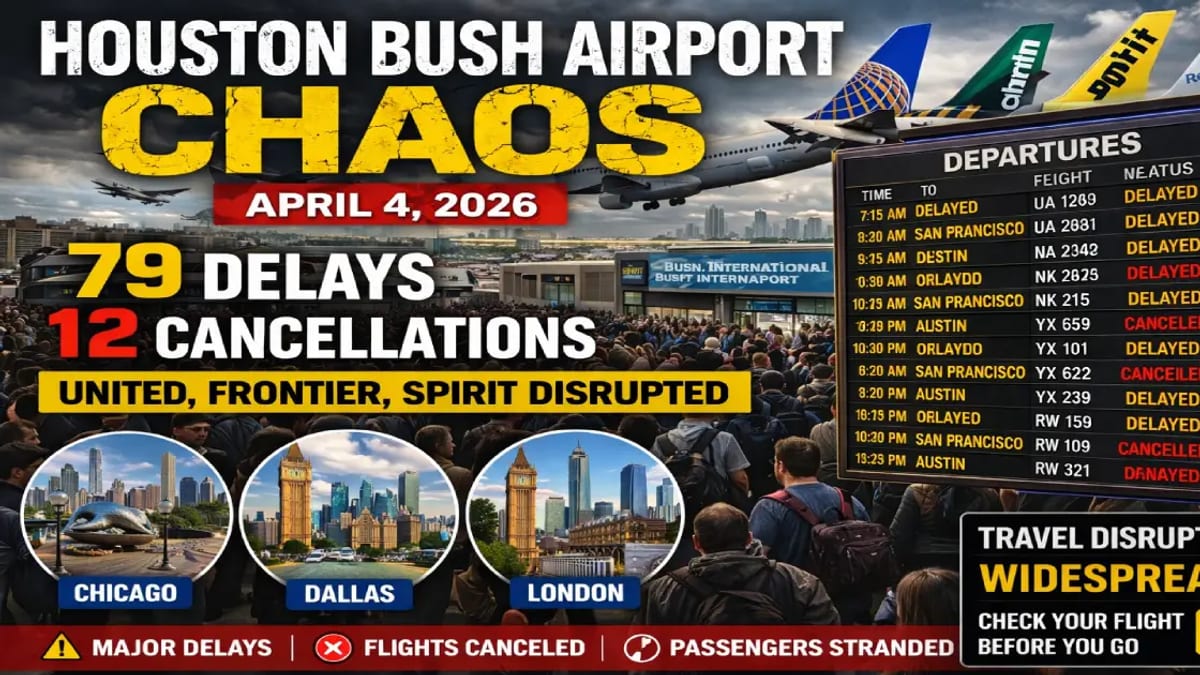
Severe thunderstorms rolling across the Houston area on April 4 triggered a fresh wave of disruption at George Bush Intercontinental Airport, where flight-tracking data shows at least 132 delays and 16 cancellations as storms collided with ongoing construction and a strained security system.
Get the latest news straight to your inbox!
Storms, Ground Delays and a Saturated Schedule
The most acute disruption unfolded in the late afternoon and early evening on April 4, when intense thunderstorms moved across the Houston region and into key air corridors used by George Bush Intercontinental Airport. Publicly available aviation dashboards and local media coverage indicate that a formal ground delay program was put in place for arriving flights, sharply reducing the rate at which aircraft could land and depart.
Television news reports out of Houston described a ground stop and arrival metering that extended into the early evening, with the Federal Aviation Administration’s website listing thunderstorms as the primary constraint on airport capacity. For travelers already in the air, that translated into extended holding patterns and diversions to alternate airports. For those on the ground at Bush, it meant aircraft waiting for departure slots long after boarding was complete.
Nationwide, April 4 was already shaping up as a difficult day for air travel, with travel-industry summaries citing hundreds of cancellations and several thousand delays across the United States. Within that national picture, Houston’s Bush airport stood out as one of the more heavily affected hubs, with at least 132 flights delayed and 16 canceled by late evening, based on aggregated flight-status tallies. Those figures put Bush among the country’s higher-impact airports for the day.
The disruption occurred during a period of traditionally busy spring travel, when airlines are operating schedules that are close to pre-2020 levels and in some cases flying fuller planes than before the pandemic. With little slack left in daily operations, a few hours of constrained arrivals and departures at a major hub can quickly cascade into widespread delays, missed connections and late-night cancellations.
Construction and Capacity Constraints at a Major Hub
The weather was only part of the story at Bush on April 4. Federal aviation planning documents for the first quarter of 2026 describe extensive, multi-year construction across the airport complex, including taxiway closures and airfield work expected to continue into 2027. Those projects are flagged as likely to reduce capacity and increase delays during periods of high demand or poor weather.
When thunderstorms arrived over Houston on April 4, this reduced operational margin appears to have contributed to longer-lasting impacts. With parts of the airfield constrained by construction, controllers and airlines had fewer options to sequence arrivals and departures around the most intense cells. As a result, even relatively short-lived storms could have outsized effects on gate availability and pushback times.
Construction is also reshaping passenger access to terminals and roadways around Bush. Airport advisories issued in recent months highlight lane closures and detours on approaches to the terminals, conditions that can lengthen drop-off and pick-up times and add another layer of uncertainty for travelers trying to judge when to leave for the airport. On an already disrupted day, even small delays in reaching the terminal can be enough to tip tight itineraries into missed flights.
Industry analysts note that large hub airports undergoing construction are particularly vulnerable when severe weather intersects with peak travel periods. The April 4 disruptions at Bush reflect that pattern, combining a temporary shock from thunderstorms with a longer-term squeeze created by reduced airfield and landside capacity.
Security Lines and Recent TSA Staffing Strains
The flight delays and cancellations on April 4 came against a backdrop of scrutiny over security wait times at Bush. In the weeks leading up to the storms, national news outlets and local coverage documented multi-hour security lines at the airport, driven in part by Transportation Security Administration staffing issues linked to the broader federal budget environment.
Reports in late March pointed to Bush as one of the hardest-hit U.S. airports, with some travelers facing waits of three to four hours during peak periods. While more recent updates from federal and airport sources indicated an improvement in staffing and shorter projected queues, the episode has left many passengers nervous about cutting arrival times too close.
Those concerns likely influenced traveler behavior on April 4, as passengers adjusted their plans to arrive earlier than usual in anticipation of possible bottlenecks at security. That surge behavior, noted in public commentary and travel forums, can itself contribute to longer lines when large numbers of people arrive well ahead of their departure times. On a weather-disrupted day, the combination of earlier arrivals and delayed departures can crowd gate areas and concourses, compounding the sense of chaos.
Airlines operating from Bush have tried to ease some of the uncertainty by publishing security wait-time estimates through their own digital channels and apps, relying on data from airport feeds and federal agencies. For travelers caught up in the April 4 disruptions, that information helped some people adjust their schedules, but it could not fully offset the impact of constrained flight operations once the thunderstorms took hold.
Traveler Impact and Airline Response at Bush
The 132 delays and 16 cancellations at Bush on April 4 translated into missed connections, overnight stays and rebooked itineraries for hundreds of passengers. Social media posts and traveler reports described long lines at customer service counters, significant hold times on airline call centers and rebookings that pushed some journeys into April 5 or beyond.
Airlines serving Bush responded with a mix of schedule adjustments and policy changes. At least one major carrier issued a weather-related travel waiver for Houston, allowing affected customers to change flights within a defined window without additional change fees, provided they kept the same origin and destination. Such waivers, which have become more common in recent years, are designed to encourage passengers with flexible plans to move onto less congested days or times, easing the immediate pressure on an airport during a disruptive event.
Operationally, carriers prioritized maintaining the integrity of longer-haul and international routes, in some cases delaying shorter regional flights or consolidating services where passenger loads permitted. Industry observers note that this strategy can help airlines preserve aircraft positioning and crew rotations, but it often leaves travelers on shorter domestic segments facing the highest risk of delay or cancellation.
For those stranded at Bush on April 4, options ranged from same-day rebookings onto later flights once the storms eased, to overnight stays in nearby hotels when connections could not be salvaged. The spike in demand for last-minute accommodation, combined with other disruption across the Texas and Southeast corridor, made it more difficult in some cases to secure reasonably priced rooms close to the airport.
What April 4 Means for Future Travel Through Houston
The events at Bush on April 4 highlight how multiple stressors can converge on a single travel day. Thunderstorms over Texas, long-running construction on the airfield and recent pressure on security staffing combined to turn an ordinary spring Saturday into a day of elevated disruption, even if the raw numbers fell short of the most severe nationwide meltdowns seen earlier in the year.
For travelers planning upcoming trips through Houston, the episode underscores the value of building additional time into itineraries, particularly when connecting through Bush during storm-prone periods. Travel advisors frequently suggest longer layovers at major hubs with known weather and construction challenges, giving passengers more flexibility to absorb delays without missing onward flights.
The airport’s ongoing construction program and the federal effort to stabilize TSA staffing should, over time, improve the resilience of operations at Bush. Until that work is complete, however, the April 4 disruptions serve as a reminder that high-traffic hubs can move quickly from routine operations to widespread delay whenever weather, infrastructure constraints and tight schedules intersect.
Airlines and airports across the country will be watching closely as the spring travel season continues, looking for lessons in how to manage storms like those that swept Houston on April 4 and how to maintain passenger confidence despite the recurring risk of disruption at the nation’s busiest hubs.