

More news on this day
From the outside, the B-2 Spirit seems all sweeping wings and empty space, but inside its angular frame, two pilots share one of the tightest, most scrutinized cockpits in military aviation.
Get the latest news straight to your inbox!
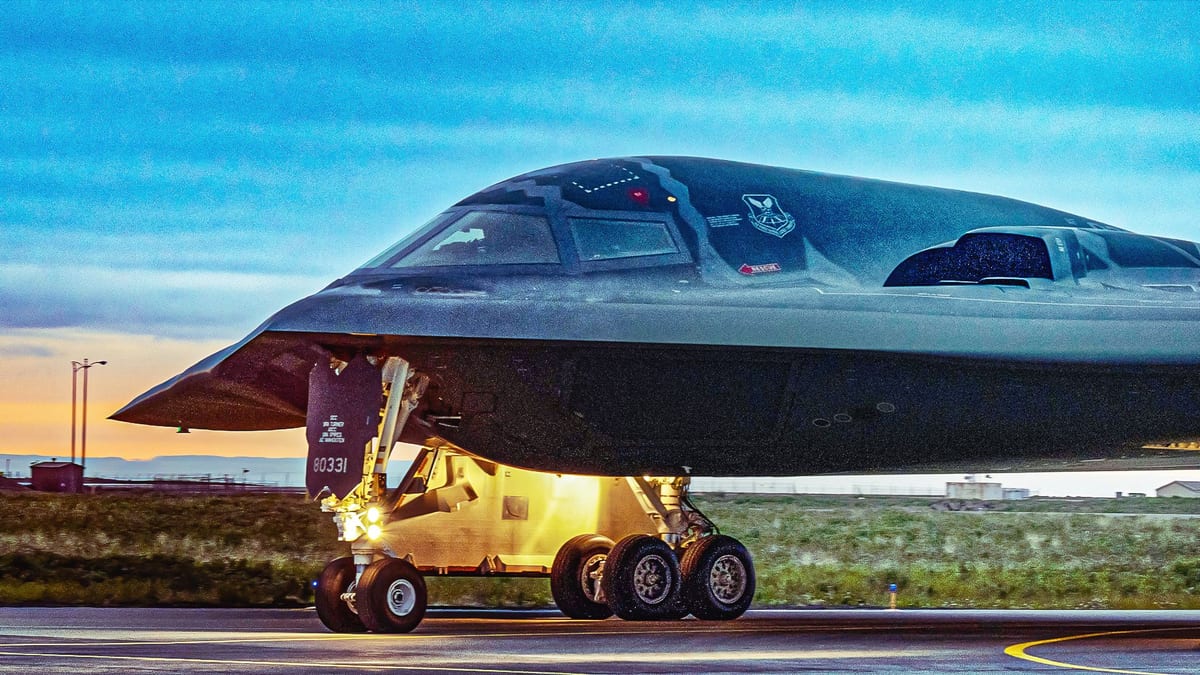
Image by Simple Flying
A Two-Person Nerve Center in a Flying Wing
The B-2 Spirit’s cockpit is far smaller than its 52-meter wingspan suggests. Publicly available material shows that the stealth bomber is flown by a crew of two seated side by side, the pilot on the left and the mission commander on the right. Despite the aircraft’s vast internal fuel capacity and weapons bays, the pressurized forward section is compact, wrapping tightly around the crew and avionics.
Photos released by the U.S. Air Force and Northrop Grumman reveal a cockpit dominated by multifunction displays, clustered in front of each seat and in the center console. These digital screens concentrate flight data, navigation information, threat warnings and weapons status into a format that reduces the need for sprawling banks of analog gauges. Yet the sidewalls, overhead panels and center pedestal still carry rows of switches and knobs, creating a dense, almost submarine-like environment.
Unlike older bombers that may carry three or four crew members, the B-2’s systems are designed so two people can manage long-range strategic missions. That design philosophy, paired with the aircraft’s low-observable contours, limits how much physical volume can be devoted to human comfort. The result is a cockpit that functions as both flight deck and mission control center, but leaves little spare room once oxygen equipment, helmets, checklists and survival gear are added.
Reports from aviation publications indicate that even basic movement is constrained. Getting in and out requires climbing a narrow ladder from the belly access hatch into the forward fuselage, then threading past structural frames and equipment racks before settling into ACES II ejection seats. Once strapped in with harnesses and connected to communications and oxygen systems, pilots have only modest space to stretch or shift position.
Glass Cockpit Modernization in a Confined Shell
Although the B-2 first flew in the late 1980s, its cockpit has been steadily modernized while retaining the same tight physical footprint. Defense and industry reports describe ongoing display and mission-computer upgrades that replace aging electronics with higher-resolution color screens and more capable processors. These changes are intended to keep the Spirit compatible with modern precision weapons and data links without altering its external signature.
Recent coverage of U.S. Air Force acquisition documents shows that a Display Modernization program is reworking how information appears in front of the crew. The shift is toward larger, more integrated glass panels that can be reconfigured in flight, giving pilots flexible layouts for navigation, threat monitoring and weapons management. In a cockpit where every centimeter counts, consolidating functions into fewer, more capable displays also helps reduce clutter.
Despite the digital upgrades, the underlying ergonomics are still shaped by the original stealth-driven design. The sharply angled windscreen and thick framing limit outward visibility compared with many conventional aircraft, increasing reliance on sensors and avionics. Control sticks, throttles and mission keyboards are arranged so both pilots can manage flight and targeting duties in close quarters, handing off responsibilities during long legs over ocean or hostile territory.
Analysts note that modernization efforts are constrained by the need to preserve the bomber’s radar-evading profile. Significant structural changes to enlarge the cockpit or add windows would risk altering its low-observable characteristics. As a result, improvements tend to focus on what can be changed inside the existing shell: software, displays, wiring and human-machine interfaces rather than the basic size of the space.
Living in a Tight Space on 30-Hour Missions
The B-2 was built for extreme range, and operational history shows that missions lasting 30 hours or more are not unusual. In that context, the compact cockpit becomes not just a workplace but a confined living space. Travel and defense features that examine long-duration sorties over the Middle East and Pacific describe how the crew must eat, rest and manage basic needs within a few square meters.
Behind the two ejection seats, a narrow area serves as a makeshift rest zone. Accounts from aviation writers and former crew members indicate that this space typically holds a simple fold-out cot or foam pad along with a small storage area for personal gear and mission essentials. There is also a rudimentary chemical toilet, partially screened from view, which is often supplemented by disposable urinal bags to cope with ultra-long legs.
Air Force medical and safety literature referenced in public reports highlights the challenges of fatigue in such a constrained environment. With no separate crew-rest compartment, sleep must be managed in shifts only a few feet from active flight controls and avionics racks. Noise levels, airflow from environmental systems and constant radio chatter can make genuine rest difficult, further emphasizing how demanding these missions can be on the body.
To cope, mission planning includes detailed guidance on hydration, nutrition and alertness strategies. Crews bring carefully selected snacks and meals that can be handled easily in the cockpit, often using small shelves or their laps as impromptu tables. Exercise is limited to simple stretches and movements performed while strapped to the seat or standing briefly in the narrow aisle, mindful of overhead panels and exposed wiring.
Human Factors and the Psychology of a Hidden Cockpit
The B-2’s cockpit is not only physically tight but also psychologically unique. Pilots navigate across continents seated deep within a window-limited flying wing, largely cut off from traditional visual references. Aviation psychologists who study long-duration operations point to the mental strain of sustained vigilance in a darkened, enclosed space dominated by glowing screens and synthetic sensor views.
Published safety and research material for long-range aircrews suggests that monotony, circadian disruption and the ever-present requirement for precision can be as challenging as the physical constraints. Unlike transport or refueling aircraft, there is no relief crew waiting in a spacious cabin. The same two people who launched the bomber often remain responsible for it from takeoff to landing, with only in-flight rest cycles to mitigate fatigue.
The secrecy surrounding the B-2 program adds another layer. Because only limited imagery and documentation are available, much of what the public sees are carefully curated photographs and brief video clips. Aviation analysts note that the actual noise levels, ambient lighting conditions and sensory experience of flying in the cockpit can only be inferred from these glimpses and from general research into similar military flight decks.
Despite these challenges, the cockpit’s cramped design is widely regarded by defense observers as the price of extreme capability. The same tightly packed avionics, fuel systems and structural members that crowd the crew also allow the aircraft to slip past radar coverage and reach targets that might otherwise be inaccessible. For pilots, every hour spent in the cockpit underscores the intimate link between confinement and reach in modern strategic airpower.
The Next Generation and a Vanishing Interior
The eventual arrival of the B-21 Raider is expected to shift some of the strategic burden away from the B-2, but for now the Spirit remains the only operational stealth bomber of its type. Modernization plans suggest the cockpit will continue evolving incrementally, gaining more capable displays and mission systems while remaining fundamentally compact.
As newer platforms enter service, aviation historians predict that the B-2’s interior may become more visible through museum exhibits and declassified material. For the moment, however, most travelers and aviation enthusiasts must rely on a patchwork of officially released imagery, technical summaries and secondhand descriptions to imagine what it is like to spend a day or more inside the Spirit’s tight cockpit.
In that sense, the B-2’s interior mirrors its operational purpose. It is a space that exists to do difficult work far from public view, concealed beneath faceted glass and composite skin, where two people sit shoulder to shoulder in one of the smallest rooms ever built to change events on the far side of the world.