

More news on this day
Tokyo is beginning to rethink its long-standing scarcity of public trash cans, as a surge in international visitors collides with security-era policies and pushes the city’s famed cleanliness to its limits.
Get the latest news straight to your inbox!
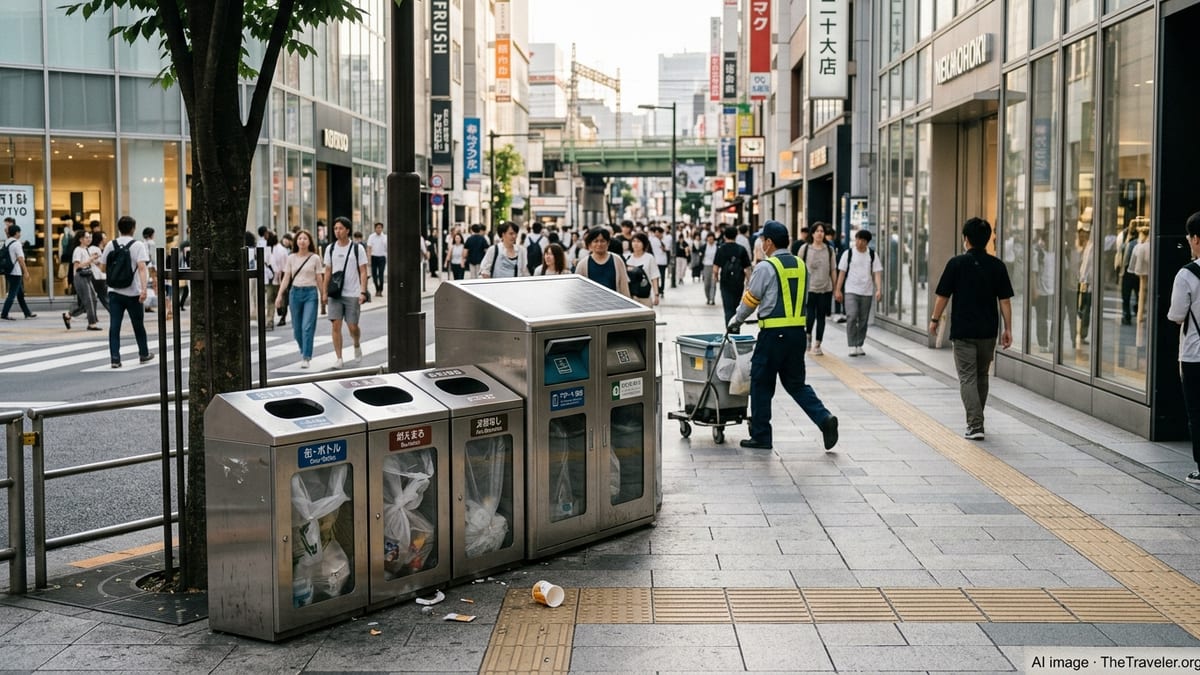
Tourism Boom Exposes Limits of a Bin-Light City
For decades, visitors have marveled at how Tokyo’s streets stay remarkably clean despite a noticeable lack of public trash cans. That minimalist approach to waste infrastructure is now under pressure. International arrivals have rebounded strongly and surpassed pre-pandemic levels, concentrating huge crowds in districts such as Shibuya, Shinjuku and Asakusa. Publicly available information shows that foreign visitors increasingly cite the scarcity of bins as one of the most frustrating aspects of travel in Japan, particularly in major rail hubs and shopping streets.
Reports based on recent government surveys indicate that more than one in five foreign tourists list the lack of public trash cans as their top inconvenience. Many arrive with expectations shaped by other global cities, where large street bins, frequent collection and event-specific receptacles are standard. Confronted with Tokyo’s sparse bin network, they are left carrying empty drink bottles and food packaging for hours or improvising around convenience store bins and hotel rooms.
The growing mismatch between visitor expectations and local norms is now visible on the ground. Travel and local media outlets describe overflowing receptacles around nightlife hotspots, popular crossings and seasonal events, along with sporadic litter in alleyways and near convenience stores. While overall street cleanliness remains high by international standards, the stress created by mass tourism is eroding the low-waste balance that Tokyo relied on for years.
Tourism-focused commentary in Japan increasingly frames the trash can issue as a test of how the country adapts its infrastructure to a new era of volume tourism. The challenge is to meet visitor needs without undermining the social habits and safety concerns that shaped the current system.
Security Concerns Shaped a Sparse Bin Landscape
Tokyo’s shortage of public trash cans did not happen by accident. Historical accounts of urban policy note that many receptacles were removed from train stations and busy streets after the 1995 sarin gas attack on the Tokyo subway. Concerns about concealed devices and hazardous substances prompted transit operators and local governments to strip out metal bins and avoid placing new ones in crowded public areas.
Waste management overviews explain that, rather than replacing the removed bins with secure designs, authorities leaned on established social practices. Residents are accustomed to separating waste at home, following strict collection schedules and, when necessary, carrying their trash with them. Eating and drinking while walking is also considered poor etiquette in many settings, which reduces on-the-go waste compared with other large cities.
As a result, Tokyo evolved into a metropolis where public bins are clustered at specific nodes rather than spread along every block. Train operators that still provide receptacles often use clear, compartmentalized containers and situate them on platforms or concourses, while city-managed parks and some tourist facilities maintain sorted bins with prominent signage. Outside those locations, everyday street furniture rarely includes a wastebasket.
This model functioned relatively smoothly when most people on the streets were local residents familiar with the system. The rapid growth in short-stay international visitors, many consuming drinks and snacks on the move, has revealed the limits of a network that assumes long-term familiarity and a strong home-return habit for waste.
Shibuya’s Crowds, Litter and a Push for More Bins
Few areas illustrate the tension more clearly than Shibuya, one of Tokyo’s busiest entertainment and nightlife districts. Reports describe a marked increase in litter and overflowing trash cans around Shibuya Station, Center Gai and the famous scramble crossing in recent years, coinciding with a sharp rise in foreign foot traffic and late-night street drinking.
Local news coverage indicates that Shibuya Ward is now moving on multiple fronts to regain control of its streetscape. Ordinances approved for implementation in the 2026 fiscal year introduce fines for littering in designated zones and expand obligations for businesses. Convenience stores, cafes and similar outlets in key areas will be required to install and maintain trash cans accessible to customers and passersby, increasing the available disposal points without returning to a city-funded, fully street-side network.
At the same time, Shibuya is tightening rules around public behavior. Separate measures target outdoor drinking in and around major crossings, where weekend crowds have often left piles of cans, bottles and food containers. Nighttime scenes of impromptu gatherings, plastic bags tied to railings and ad hoc piles beside the few existing bins have fueled debate among residents and in national media about the sustainability of the current tourism style.
Observers see Shibuya’s evolving approach as a test case for how other wards might respond. By pairing targeted increases in bin availability with enforcement tools and clearer responsibilities for businesses, the district is signaling that infrastructure, regulation and visitor communication must work together rather than in isolation.
Smart Bins and Data-Driven Waste Management
Alongside local ordinances, Tokyo is experimenting with technology to manage a higher volume of on-the-go waste. According to information published on the Tokyo Metropolitan Government’s own channels, the city has begun deploying solar-powered smart trash cans, often branded as SmaGO, in high-traffic areas such as Omotesando and around major commercial zones.
These units incorporate internal compactors and fill-level sensors that can hold several times the volume of a standard city bin. Data transmitted to operators shows when a particular bin is nearing capacity, allowing collection teams to prioritize routes and avoid visible overflows. Reports on the program state that by mid-2024 around 70 such smart bins had been installed across Tokyo, with additional units in other Japanese cities facing similar tourism pressures.
Urban policy analysts highlight these smart receptacles as a way to reconcile visitor-friendly infrastructure with staffing and budget constraints. Instead of dramatically expanding the total number of conventional bins, cities can deploy a smaller network of high-capacity, closely monitored units at strategic bottlenecks. The approach also keeps the streetscape relatively uncluttered, aligning with Tokyo’s aesthetic preference for minimal street furniture.
However, technology alone does not resolve questions about who can use which bins and for what kind of waste. Some convenience stores and facilities have tightened rules around their own receptacles after seeing them used as general dumping points. The rollout of smart bins is therefore accompanied by renewed efforts to communicate usage rules and waste separation expectations to visitors.
Visitor Expectations and the Future of Tokyo’s Streets
The friction around trash cans is ultimately about more than infrastructure. It reflects a deeper adjustment as Japan navigates record tourism while maintaining social norms that predate the current visitor boom. Surveys and anecdotal accounts reveal that many travelers arrive with little awareness of local etiquette around eating while walking, carrying personal waste or sorting recyclables.
In response, tourism agencies and municipal bodies are placing greater emphasis on signage, multilingual guidance and pre-arrival messaging. Campaigns encourage visitors to hold onto their trash until they reach a station, park, convenience store or hotel, and to treat public spaces as shared living rooms rather than disposable venues. Some promotional materials present carrying a small waste bag as part of “traveling like a local” in Japan.
At the same time, domestic commentary increasingly argues that messaging must be matched by tangible changes in the urban environment. Advocates for more bins point out that event venues, shopping streets and festival locations already demonstrate how quickly receptacles can overflow when crowds are dense, and that relying solely on personal responsibility is less realistic as visitor numbers climb.
Tokyo’s evolving mix of targeted bin installation, business obligations, smart technology and behavior-focused communication suggests a gradual shift rather than a wholesale reversal of past policy. For travelers, that means the city is likely to remain relatively light on casual street-side trash cans for the foreseeable future, even as new disposal options appear in the places where tourism pressure is greatest.