

More news on this day
A rarely seen cherry blossom street inside Tokyo’s Imperial Palace opened to the general public on March 21, instantly recasting spring travel to Japan as images of the newly accessible route spread worldwide and tour operators scrambled to respond.
Get the latest news straight to your inbox!
A Sudden Opening Inside Japan’s Most Guarded Estate
The Imperial Palace’s Inui Street, a tree-lined avenue usually reserved for tightly controlled seasonal access, began a special nine-day opening in central Tokyo on March 21. Publicly available information indicates that the route, which cuts through the palace grounds behind the East Gardens, will welcome visitors through March 29, coinciding with the early stages of the 2026 cherry blossom season.
Inui Street has been opened on a limited basis in past years, but coverage in Japanese media and on social platforms suggests that this spring’s access is broader and more prominently promoted than in previous seasons. The move places one of the country’s most symbolically important inner landscapes directly into the global spotlight just as international arrivals to Japan continue to climb.
The timing also aligns with updated cherry blossom forecasts that place Tokyo’s main bloom period around late March. Travel planners note that this overlap between a rare palace opening and peak sakura viewing has created an unusually intense focus on a single corridor of trees inside the capital’s historic core.
From Quiet Palace Path to Viral Travel Sensation
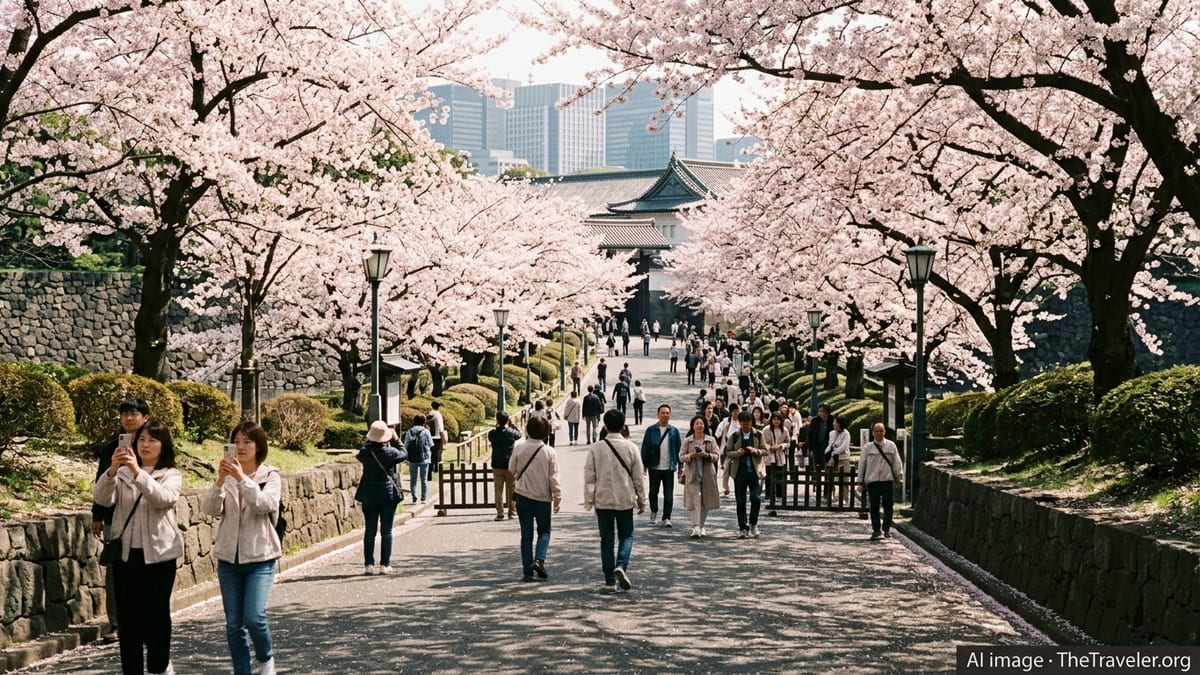
Within hours of the gates opening, photos of Inui Street’s carefully tended cherry trees, palace walls and manicured slopes began circulating heavily on international social media feeds and travel forums. Images show a gently curving roadway framed by pale pink blossoms, low stone embankments and uniform palace-style lamp posts, creating a scene that contrasts sharply with the glass towers surrounding the Chiyoda district.
According to published coverage in Japanese outlets, visitors enter the grounds after passing through airport-style security checks and then follow a designated one-way walking route. The controlled layout allows steady movement while still giving unobstructed views of the blossoms and palace architecture, a combination that has made the street particularly photogenic for visiting travelers.
Travel commentators point out that many global visitors were already in Tokyo for the broader hanami period, and the sudden visibility of this inner palace route acted as a catalyst. Some tour organizers have begun rerouting half-day city walks to pass through the admission checkpoints, while independent travelers share time-saving tips for navigating nearby subway stations and crowd peaks.
Tourism Stampede Strains Central Tokyo
The immediate impact of the opening has been most visible around major access points such as Tokyo Station, Otemachi and Kudanshita, where commuter-heavy transport hubs are now accommodating a sharp rise in luggage-carrying visitors. Reports indicate longer queues for station lockers, elevated ride-hailing demand and heavier congestion on key pedestrian avenues leading toward the palace perimeter.
Near the moat, long-established cherry blossom spots such as Chidorigafuchi Greenway and the surrounding parks are experiencing knock-on effects from the surge. Travel blogs and crowd reports describe instances of visitors spending a morning on the outer moats and then joining the flow into the Inui Street opening, creating a continuous loop of sakura viewing concentrated within a compact area of central Tokyo.
Accommodation data compiled by major booking platforms before the opening already showed tight availability for late March in Tokyo, particularly near the Imperial Palace and major business districts. The additional interest generated by the palace street appears to be pushing last-minute travelers farther into peripheral neighborhoods and nearby cities, reinforcing guidance that cherry blossom trips now require significantly earlier planning than in the past.
Managing Expectations: Limited Dates, Tight Controls
Despite sensational headlines, Inui Street’s opening remains strictly time-limited and carefully regulated. Public information from government and tourism channels emphasizes that access is restricted to specific dates and daily hours, with visitors subject to bag checks, route guidance and, if necessary, temporary entry suspensions when congestion builds.
On-the-ground reports highlight that the walking experience is more akin to a structured procession than a leisurely park stroll. Trip notes mention designated photo zones and instructions not to stop in narrow sections, which can surprise travelers expecting a relaxed picnic-style hanami comparable to Shinjuku Gyoen or Ueno Park.
Travel writers advise that those hoping to photograph the corridor under optimal conditions should plan for early-morning or late-afternoon visits, when the light is softer and temperatures cooler, while accepting that some degree of crowding is now effectively built into the experience. They also suggest pairing an Inui Street walk with nearby but less publicized viewing points around the wider palace moat, where paths and small parks often offer more space to linger.
What the Opening Means for Future Sakura Seasons
The prominence of this year’s Inui Street opening is prompting wider discussion about how Japan manages access to its most iconic cherry blossom sites as tourism grows. Commentators note that limited windows into previously restricted areas can disperse visitors away from overburdened parks, but can also amplify demand when the opportunity is perceived as rare and exclusive.
For tour operators, the palace opening is likely to solidify Tokyo’s position as the default base for first-time cherry blossom travel, thanks to the combination of high-profile sites and major international air links. Some agencies are already marketing future itineraries that highlight “inner palace” access, even as the exact conditions and dates of any later openings remain subject to annual announcements.
Travel planners recommend that visitors treat Inui Street as a bonus rather than the sole focus of a cherry blossom trip, pointing to a wide array of alternative spots across the capital and beyond, from riverside promenades in Meguro to temple-lined hillsides in Kyoto. Nonetheless, the sudden visibility of a once-quiet palace road has underscored how a single adjustment to access can redirect the global flow of travelers in the space of a few spring days.