

If you love northern lakes, granite shorelines and quiet pine forests, Ontario is an easy favorite. Yet across North America there are other regions that offer the same mix of glassy water, dark skies and low-key cottage culture, often with easier access and fewer crowds. From the upper Midwest to New England and the American West, these lake destinations deliver the same nature-forward escape many travelers seek in Ontario, with their own distinct landscapes and local flavor.
Minnesota: The Original Land of 10,000 Lakes
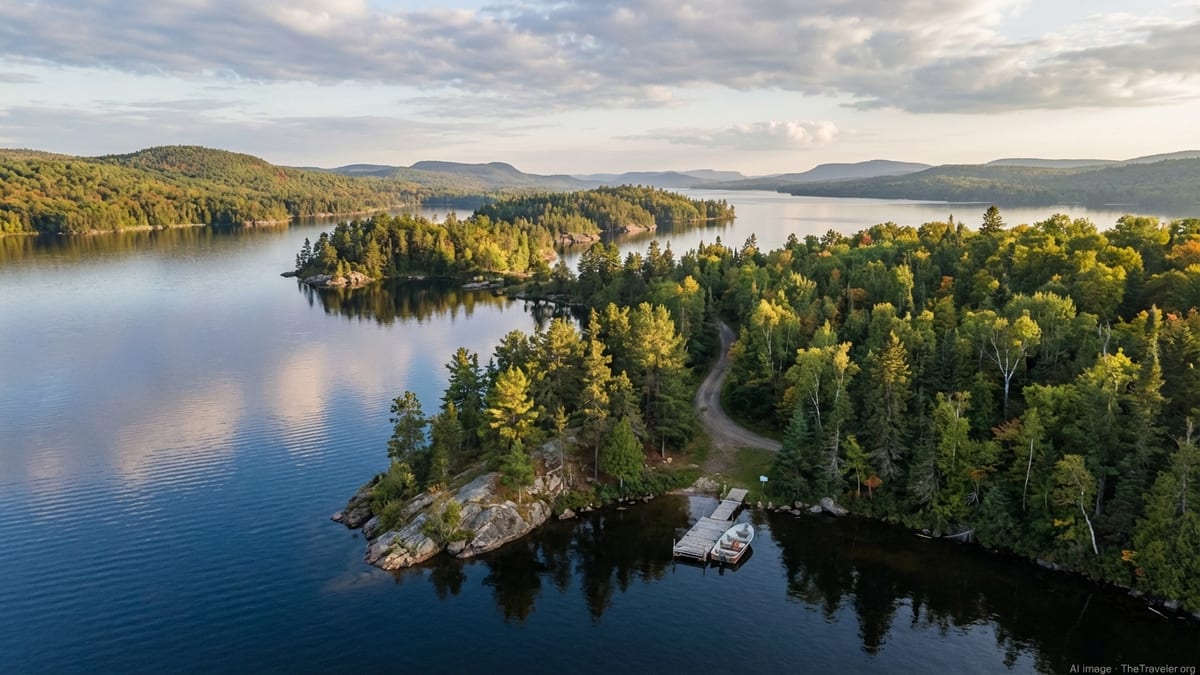
Minnesota feels instantly familiar to anyone who has spent summers in Ontario. The state’s nickname, the Land of 10,000 Lakes, only hints at the density of water here, from tiny kettle ponds to broad glacial lakes that resemble inland seas. Much like northern Ontario, northern Minnesota is a tapestry of mixed forests, rocky shorelines and tannin-stained rivers flowing quietly under spruce and birch. Visitors come for long days on the water, loons calling at dusk, and the simple pleasure of watching the sky reflect in still bays at sunrise.
Voyageurs National Park in the far north captures this atmosphere especially well. It is a water-based park where most travel happens by boat across lakes interconnected much like the Canadian Shield waterways just over the border. Houseboats, small fishing boats and kayaks drift between forested islands, and campsites are accessible only from the water, maintaining a wild, low-impact feel. Dark skies, frequent northern lights in season and a chorus of wolves and owls at night make it an appealing alternative for visitors who might otherwise head to remote corners of Ontario to find solitude.
Further east, the Boundary Waters Canoe Area Wilderness extends for more than a million acres along the international border. Hundreds of lakes link through short portages, forming multi-day canoe routes that rival classic Ontario backcountry trips in Quetico or Temagami. Motorized access is tightly regulated, preserving a quiet paddling experience where you are more likely to encounter loons and moose than other people. For many travelers who prize Ontario’s canoe culture, the Boundary Waters delivers similar rewards in a slightly different setting.
For those who prefer a lighter adventure, lakes throughout central Minnesota offer accessible cabin rentals, sandy beaches and small resort towns with bike paths and family-friendly swimming areas. Itasca State Park, home to the headwaters of the Mississippi River, adds a touch of legend to the lake experience while still serving up clear water and forested campsites. Travelers who love Ontario but want better road access, a longer season of services and a broad mix of activity levels will find Minnesota a natural substitute.
Michigan’s Upper Peninsula and Great Lakes Shores
Michigan’s Upper Peninsula, or U.P., offers another compelling alternative to Ontario, particularly for travelers who are drawn to the scale of the Great Lakes. Here, Lake Superior and Lake Michigan form sprawling freshwater horizons punctuated by sandstone cliffs, cobble beaches and quiet harbor towns. The landscape mirrors northern Ontario’s coastal stretches, yet the road network and small communities make it surprisingly approachable for a first-time visitor.
Pictured Rocks National Lakeshore is one of the region’s standout areas, with sheer cliffs glowing in bands of ocher, green and rust above the deep blue of Superior. Hiking trails thread along the edge of the escarpment and drop to pocket beaches accessible only on foot or by boat. Inland, a network of smaller lakes offers calmer conditions for paddling, fishing and camping, so travelers are not entirely at the mercy of big-water wind and waves. The combination of inland and coastal lakes feels similar to pairing a trip to Ontario’s inland parks with a detour to Lake Superior’s North Shore.
Elsewhere on the U.P., places like the Hiawatha National Forest and the interior highlands are dotted with glacial lakes surrounded by maple and birch forest. In autumn, these woodlands turn vivid shades of red and gold that frame mirror-flat lakes on still mornings. Rustic campgrounds and small, family-run resorts line many shorelines, offering the same low-key cottage atmosphere visitors associate with Ontario’s Muskoka or Kawarthas regions, but with the added drama of nearby Great Lakes coastlines.
Farther south, northern lower Michigan around Traverse City and Petoskey combines clear inland lakes with easy wine-country touring and small-town dining. While more developed than much of northern Ontario, this area is a good choice for travelers who enjoy time on the water but still want cafés, galleries and tasting rooms within a short drive. The water remains central to the experience, whether that means paddling on slender Torch Lake, sailing on Grand Traverse Bay or simply watching the sun set behind Lake Michigan’s low dunes.
Lake Superior’s U.S. North Shore
If your favorite parts of Ontario involve dramatic rock shorelines and cold, clear water, the U.S. North Shore of Lake Superior in Minnesota offers a particularly close match. From Duluth to the Canadian border, the road hugs a coastline of basalt cliffs, cobble beaches and pebble coves where the immense lake stretches to the horizon. The setting recalls Ontario’s north shore of Superior, but with a string of compact state parks that make access easy, even for travelers with limited time.
Along this coast, waterfalls tumble into narrow gorges just a short walk from the highway, and hiking trails climb to overlooks with sweeping views of Superior and inland lakes. Split Rock Lighthouse, perched above a rocky promontory, offers a maritime counterpoint to Ontario’s inland lighthouses, while nearby campgrounds and cabins sit within earshot of waves rolling in at night. Cooler temperatures, frequent fog banks and sudden shifts in weather are part of the experience here, much as they are along Ontario’s larger lakes.
Inland from the shore, the Superior National Forest unfolds in ridges, bogs and hidden lakes that mirror the Canadian Shield landscapes across the border. Short hikes lead to quiet viewpoints over beaver ponds and spruce stands, while longer routes traverse high ridges with pockets of blueberries in late summer. Lake access remains excellent, with small fishing lakes and paddle-in campsites that appeal to visitors looking for a taste of wilderness without committing to a full backcountry expedition. It is a region where you can spend the morning on a cliff-top trail and the afternoon skimming a stone across a still inland bay.
For road-trippers who might have once planned to loop around Ontario’s lake country, the North Shore offers a simple, linear alternative with frequent waysides, viewpoints and trailheads. Between stretches of hiking and shoreline exploration, Duluth and several smaller towns provide occasional urban comforts, craft breweries and local cafés. It is a coastal drive that feels rooted in lake and forest rather than in resort development, making it a strong choice for travelers who want easy access to nature without sacrificing comfort.
New England Lakes: Maine, New Hampshire and Vermont
Travelers who love Ontario’s mix of water and forest but want a different cultural backdrop often turn to northern New England. Here, the region’s glacier-carved lakes lie amid mountains rather than the low rocky plateaus of the Canadian Shield. Yet the essential ingredients are familiar: mirrored sunsets, loons calling across the water, and families returning to the same rented cabins year after year.
In Maine, large lakes such as Moosehead and Rangeley are ringed by spruce, maple and small peaks that rise steeply from the shore. The atmosphere is decidedly rural, with scattered lodges, small marinas and a tradition of simple, wood-paneled lakefront camps. Paddlers share the water with anglers and the occasional floatplane, while moose, deer and bald eagles are common sights along quiet coves. For visitors accustomed to Ontario’s northern towns, these Maine communities feel both familiar and refreshingly different, influenced as much by Atlantic maritime culture as by inland forest life.
New Hampshire’s Lakes Region, anchored by broad Lake Winnipesaukee, offers a livelier take on the lake-and-mountain setting. Towns around the shore host marinas, boat tours and seasonal events that lend the area a classic summer-holiday energy. Yet step just beyond the main hubs and you find calm bays, forested islands and small public landings where a rented canoe or kayak can slip out toward quieter water. The nearby White Mountains add another layer to the experience, allowing visitors to combine summit hikes and scenic drives with evenings on the dock.
Vermont, meanwhile, mixes smaller, tranquil lakes with the long ribbon of Lake Champlain along its western edge. Here, state parks protect stretches of shoreline where campers wake to mist rising from the water against a backdrop of the Adirondacks. The lake culture leans toward sailboats and relaxed paddling rather than high-speed motorcraft, giving many corners of Champlain a peaceful mood despite its size. Travelers who enjoy Ontario’s combination of farm country, lakefront cottages and small creative towns will likely appreciate Vermont’s blend of local food, independent shops and forested shorelines.
Idaho and Montana: Mountain Lakes of the American West
For a dramatic shift in scenery without losing the core appeal of clear water and quiet shores, the interior Northwest provides a compelling alternative to Ontario. Northern Idaho and western Montana are stitched together by long, fjord-like lakes and high-elevation basins where snow-fed water reflects dense conifer forests and distant summits. The mood is wilder and more vertical than in central Canada, but a similar sense of remoteness pervades many valleys and inlets.
In Idaho, large lakes such as Pend Oreille, Priest and Coeur d’Alene create deep blue corridors between mountains. Small towns on their shores range from understated fishing hubs to upscale resort communities, yet much of the shoreline remains forested and relatively undeveloped. Public access points and state parks offer beaches, boat launches and campgrounds, making it straightforward to get on the water even without owning gear. Travelers used to Ontario’s long cottage-lined lakes will notice both the familiar palette of pine and granite and the unfamiliar drama of peaks dropping directly into the water.
Across the border in Montana, lakes form an essential part of the state’s national park and wilderness experience. Glacier National Park in particular is dotted with elongated basins such as Lake McDonald and Saint Mary Lake, which capture pastel sunrises and glowing evening alpenglow on the surrounding peaks. Many trailheads begin near water, so day hikes can combine shoreline walking with high passes and flower-studded meadows. Outside the parks, regions like the Seeley-Swan Valley mix chains of mid-size lakes with quiet campgrounds, giving visitors plenty of options for swimming, paddling and wildlife watching away from crowds.
This corner of the American West best suits travelers who are comfortable with occasional long drives and variable mountain weather. In return, they gain access to sparsely settled shorelines, frequent wildlife sightings and the chance to experience star-filled skies reflected in still water on calm nights. For Ontario devotees curious about western landscapes but reluctant to give up time on the lake, Idaho and Montana strike a satisfying balance.
Quebec’s Laurentians and Eastern Townships
Although Ontario is often the first Canadian region that comes to mind for lake trips, neighboring Quebec offers an extensive network of freshwater escapes that feel both familiar and distinct. The Laurentian Mountains, just north of Montreal, are dotted with lakes of all sizes set among rounded hills and mixed forests. Many have long traditions as summer retreats, with classic wooden inns, family-run cabins and small beaches where generations have learned to swim and paddle.
The atmosphere here blends rustic and refined. On one side of a lake, you might find a simple public dock with a handful of locals launching canoes; on the other, a historic resort with a veranda facing the water and a row of brightly colored kayaks. Hiking trails climb to viewpoints over the lakes and down through maple stands that blaze with color in autumn. For visitors who know Ontario’s cottage country, the Laurentians offer a similar pattern of water and woods layered with the region’s French-language culture, cuisine and village architecture.
To the southeast, the Eastern Townships extend this lake-dotted landscape toward the U.S. border, combining gently rolling farmland with ridges and forest preserves. Lakes such as Memphremagog and Massawippi provide long sightlines framed by vineyards, orchards and historic villages. Cyclists and paddlers share the roads and shorelines, creating a relaxed, human-scale rhythm that contrasts with the relative isolation of many Ontario lakes. Yet the essential ingredients remain the same: fresh water, tree-lined hills and a sense of stepping into a slower, seasonal way of life.
Quebec’s lake regions suit travelers who value cultural texture alongside outdoor time. Even small towns often have bakeries, markets and cafés that extend the day’s pleasures beyond the shoreline. For those curious to explore Canada beyond Ontario while keeping the focus squarely on lakes and nature, the Laurentians and Eastern Townships provide a gentle, engaging alternative.
The Takeaway
Ontario deserves its reputation as a classic lake destination, but it is far from the only place where water, forest and sky come together in compelling ways. Across North America, regions from Minnesota to Maine and Montana offer travelers a similar combination of still bays, starry nights and wildlife-rich shorelines, each filtered through its own landscape and culture. Choosing an alternative to Ontario can mean trading granite outcrops for mountain peaks, or cottage-lined bays for broad Great Lakes horizons.
For many travelers, the most satisfying approach is not to replace Ontario outright, but to treat these other regions as chapters in a longer exploration of northern lake country. One year might focus on canoe routes in the Boundary Waters, the next on coastal cliffs above Lake Superior, and another on mountain-ringed basins in the interior Northwest. Wherever you go, the essentials remain: time on the water, quiet trails under tall trees and evenings spent watching wind patterns move across a lake’s surface.
Ultimately, the best alternative to Ontario is the one that matches your preferred balance of wilderness and comfort, remoteness and accessibility. Whether you choose a houseboat on a chain of Minnesota lakes, a shoreline campsite facing the Atlantic light on a New England lake, or a mountain valley studded with glacial ponds, you will find that the appeal of lakeside travel transcends any single province or state.
FAQ
Q1. Which region feels most similar to Ontario’s classic cottage country?
For many travelers, central and northern Minnesota offer the closest match, with abundant mid-size lakes, pine forests and a strong cabin culture.
Q2. Where can I find the best canoeing that compares to Ontario’s backcountry routes?
The Boundary Waters Canoe Area Wilderness in Minnesota and parts of Maine’s inland lake country provide extensive linked waterways ideal for multi-day paddling trips.
Q3. Are these alternatives easier to reach than remote parts of Ontario?
In many cases yes. Regions such as Minnesota, the Upper Peninsula of Michigan and New England’s lake districts have good road networks and regional airports.
Q4. Which destination is best for combining lakes with mountain hiking?
Northern New England, particularly New Hampshire and Vermont, and the interior Northwest in Idaho and Montana pair clear lakes with accessible mountain trails.
Q5. What if I want Great Lakes scenery without crossing into Ontario?
The U.S. North Shore of Lake Superior in Minnesota and Michigan’s Upper Peninsula both offer big-water views, coastal cliffs and small harbor towns.
Q6. Are there quieter options for peak summer travel?
Less-developed parts of northern Minnesota, interior Michigan forests, Montana’s lake valleys and Quebec’s smaller lakes can feel calmer than major resort hubs.
Q7. How do these regions compare for wildlife viewing?
All offer good chances to see loons, eagles and deer, while more remote areas in Minnesota, Maine, Idaho and Montana may also yield moose and, occasionally, bears.
Q8. Can I find the same dark skies and stargazing outside Ontario?
Yes. Designated dark-sky areas in places like northern Minnesota and many rural lake regions in the West and New England provide excellent stargazing on clear nights.
Q9. Which alternatives work best for families new to outdoor travel?
New Hampshire’s Lakes Region, Vermont’s state parks, and accessible lake towns in Minnesota and Michigan balance easy amenities with plenty of nature.
Q10. How should I choose between these destinations for a first trip?
Consider your priorities: driving distance, preferred activities, comfort level with remoteness and interest in local culture. Then match those with the region that best fits.