

Portugal may be a relatively small country on the map of Europe, but its range of landscapes, historic cities, and coastal scenery feels remarkably vast. From ornate riverside monasteries in Lisbon to vine-covered hills above the Douro River, from surf-lashed Atlantic cliffs in the Algarve to volcanic lakes in the Azores, the country offers a dense collection of truly memorable places. For travelers planning a first or even third trip, choosing where to focus can be the hardest part. The following guide highlights the top attractions in Portugal that consistently impress visitors and reward a deeper look, pairing world-famous icons with naturally beautiful regions that still feel refreshingly local.
Lisbon’s Timeless Riverfront and Historic Neighborhoods
Lisbon is often the first stop for travelers, and with good reason. Set across seven hills above the Tagus River, the city blends grand avenues and hilltop viewpoints with tightly packed historic districts. Along the riverfront, the district of Belém stands out for its concentration of monuments from Portugal’s Age of Discovery, when navigators set sail to chart new maritime routes. Here, ornate stone carvings, cloisters, and watchtowers speak to the country’s former global reach, while nearby bakeries serve the custard tarts that have become Lisbon’s most famous sweet export.
Beyond Belém, the city’s older quarters reveal very different personalities. The Alfama district, with its steep stairways and maze-like alleys, still has the feel of a working neighborhood despite rising visitor numbers. Laundry hangs from wrought-iron balconies, tram tracks hug sharp corners, and evening brings the sound of fado music from intimate restaurants. West of the center, the riverside district that grew out of the Lisbon World Expo of 1998 showcases a more contemporary face of the city, with modern parks, long promenades, and striking river views.
Lisbon’s viewpoints are attractions in their own right. Terraces such as those in the Graça and São Pedro de Alcântara areas provide sweeping vistas over tiled rooftops, church domes, and the river beyond. The city’s hills can be demanding on foot, but a network of trams, elevators, and funiculars makes exploring more manageable. When planning time in Lisbon, it is worth scheduling both daylight hours to admire the architecture and evening strolls to experience the city’s outdoor café culture and illuminated monuments.
While Lisbon has grown busier over the past decade, it still rewards visitors who venture beyond the most photographed spots. Exploring residential streets in neighborhoods like Campo de Ourique or Estrela, or spending a quiet hour in one of the city’s gardens and riverside parks, offers a more relaxed view of daily life. Balancing headline sights with these slower moments can help travelers appreciate the capital as more than just a string of postcard-ready scenes.
Sintra’s Romantic Palaces and Fairy-Tale Hills
Less than an hour from central Lisbon, Sintra feels like a world apart. The town sits in forested hills that often catch Atlantic mist, creating a microclimate that is cooler and more humid than the capital’s riverfront. This landscape attracted Portuguese royalty and aristocrats for centuries, and the slopes above Sintra are dotted with palaces, villas, and gardens that seem tailor-made for daydreamers. The area is recognized as a Cultural Landscape of World Heritage significance, a reflection of how architecture and nature intertwine on these hillsides.
Most visitors are drawn first to the brightly colored hilltop palace that has become Sintra’s signature image. Its terraces frame wide views towards the coastline, and on clear days it is possible to see beaches in the distance. Inside, tiled rooms, decorative ceilings, and eclectic furnishings reveal a 19th-century taste for revivalist styles. Elsewhere, an older royal palace in the center of town is recognizable by its conical chimneys and contains lavishly decorated chambers of its own, bearing witness to the period when Sintra was a key base for Portuguese monarchs.
Sintra’s appeal goes beyond interiors and facades. The surrounding hills are threaded with walking paths shaded by oaks, pines, and exotic trees brought here by former estate owners. Gardens in the area range from formal terraces to wilder, more symbolic landscapes that mix grottoes, towers, and underground passageways, inviting visitors to wander at a slower pace. Many travelers choose to combine one or two of the main palaces with a short forest walk and a café break in town to avoid turning their visit into a rushed checklist.
Because Sintra’s scenic lanes are narrow and parking is limited, practical planning makes a real difference. In recent years, local authorities have encouraged visitors to rely more on shuttle buses, local trains, and marked trails rather than private cars. Starting early, pre-booking timed entry when available, and allowing extra time between sites can help travelers enjoy the atmosphere rather than spending their day in traffic or queues. Even a carefully curated half-day visit can feel magical in this distinctive hill town.
Porto and the Douro Valley’s Wine-Laced Landscapes
To the north, Porto offers a compelling contrast to Lisbon. Spread along the steep banks of the Douro River, the city is characterized by granite facades, azulejo-clad churches, and narrow streets that tumble downhill towards the waterfront. Its historic core, recognized for its urban fabric and riverside setting, mixes baroque towers, traditional markets, and contemporary cultural institutions. At river level, the old quayside neighborhood hosts outdoor cafés and traditional boats that once carried wine casks from the interior.
Across the river, in the separate municipality of Vila Nova de Gaia, a line of port wine lodges reminds visitors of Porto’s long association with fortified wines. Many of these cellars offer guided tours and tastings that explain how grapes grown far upstream in the Douro Valley are transformed and aged. Whether travelers are dedicated wine enthusiasts or simply curious, spending an afternoon learning about these traditions can deepen the experience of seeing the terraced vineyards later in the journey.
Those vineyards are the main attraction of the Douro Valley, one of Portugal’s most emblematic landscapes. For many kilometers, steep hills rise sharply from the river, carved into terraces supported by stone walls and planted with vines. In harvest season, small teams move systematically down the rows to gather grapes, a scene that has repeated itself for generations. The valley’s visual power lies in the interplay between the natural river corridor and the clearly human-shaped slopes that surround it.
Travelers can explore the Douro by train, boat, car, or a mix of all three. A popular approach is to take the railway that traces the river and then connect with a cruise or a local transfer to visit a quinta, or wine estate. Many estates now welcome guests for tastings, lunches, or even overnight stays, offering views over the terraces in the softer evening light. While the region is best known for port wine, unfortified Douro table wines have earned increasing recognition, and visitors will find a growing variety offered at cellars and restaurants throughout the valley.
The Algarve’s Dramatic Coastlines and Hidden Coves
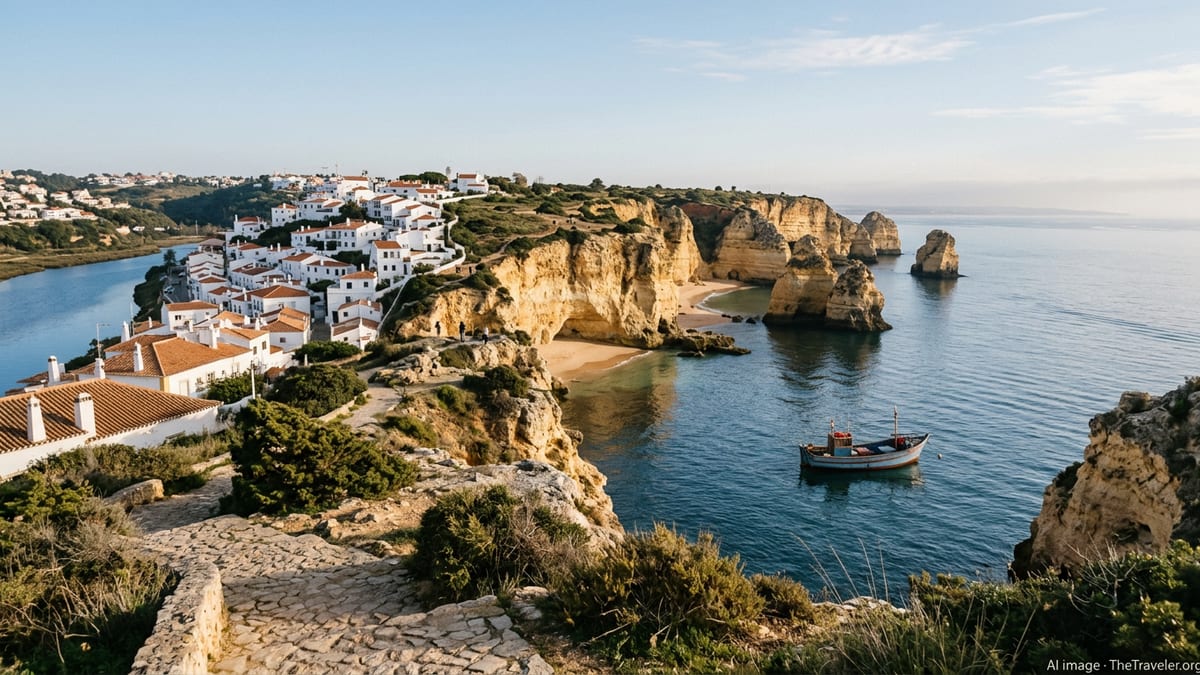
In the far south, the Algarve has long been Portugal’s best-known beach region. Its popularity stems from a combination of reliable sunshine, relatively mild winters, and a coastline rich in cliffs, coves, and long sandy stretches. The central and western parts of the region are particularly dramatic, with honey-colored limestone formations eroded into arches, sea stacks, and grottoes. Early morning and late afternoon light bring out the textures in these rock faces, while boat tours and coastal paths reveal perspectives that are impossible to appreciate from a single beach towel.
Beyond the main resort towns, travelers willing to venture slightly farther find quieter corners that still feel tied to fishing and farming traditions. In the eastern Algarve, the coastline softens into islands and sandbanks that shelter lagoons and birdlife, while whitewashed towns preserve a more low-rise profile. To the west, the land narrows to a promontory often described as the end of the continent, marked by a historic fortress and lighthouse. Standing here on a windy day, looking out over cliffs beaten by Atlantic swells, many visitors feel a heightened sense of Portugal’s maritime identity.
The Algarve has expanded its offerings in recent years to attract travelers who want more than sun and sea. Walking routes along the cliffs and through the interior help distribute visitors beyond a handful of famous coves, while local authorities and guides emphasize the importance of staying on marked paths and respecting fragile vegetation along the coast. Inland, olive groves, cork oak forests, and traditional villages offer a slower pace, with small country restaurants serving regional dishes that rely heavily on fresh seafood, vegetables, and locally produced olive oil.
Because the Algarve remains one of Portugal’s busiest regions, timing and location matter. Shoulder seasons outside the peak summer months often deliver pleasant weather with thinner crowds, and choosing a base in or near a smaller town can provide easier access to both beaches and countryside. With thoughtful planning, even this well-known region can still feel like an exploration rather than a race from one viewpoint to the next.
Coimbra, Central Monasteries, and Portugal’s Scholarly Heart
Between Lisbon and Porto, central Portugal hides some of the country’s most significant historic sites, often in quieter settings. The city of Coimbra, rising steeply from the banks of the Mondego River, is dominated by one of Europe’s oldest universities. Its hilltop campus, with elaborate gateways and courtyards, has shaped the city’s character for centuries. Students in traditional capes still gather in squares and cafés, especially at the start of the academic year, and university traditions are woven into local music and festivals.
One of Coimbra’s most celebrated attractions is its historic library, admired for its baroque interior and carefully preserved collections of rare books. Visiting is typically done on timed-entry tickets to protect the fragile environment, and the brief time allowed inside encourages guests to look closely at painted ceilings, gilded woodwork, and shelf after shelf of leather-bound volumes. Elsewhere in the city, former monasteries, botanical gardens, and riverside promenades provide contrasting spaces for reflection and relaxation.
The broader central region is also home to several monumental monasteries that played key roles in Portuguese history. Large complexes built in Gothic and later styles anchor small towns and rural areas, their cloisters and chapter houses offering a sense of the religious and political power they once embodied. Some were founded to commemorate major battles or victories, and they serve as burial places for members of medieval dynasties. Intricate stonework, including carved tracery and sculpted figures, rewards visitors willing to pause and look beyond the sheer scale of the buildings.
Many of these sites receive fewer international visitors than the major cities, which can make them feel especially atmospheric. Wandering almost alone through a vast church nave or open cloister can leave a strong impression, particularly for travelers interested in architecture or history. Combining a stop in Coimbra with visits to a monastery or two allows for a deeper understanding of how learning, faith, and royal power intersected across centuries in Portugal’s heartland.
Island Escapes: The Azores and Madeira’s Natural Drama
For travelers ready to look beyond mainland Portugal, the Atlantic archipelagos of the Azores and Madeira offer some of the country’s most striking natural attractions. Scattered across the ocean between Europe and North America, the Azores consist of nine main islands formed by volcanic activity. Their landscapes include crater lakes, steaming vents, green pastures, and rugged coastlines where waves crash against black lava cliffs. Weather here can shift quickly, with sun, mist, and showers often sharing the same day, but these changing conditions contribute to the islands’ rich vegetation and dramatic skies.
On São Miguel, the largest island, visitors are drawn to viewpoints over twin-colored crater lakes and to valleys where hot springs emerge near tea plantations and dairy farms. Other islands offer their own highlights, from high volcanic cones and vineyards planted in walled plots to waterfalls, calderas, and remote coastal trails. Whale and dolphin watching has become a major draw across the archipelago, with local operators working under regulations designed to keep a safe distance and minimize disturbance to marine life.
Farther south, closer to the coast of North Africa, Madeira presents a different island experience. Known for its steep mountains and deeply cut valleys, it has long been a favored destination for walkers and gardeners. One of Madeira’s most distinctive attractions is its network of levadas, narrow irrigation channels originally built to bring water from the rainy north side of the island to the drier south. Footpaths that run alongside many of these channels now form a web of hiking routes that range from gentle walks through laurel forests to more exposed cliffside paths with expansive ocean views.
Both the Azores and Madeira place growing emphasis on sustainability and controlled tourism. Authorities and local communities monitor trail use, limit access to especially fragile areas, and encourage activities that align with conservation goals, such as guided hikes, low-impact whale watching, and agricultural tourism. For visitors, this means that reservations and advance planning are often essential, especially in peak seasons, but the reward is an island experience that still feels anchored in local life and close to nature.
Peneda-Gerês and Portugal’s Wild North
Travelers who associate Portugal primarily with beaches and cities are often surprised by the rugged character of the country’s far north. Near the border with Spain, Peneda-Gerês National Park protects a large area of mountains, forests, and traditional villages. As Portugal’s only national park, it holds particular significance for conservation, preserving habitats for a wide range of plant and animal species. Granite peaks, deep valleys carved by rivers, and high plateaus create a varied landscape that changes markedly between seasons, from spring wildflowers to autumnal golds and browns.
Human presence here is longstanding but relatively light, as reflected in stone villages, terraced fields, and traditional communal granaries that dot the hillsides. Visitors can still see herds of goats or cattle being moved along ancient paths, and some communities maintain seasonal transhumance traditions, moving livestock between summer and winter pastures. Historical remains, including megalithic structures and traces of Roman roads, offer reminders that humans have navigated these mountains for millennia.
Hiking is the most rewarding way to experience Peneda-Gerês. Marked trails of varying lengths and difficulties lead to viewpoints, waterfalls, and high ridgelines, while shorter walks connect villages, chapels, and sanctuaries that have long been pilgrimage destinations. Because the terrain can be demanding and weather is changeable, local advice is invaluable, and many visitors opt to explore at least part of the park with experienced guides who understand both the environment and local customs.
As with many protected areas, balancing visitor access with environmental protection is an ongoing concern. Authorities limit development within the park, regulate camping, and monitor popular swimming spots and viewpoints to avoid excessive pressure. Travelers can play a role by staying on designated paths, minimizing noise and waste, and choosing accommodations and tour operators that follow clear sustainability practices. Those who do so are rewarded with one of Portugal’s most immersive natural experiences, a counterpoint to the country’s urban and coastal attractions.
The Takeaway
Portugal’s appeal lies in the richness it packs into a relatively compact territory. The grand riverfront monuments and steep neighborhoods of Lisbon, the misty palaces and gardens of Sintra, the wine terraces of the Douro, and the cliffs and coves of the Algarve each show a different facet of the country’s identity. Inland cities and monasteries highlight a long scholarly and religious tradition, while the Atlantic islands and northern national park reveal a wilder side where nature still holds clear sway. Taken together, these places form a mosaic that can keep travelers returning to Portugal again and again.
No single itinerary can capture all of these attractions in depth, so the most satisfying trips are often those that focus on a few regions at a time. Whether you are planning a long weekend centered on a single city or a multi-week journey that links mainland, mountains, and islands, the key is to balance headline sights with quieter moments. Leave room for a spontaneous village café, an unscheduled viewpoint, or an evening walk along a river or cliff path. In Portugal, some of the most enduring memories come not only from famous monuments, but from these unscripted, everyday encounters with place and people.
FAQ
Q1. How many days do travelers need to see Portugal’s top attractions?
For a first visit that includes Lisbon, Sintra, Porto, and the Douro, many travelers find 10 to 14 days comfortable. Adding the Algarve, islands, or the north typically requires at least a few extra days.
Q2. When is the best time of year to visit Portugal?
Late spring and early autumn generally offer pleasant temperatures, longer daylight, and somewhat fewer crowds than the peak summer months, especially in coastal and city destinations.
Q3. Is it easy to travel between Portugal’s main attractions by public transport?
Major routes linking Lisbon, Porto, Coimbra, and regional hubs are well served by trains and buses. More remote areas, including parts of the Algarve interior, the Douro vineyards, and Peneda-Gerês, may require rental cars or guided tours.
Q4. Do travelers need a car to explore the Douro Valley?
A car can offer flexibility, but it is not strictly necessary. Many visitors rely on a combination of trains, river cruises, and transfers arranged by wine estates or tour operators to experience key viewpoints and vineyards.
Q5. Are Sintra’s palaces suitable for travelers with limited mobility?
Some palace interiors and gardens involve steep paths, stairs, and uneven surfaces. However, certain viewpoints and sections are more accessible, so it is advisable to check current accessibility details in advance and allow extra time.
Q6. How crowded do the Algarve’s beaches get in summer?
In July and August, popular beaches and cliffside viewpoints can feel very busy, especially near major resort towns. Choosing lesser-known coves, visiting early or late in the day, or traveling in shoulder seasons can provide a calmer experience.
Q7. Is it worth flying to the Azores or Madeira on a short trip?
If you have fewer than seven or eight days in total, adding an island can feel rushed. With 10 days or more, dedicating several days to either the Azores or Madeira can be very rewarding, especially for nature-focused travelers.
Q8. What should travelers pack for visiting Portugal’s different regions?
Comfortable walking shoes, layers for shifting temperatures, a light waterproof jacket, sun protection, and swimwear cover most needs. In mountainous or island areas, extra warm layers and more robust footwear are useful.
Q9. Are Portugal’s top attractions suitable for families with children?
Yes, many highlights, from castles and palaces to beaches and island landscapes, appeal to children. Families often appreciate mixing city days with time outdoors in the Algarve, the Douro, or the islands to balance sightseeing with play.
Q10. How can travelers visit popular sites in Portugal more sustainably?
Choosing train travel where possible, visiting in shoulder seasons, supporting locally owned businesses, carrying reusable bottles, and respecting marked trails and local regulations all help reduce environmental impact while exploring the country.