

More news on this day
Travellers at Toronto Pearson International Airport faced hours of disruption as 149 delays and 17 cancellations rippled across key transborder routes to Chicago, Miami and Dallas, affecting operations by Air Canada, WestJet, United Airlines and other carriers.
Get the latest news straight to your inbox!
Stranded Travellers Confront Mounting Delays
Toronto Pearson International Airport, Canada’s busiest air hub, saw a fresh wave of operational disruption as dozens of departures and arrivals were pushed back or scrubbed altogether. Publicly available flight-tracking data indicated at least 149 delayed services and 17 cancellations tied to the airport over the course of the day, stranding passengers in terminals and on aircraft waiting for new departure times.
The disruption hit a mix of domestic and international services, but the most visible impact for many travellers came on high-frequency transborder routes connecting Toronto with major U.S. hubs. Flights serving Chicago, Miami and Dallas were among those delayed, amplifying the effect on connecting passengers heading deeper into the United States and onward to Latin America and Europe.
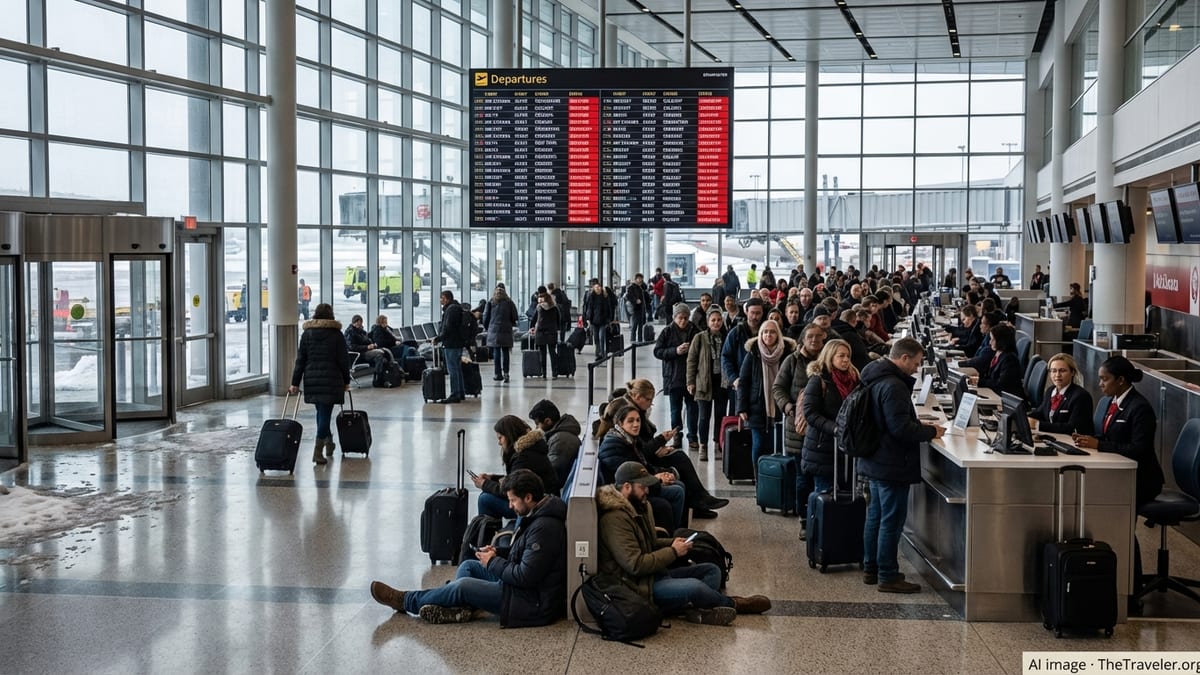
Images and updates shared on social media from inside Pearson showed crowded gate areas, long customer-service queues and departure boards dominated by yellow and red delay markers. Travellers described repeated schedule changes as crews and aircraft were repositioned, with some services pushed back by several hours.
While the precise blend of causes varied by flight, operational data and published coverage pointed to a mix of knock-on congestion, shifting crew availability and broader North American network strain that has periodically affected major hubs since early spring.
Chicago, Miami and Dallas Feel the Knock-On Effects
The disruption at Toronto quickly spilled over to partner airports in the United States. Chicago, Miami and Dallas, which are all linked to Pearson by multiple daily services, experienced arrival delays and schedule reshuffles as aircraft departed Canada behind schedule or were removed from rotation due to cancellations.
These three cities function as important connecting points in their respective regions. Chicago sits at the heart of the U.S. Midwest aviation network, Miami is a key gateway to the Caribbean and Latin America, and Dallas is a major transfer point for travel across the southern United States. When Toronto-based flights arrive late or not at all, the result can be misaligned connections, crew timeouts and further delays on subsequent legs originating from those hubs.
Airport status boards in those cities reflected the ripple effect, with several Toronto-linked flights marked as late, diverted or cancelled. Passengers who had planned straightforward one-stop journeys found themselves rebooked through alternative airports or forced to overnight while waiting for the next available seats.
Transborder routes between Canada and the United States are particularly sensitive to schedule disruptions because they are often timed to feed morning and evening banks of long-haul departures. A delay on a single Toronto–Chicago rotation, for example, can cascade through an airline’s afternoon and evening operations, affecting travellers far beyond the original pair of cities.
Air Canada, WestJet, United and Others Struggle to Stabilize Schedules
The latest disruption involved a cross-section of carriers operating at Toronto Pearson. Flight data showed that Air Canada and its regional affiliates, WestJet and U.S. partner airlines such as United were all contending with off-schedule operations on services linking Toronto with Chicago, Miami and Dallas.
Air Canada, as Pearson’s largest tenant, faced particular scrutiny, with numerous delayed departures and arrivals across its North American network. WestJet, which also serves several U.S. destinations from Toronto, appeared in delay statistics as aircraft turned later than planned or waited for connecting passengers from other disrupted flights.
United and other U.S. carriers operating transborder services were managing their own scheduling issues as late-arriving aircraft from Toronto compressed turnaround times at U.S. hubs. Some carriers opted to consolidate lightly booked flights or swap in different aircraft types, while others issued travel waivers that allowed passengers to move onto alternative services without additional fees, according to publicly available advisories.
Operational planners across these airlines were effectively engaged in real-time triage, attempting to prioritize routes with the highest passenger loads and the fewest alternative options. That often left travellers on off-peak or secondary departures facing the longest waits for rebooking.
Passenger Experience Marked by Long Queues and Limited Options
For passengers on the ground, the immediate effect of the disruption was a familiar blend of uncertainty and inconvenience. At Toronto Pearson, long lines formed at customer-service counters as travellers sought new itineraries, meal vouchers or hotel accommodation after missed connections. Self-service kiosks and mobile apps offered some rebooking options, but availability on later flights to Chicago, Miami and Dallas tightened quickly as the day wore on.
Families traveling for holidays and business travellers with tight schedules were particularly affected. Some opted to reroute through alternative U.S. gateways such as New York, Newark or Philadelphia when seats opened up, while others chose to delay their trips entirely rather than accept lengthy layovers.
Travel advisers routinely recommend that passengers build extra time into itineraries that rely on connecting flights through busy hubs, especially during periods of heightened operational strain. The situation at Toronto Pearson underscored that guidance, as even relatively short initial delays were enough to break planned connections at downstream airports.
Consumer advocates continue to urge travellers to familiarize themselves with airlines’ specific policies on delays and cancellations, including eligibility for hotel accommodations, meal vouchers and refunds, which can vary depending on whether a disruption is within a carrier’s control or linked to external factors.
Ongoing Strain Highlights Fragility of North American Air Networks
The latest wave of delays and cancellations at Toronto Pearson comes amid a broader pattern of volatility across North American air travel. Seasonal weather, complex crew scheduling rules and tightly packed timetables have all contributed to a system where minor local issues can quickly escalate into multi-hub disruptions.
Traffic statistics show that Pearson continues to handle hundreds of daily flights, with a substantial portion involving cross-border links to the United States. Chicago, Miami and Dallas feature prominently in those schedules, reflecting deep commercial and leisure demand between Canada and U.S. markets. That same density, however, means that any breakdown in punctuality quickly affects large numbers of passengers.
Industry observers note that airlines and airports have invested in technology and staffing to improve resilience, but acknowledge that recovery from disruptions can still take several days, particularly when aircraft and crews are out of position. Travellers affected by the latest Pearson-related delays are expected to feel the impact not only on the day of the disruption, but also in the form of fuller flights and fewer available seats in the immediate aftermath.
With the busy spring and summer travel seasons approaching, the events at Toronto Pearson serve as a reminder that travellers may wish to monitor flight-status tools closely, allow generous connection windows and keep contingency plans in mind when planning trips through major hubs in both Canada and the United States.