

More news on this day
Toronto is rolling out an aggressive mix of transit upgrades, traffic controls and stadium access changes ahead of the FIFA World Cup 2026, aiming to keep hundreds of thousands of visitors, residents and workers moving smoothly during one of the busiest summers the city has ever faced.
Get the latest news straight to your inbox!
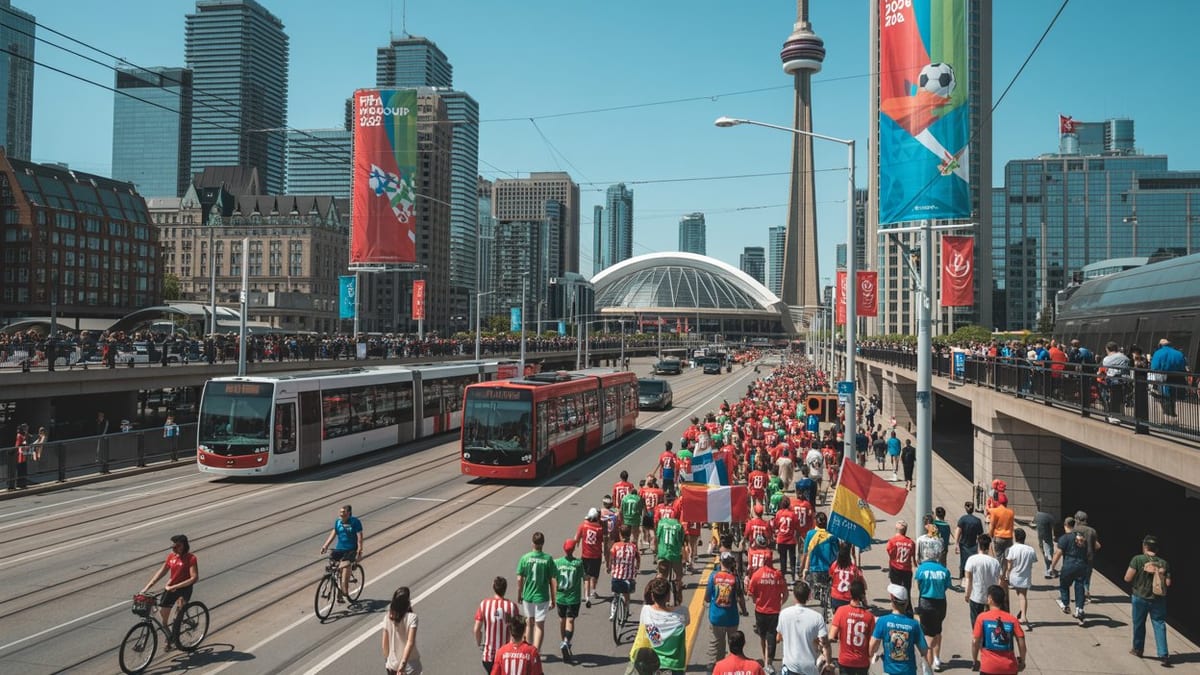
Image by Travel And Tour World
Match-Day Mobility Plan Targets Toronto Stadium and Waterfront
Publicly available information shows that Toronto will host six World Cup matches at Toronto Stadium, the tournament name for BMO Field, starting with Canada’s opening group game on June 12, 2026, and including a knockout match on July 2. Forecasts cited in recent coverage suggest crowds of more than 45,000 per game at the venue, plus up to 20,000 people per day at the nearby FIFA Fan Festival along the waterfront and Exhibition Place grounds.
A newly released World Cup mobility plan focuses on the tight cluster of neighbourhoods around the stadium, including Exhibition Place, Liberty Village, Fort York and the central waterfront. The document outlines layered measures that range from transit service boosts to special traffic zones designed to prioritize buses, streetcars, pedestrians and cyclists on match days.
One of the defining features of the plan is an explicit push to keep private vehicles away from the immediate stadium area. Reports indicate that there will be no general public parking at Toronto Stadium or on adjacent Exhibition Place lands during the tournament, with only limited, pre-arranged spaces for accredited groups. Event organizers and city communications are steering fans instead toward transit, walking and cycling as the primary ways to access the venue.
With ticket demand for the World Cup measured in the hundreds of millions of global requests, Toronto’s role as a major North American gateway has added urgency to getting the local end of each trip right, from airport arrivals to the last kilometre of travel to the stadium gates.
GO Expansion, SmartTrack and Union Station Upgrades Anchor Rail Access
Regional rail is set to do much of the heavy lifting during the tournament. The province and Metrolinx continue work under the GO Expansion program, which is designed to add more trains, more often, on core commuter corridors feeding into Union Station. Recent project materials highlight new track, signalling and platform upgrades at Union Station intended to increase capacity and improve passenger circulation before 2026.
Within the city, Toronto’s long-running SmartTrack Stations Program is another piece of the World Cup puzzle. The program, jointly funded by the city, federal government and province, is building a series of new urban GO stations at key locations such as King–Liberty, Bloor–Lansdowne and Finch–Kennedy. These infill stops are intended to turn existing commuter rail lines into more subway-like services for city riders, with King–Liberty in particular positioned to serve Liberty Village and the western approach to the stadium precinct.
Project descriptions from the city and Metrolinx stress that these stations are being integrated with the broader network, including TTC surface routes and, over time, new rapid transit such as the Ontario Line and future waterfront light rail. For World Cup visitors staying in hotel districts or short-term rentals beyond downtown, the expanded network is expected to offer additional one-transfer options to reach the stadium area via Union Station and the Exhibition GO corridor.
Technical investments are also reshaping how the system runs behind the scenes. Rail industry briefings describe significant spending in Ontario on modern communication-based train control and digital signalling, aimed at allowing trains to run closer together with higher reliability. While these upgrades will serve riders well beyond 2026, officials have cited the tournament as a key milestone for bringing new capacity online.
TTC Network Plan Adds Service to the West End and King Corridor
On the local side, the Toronto Transit Commission has begun detailing its 2026 network plan with the World Cup explicitly in mind. A recent planning document outlines a 25-point action plan that includes preparations for tournament operations, with particular attention to routes linking downtown with Toronto Stadium and the waterfront.
Streetcar and bus corridors along King Street, Queen Street and the waterfront are identified as critical match-day arteries. Public materials indicate that the TTC is coordinating closely with city traffic management teams to maintain dedicated transit priority where possible, even as some road space is reallocated for fan movement, security perimeters and temporary logistics zones around Exhibition Place.
There is also a focus on coordinating with GO Transit to make transfers as seamless as possible, including exploration of a regional visitor transit pass that could cover both local TTC services and regional rail. Such a pass, if finalized, would simplify fare payment for international visitors unfamiliar with different ticketing systems and help encourage transit use over private shuttles or ride-hailing vehicles.
At the same time, infrastructure maintenance has been carefully sequenced around the event calendar. Planning reports and local coverage describe a two-stage approach to major work on key streetcar corridors, with essential life-extension repairs scheduled before summer 2026 and more disruptive long-term upgrades pushed to the period after the tournament to avoid undermining capacity when it is needed most.
Traffic Restrictions, Walking Routes and Micromobility Options
The city’s mobility plan pairs transit upgrades with a dense package of traffic controls. Draft summaries point to rolling road closures, temporary no-parking zones and curb-lane changes around Toronto Stadium, Liberty Village and Fort York on match days, with separate but overlapping measures in place for days with large fan festival crowds at the waterfront.
Drivers can expect travel times into the core to lengthen, especially at peak hours. A recent modelling exercise reported in local media suggested that downtown traffic volumes could surge by as much as 15 percent during the tournament if no action were taken. The finalized plan seeks to blunt that impact by managing through-traffic away from the stadium zone and encouraging those who must drive to park further from the core and complete their journey on transit.
For visitors on foot, the city is emphasizing clearly marked walking corridors between Union Station, the waterfront, Liberty Village and Toronto Stadium. Wayfinding, crowd marshaling and temporary pedestrian-only segments are being designed to keep foot traffic moving while separating spectators from loading docks and service yards that must remain active during events.
Micromobility will also play a larger role than at past tournaments. Travel guides and local operators highlight Toronto’s bike-share system, which has expanded across the downtown core and waterfront, as well as designated cycling routes linking popular hotel districts with Exhibition Place. Additional bike parking and staging areas are expected near but not directly adjacent to security perimeters, giving cyclists a convenient way to complete the last leg of their journey without conflicting with stadium screening zones.
What Fans Should Expect on the Ground in Summer 2026
For international visitors, the most important takeaway is that Toronto is treating transit as the default way to reach World Cup events. Fans arriving at Pearson or Billy Bishop airports will find rail, bus and shuttle connections feeding into the TTC and GO systems, with Union Station serving as the main interchange between regional and local services.
On match days, organizers and transit agencies are advising spectators to allow extra time for every segment of their journey, including stadium entry. Variable service patterns, temporary street closures and security measures will change the feel of familiar routes, even for locals. Published guidance also urges visitors to check official schedules frequently, as game times, concurrent events and construction staging will all affect how trains, buses and streetcars are deployed.
Residents and workers in downtown neighbourhoods are being encouraged through city communications to plan ahead as well. World Cup preparations intersect with Toronto’s broader construction season and long-term transit expansion, meaning that some degree of congestion and disruption will be unavoidable despite the extensive planning now underway.
Even so, planners and analysts often point out that the same projects being accelerated for the World Cup are designed to leave a lasting legacy. Once the final whistle blows in July 2026, Toronto will be left with a more robust regional rail network, new urban stations, modernized signalling and a more finely tuned playbook for managing mobility during major events, reshaping everyday travel long after visiting fans have gone home.