

More news on this day
Travelers across Europe and the North Atlantic are gearing up for a rare celestial spectacle on August 12, 2026, when a total solar eclipse will cast a sweeping shadow across Greenland, Iceland and northern Spain, briefly turning daytime skies into twilight along a narrow path of totality.
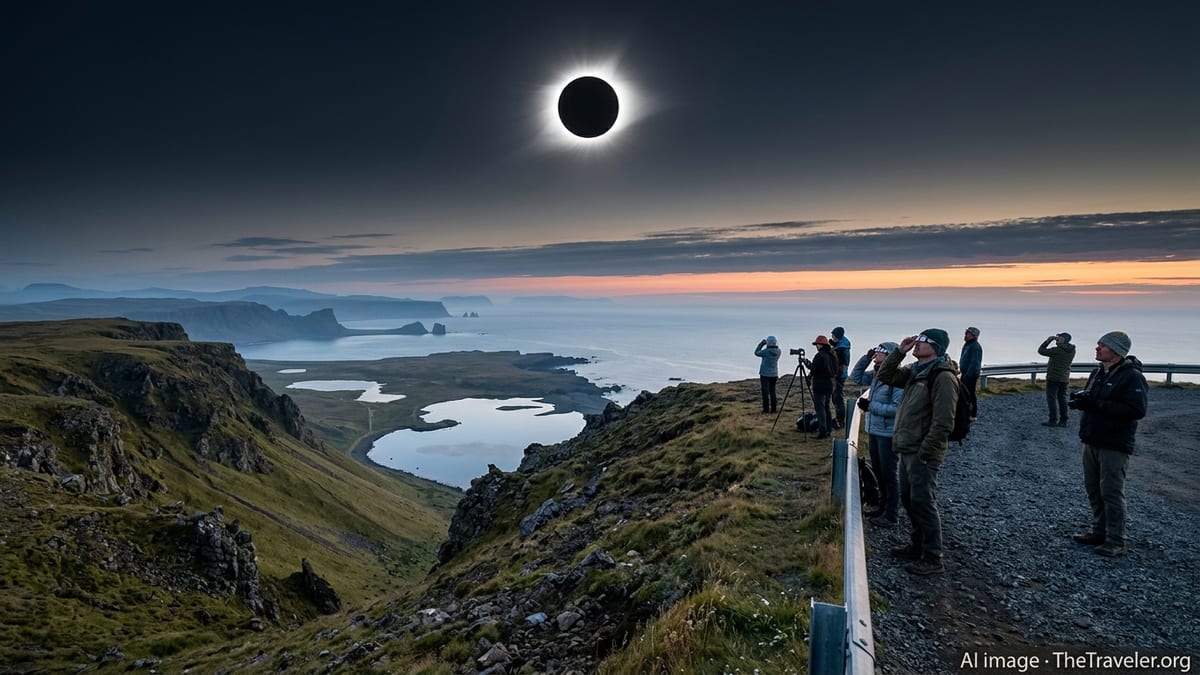
A Rare Path Across Greenland, Iceland and Spain
The total solar eclipse of August 12, 2026 is set to be one of the decade’s most anticipated astronomical events, with the Moon’s shadow tracing an unusually northerly route. Publicly available eclipse maps show the path of totality beginning at sunrise over remote Siberia before crossing the Arctic Ocean, clipping eastern Greenland, sweeping over western Iceland and then racing across northern Spain and the Balearic Islands.
Northern Europe and large parts of Africa will experience a partial eclipse, but only travelers positioned within the path of totality will see the Sun fully obscured for up to about two minutes. Forecasts and recent coverage highlight that the point of maximum duration lies just off Iceland’s west coast, while parts of northern Spain and the Balearic Islands are expected to enjoy well over a minute of totality before the event ends at sunset over the Mediterranean.
The event carries particular significance for Europe. Reports note that this is the first mainland total solar eclipse in Europe since 1999 and the first total eclipse visible from Iceland since the 1950s. For Spain, it is the first of two closely spaced total eclipses, with another due to cross the country in August 2027, adding to the sense of anticipation among astronomers and eclipse-chasing travelers.
Iceland: Dramatic Landscapes in the Heart of Totality
Iceland is emerging as one of the marquee destinations for August 12, 2026, combining a prime position in the path of totality with dramatic volcanic scenery and relatively easy access for visitors from Europe and North America. According to eclipse-focused travel guides, the Moon’s shadow will cross the island from northwest to southwest, placing the Westfjords, Snæfellsnes Peninsula, Reykjanes Peninsula and areas west of Reykjavík within or very close to the center line.
In some locations, such as coastal viewpoints in western Iceland, totality is projected to last around two minutes, with the Sun comfortably above the horizon compared with the low, near-sunset geometry further south in Spain. Local tourism information emphasizes that the country’s wide horizons, sparse tree cover and rugged coastlines may offer sweeping views of the Moon’s shadow racing across the landscape, and potentially of the eclipse reflected in fjords and open ocean.
At the same time, planners are urging realism about Iceland’s notoriously changeable summer weather and limited infrastructure. Public commentary and tourism advisories point to rapidly filling accommodation in west Iceland for the days around August 12 and warn that key roads are likely to be heavily congested on eclipse day. Travelers are being encouraged to book early, stay within the path of totality the night before, and build flexibility into their plans to move if local cloud forecasts shift.
Spain and the Balearic Islands: Sunshine, Sunset and Totality
Farther south, northern Spain and the Balearic Islands offer a very different take on the same cosmic event. Eclipse atlases and recent science coverage show the path of totality making landfall in the northwest of the Iberian Peninsula, then cutting diagonally across northern Spain before exiting over the Mediterranean, where Mallorca and neighboring islands will see totality close to sunset.
Many travelers and astronomers are eyeing Spain for its statistically clearer August skies, established tourism infrastructure and easier overland access from the rest of Europe. Travel industry materials describe likely hot, dry conditions in interior regions and around the Ebro valley, making them attractive options for those prioritizing clear skies. Coastal areas along the Bay of Biscay may face more variable weather, pushing some visitors to consider inland plateaus or southeastern portions of the path.
The Balearic Islands are expected to provide a particularly photogenic experience, with the eclipsed Sun hanging low over the sea near sunset. Projections suggest slightly shorter durations of totality here than in Iceland, but the combination of Mediterranean light, seascapes and a darkened horizon is already featuring heavily in early tour offerings. With major Spanish cities such as Madrid and Barcelona lying outside the path, domestic travelers are expected to join international visitors in moving into the totality zone, increasing pressure on transport and lodging.
Greenland and the Arctic: Remote Front-Row Seats
For travelers seeking a more remote adventure, Greenland and the surrounding Arctic seas present some of the most pristine vantage points on August 12, 2026. Eclipse maps indicate that the Moon’s central shadow will arc across eastern Greenland, passing over sparsely populated regions where only small settlements and research outposts lie under the path.
Specialist travel providers and cruise lines are responding by planning North Atlantic itineraries that position ships along the center line near Greenland and between Greenland and Iceland. Promotional materials describe opportunities to combine the eclipse with glacier scenery, icebergs and, for those staying longer into August nights, a slim chance of early-season aurora in dark enough skies.
Logistics, however, are complex. Publicly available information highlights limited air connections, tight capacity at small ports and the need for expedition-style planning in regions where weather can change rapidly and sea ice can still affect routes. For many travelers, Greenland will remain an aspirational option rather than a practical choice, but it is likely to attract dedicated eclipse chasers and polar travelers looking to combine multiple bucket-list experiences in a single journey.
Planning Ahead: Safety, Crowds and Practical Tips
With less than two years to go, astronomy outlets and travel planners are emphasizing that August 12, 2026 should be treated less as a single day trip and more as a time-bound event requiring careful preparation. Accommodation along the path of totality in both Iceland and northern Spain is already filling for the peak period around the eclipse, and reports from booking platforms indicate a pronounced spike in demand for August 2026 stays.
Travel experts recommend that visitors prioritize flexibility within the path rather than fixating on one specific scenic spot. Being able to relocate by a few tens of kilometers on eclipse morning could mean the difference between clear skies and cloud cover. In Iceland, that may involve planning around limited road networks in the Westfjords or Reykjanes, while in Spain it could mean shifting from coastal areas to clearer inland regions based on short-term forecasts.
Safety remains another key theme in public guidance. Science publications and space agencies continue to stress that observers must use certified solar viewing glasses or appropriate solar filters whenever any part of the bright Sun is visible. Only during the brief period of totality, when the Sun is completely covered, can viewers safely look with the naked eye at the darkened disk and the pale solar corona around it. Travelers are also encouraged to plan for large crowds, strong summer sun in Spain, and cooler, windier conditions in Iceland and Greenland, packing layers, sun protection and sufficient food and water for long waits outdoors.
Whether viewed from a fjord in Iceland, a hillside in northern Spain or the deck of a ship off Greenland, the August 12, 2026 total solar eclipse is poised to be one of the standout travel events of the year. For those hoping to stand in the Moon’s shadow, the message from recent coverage and destination planners is clear: start preparing now.