

More news on this day
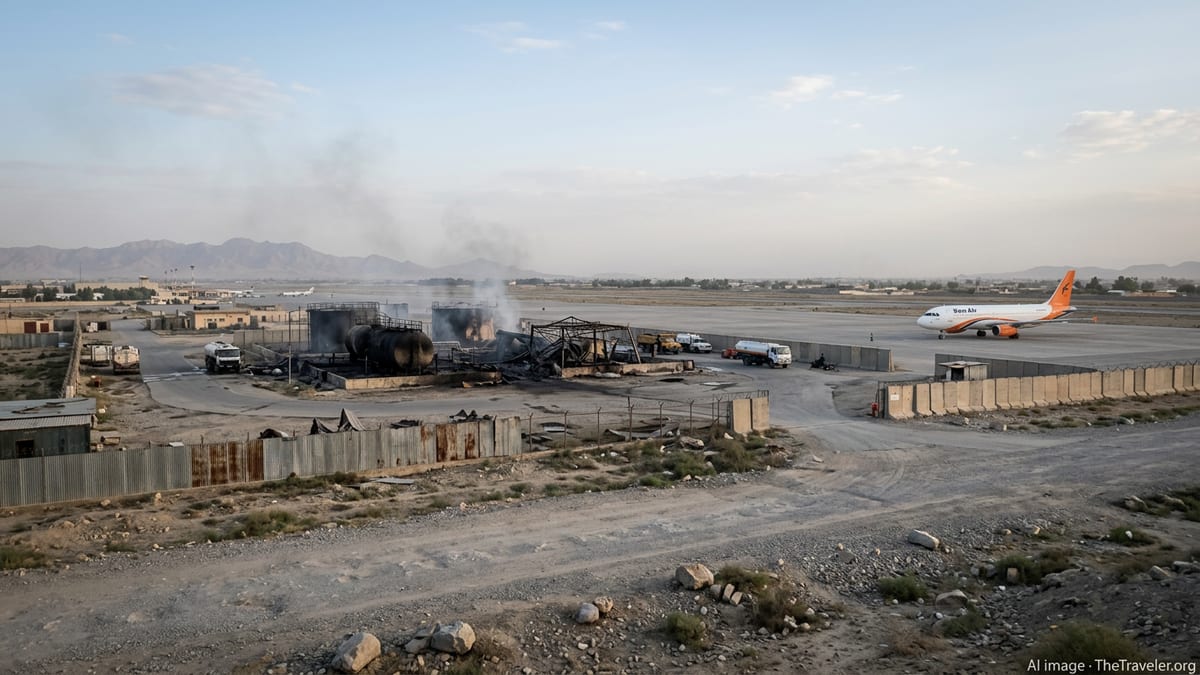
Travel to southern Afghanistan has been thrown into renewed uncertainty after airstrikes destroyed fuel facilities used by private carrier Kam Air near Kandahar airport, disrupting flight operations and dealing a serious blow to already fragile hopes of rebuilding tourism in the region.
Get the latest news straight to your inbox!
Airstrikes Disrupt Key Fuel Hub Near Kandahar
Recent air operations linked to the escalating confrontation between Pakistan and Afghanistan have reportedly struck fuel depots used by Kam Air in the vicinity of Kandahar International Airport. Publicly available information indicates that facilities supplying jet fuel for civilian carriers and humanitarian flights were heavily damaged, igniting large fires visible in videos shared on social media from March 13 and 14, 2026. The incident coincides with accounts in international news coverage noting that private airline fuel infrastructure in Kandahar was among the targets.
Reports indicate that these depots formed a central hub in the fuel supply chain for domestic aviation in southern Afghanistan. Kam Air, the country’s largest private airline, has been a primary operator on domestic routes linking Kabul with Kandahar, Herat and other regional centers. The loss of storage capacity and the heightened security risks around the airfield are expected to limit the number of flights that can safely operate until repairs, inspections and fresh supply arrangements are in place.
The strikes come amid a broader pattern of attacks on fuel and logistics infrastructure in the region, reflecting the strategic importance of energy supplies for both military operations and the basic functioning of Afghanistan’s already strained economy. For the travel and tourism sector, which relies heavily on limited air links to overcome insecurity and damaged road networks, the impact is immediate and far reaching.
Flight Cancellations Ripple Across Domestic Routes
In the days following the destruction of the depot, aviation observers and local travel operators have reported significant disruptions to scheduled services into and out of Kandahar. Published flight schedules already showed a modest level of domestic connectivity, with Kam Air operating only a handful of weekly rotations between Kabul and major southern cities. The sudden loss of on site fuel capacity near Kandahar airport raises the risk of additional cancellations, diversions or load restrictions on any flights that do attempt to operate.
Travel agencies that organize trips for journalists, aid workers and niche adventure travelers describe an environment where even minor operational shocks can cascade quickly. Southern Afghanistan’s airports have limited redundancy, and carriers often depend on a small number of suppliers and storage facilities at each field. With a key fuel node disabled, aircraft may need to carry extra fuel from other cities, reduce passenger numbers, or skip Kandahar entirely until reliability can be restored.
International overflight advisories published in early March 2026 were already urging operators to avoid landing in Afghanistan where possible and instead transit at high altitude due to security and infrastructure concerns. The attack on Kam Air’s depot reinforces these cautions, making discretionary travel, tourism charters and exploratory trips even less likely to proceed in the short term.
Setback for Emerging Cultural and Heritage Tourism
Over the past two years, a small but noticeable revival of interest in Afghanistan’s cultural heritage has taken shape, including tentative itineraries that feature Kandahar and surrounding provinces. These trips, often arranged through specialist operators, focus on historic mosques, traditional bazaars and the landscapes of the Arghandab and Helmand river valleys. Organizers rely on tight coordination of domestic flights, private drivers and local guides to minimize exposure to security risks on the ground.
The latest airstrike damage threatens to reverse these fragile gains. With fewer reliable flights into Kandahar, tour planners have limited options for building safe, time efficient routes that include southern highlights. Road journeys from Kabul or Herat remain long and, in many stretches, hazardous due to a combination of poor maintenance, heavy truck traffic and shifting security conditions documented in past accident and incident reports along the Kabul Kandahar and Kandahar Herat corridors.
Potential visitors who had been watching for signs of stabilization in Afghanistan’s south may now view the region as even less accessible. Travel risk assessments prepared for media organizations and NGOs are likely to factor in not only the security implications of regional airstrikes but also the operational fragility revealed by the destruction of a single private fuel depot. As a result, cultural tourism products that depend on Kandahar as a gateway or centerpiece may be postponed, rerouted to other cities, or cancelled entirely.
Local Economies Around Kandahar Lose Vital Visitor Spending
Although visitor numbers to Kandahar remain a fraction of pre conflict levels in Afghanistan’s more stable eras, even limited tourism has provided important supplemental income to local communities. Small guesthouses, family run restaurants, drivers, fixers and crafts vendors in and around the city benefit from the periodic arrival of foreign journalists, researchers, humanitarian delegations and highly risk tolerant adventure travelers.
With fuel infrastructure in ruins and flight schedules in flux, that trickle of visitors is likely to slow even further. Local businesses positioned around the airport access roads and in central districts depend heavily on the modest demand generated by air arrivals. Any sustained reduction in flights amplifies existing economic pressures, especially in markets that also serve transient passengers and airport staff.
The disruption also affects the supply of goods that support tourism services. Reduced air cargo capacity into Kandahar can make it harder for hotels and guesthouses to obtain imported food items, equipment and spare parts. Combined with currency volatility and chronic unemployment, the loss of predictable air links adds another layer of uncertainty for entrepreneurs who had cautiously invested in the hope of a gradual tourism rebound.
Uncertain Recovery Timeline for Air Travel and Tourism
Analysts tracking Afghanistan’s aviation sector note that the pace of recovery from the depot strike will depend on several factors, including security conditions around Kandahar airport, the availability of replacement fuel stocks, and the willingness of insurers and international partners to continue supporting operations. Publicly available reporting suggests that repair and reconstruction work on damaged infrastructure often proceeds slowly in high risk environments, where specialized contractors and equipment are scarce.
In the interim, travelers with essential reasons to visit southern Afghanistan may need to route through Kabul, Herat or international gateways and then rely on overland transfers, accepting longer journey times and higher risk profiles. Specialist operators are expected to revisit contingency plans, such as building in additional buffer days, securing alternative transport options, or concentrating itineraries in regions less exposed to active cross border tensions.
The broader question for Afghanistan’s tourism prospects is whether continued strikes on economic infrastructure will deter the limited pool of visitors who have shown interest in the country despite its political and security challenges. The destruction of Kam Air’s fuel depot near Kandahar underscores how quickly a single event can sever lifelines that connect remote cultural sites and communities to the outside world, highlighting the vulnerability of any nascent tourism recovery in the south.