

More news on this day
A tourist coach carrying holidaymakers in Odisha has crashed and come to rest across a key roadway, blocking traffic in both directions, trapping several passengers inside the vehicle and exposing others on board to dangerous roadside conditions as an official investigation into the incident gets under way.
Get the latest news straight to your inbox!
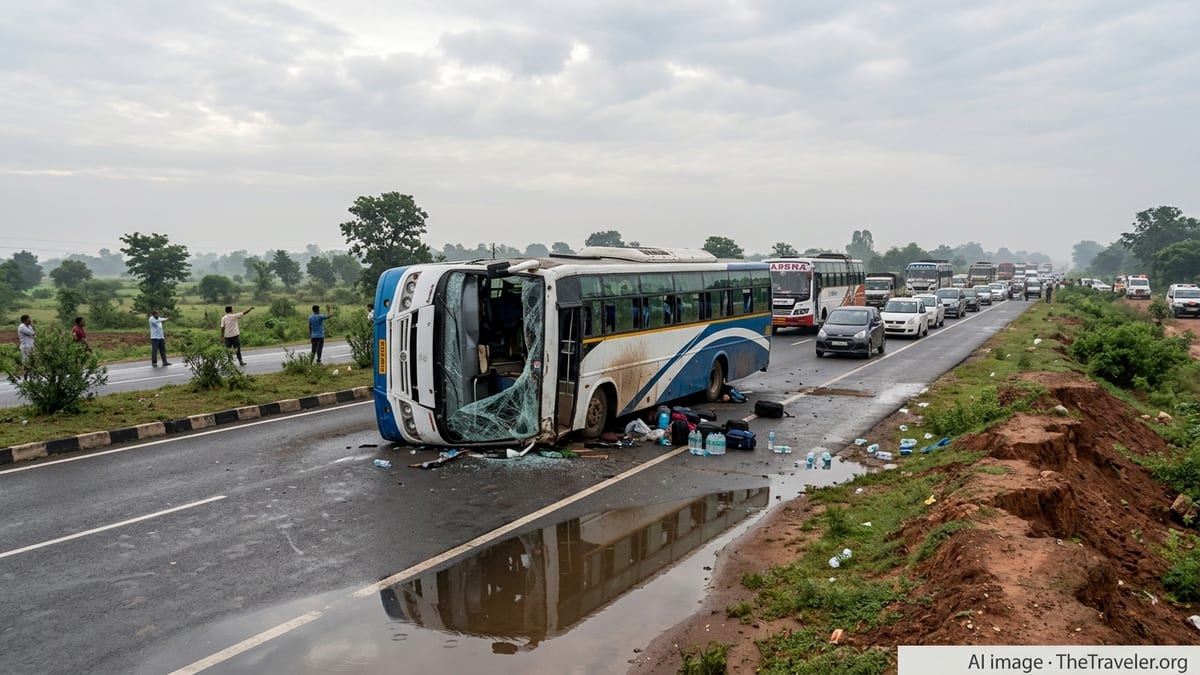
Coach Overturns on Busy Route, Turning Corridor Into Gridlock
Initial reports from regional news outlets and local broadcasters indicate that the tourist bus was traveling along a busy highway in Odisha when the driver appears to have lost control on a stretch of road described as narrow and uneven, with poor visibility and ongoing roadside works. The coach reportedly skidded, hit the embankment and tipped to its side, coming to rest across multiple lanes and instantly transforming a crucial corridor for intercity movement into a long bottleneck.
Images and video circulating on social and news platforms show the bus lying at an angle, partially on the carriageway and partially against a roadside barrier, with vehicles stacked up for a considerable distance in both directions. The position of the overturned vehicle has made it difficult for other large vehicles to navigate around the site, effectively blocking access for regular traffic and complicating efforts to reach the stranded passengers quickly.
Witness accounts shared in local coverage describe drivers abandoning their vehicles to walk toward the scene, while others attempted risky maneuvers on the highway shoulder or the opposite lane in an effort to turn back. These improvised detours have raised additional safety concerns, especially with heavy trucks and smaller vehicles competing for limited space on an already compromised road segment.
The crash occurred at a time of day when tourist and commuter traffic is typically high, intensifying the disruption. The affected route is commonly used by domestic visitors heading toward coastal and temple destinations in Odisha, and the gridlock has reportedly delayed other tourist coaches and long-distance buses attempting to access key hubs and resort areas.
Passengers Trapped Inside Wreckage Amid Hazardous Conditions
According to publicly available information from regional media, several passengers were initially trapped inside the damaged coach after the impact. The bus’s side windows and emergency exits were reportedly difficult to access once the vehicle rolled, and the narrow space between the bus and the roadside barrier limited movement around the wreckage.
Local coverage notes that some passengers managed to escape through shattered windows, while others remained pinned in their seats by collapsed luggage racks and deformed metal. Bystanders and passing motorists were seen attempting to assist, but the precarious position of the bus, along with the steady flow of vehicles trying to squeeze by, created an extremely unsafe environment for ad hoc rescue efforts.
The crash site itself has been described as treacherous, with loose gravel, broken glass and spilled fuel on the tarmac, heightening the risk of slips and secondary collisions. Intermittent rainfall in parts of Odisha in recent days has also been cited in commentary as a factor that may have reduced tire grip and visibility on the route, though the precise weather conditions at the time of the crash remain to be clarified.
Medical teams and recovery crews have faced delays reaching the location due to the solid line of vehicles backed up on both sides of the accident. Reports indicate that some injured passengers were treated at the roadside before being transferred to nearby health facilities once ambulances and support vehicles could thread their way through the congestion.
Road Safety Concerns Highlighted on Key Tourist Corridors
The incident has once again brought attention to the vulnerability of tourist and long-distance buses traveling on mixed-traffic highways in eastern India. Odisha has sought to expand its tourism footprint in recent years, promoting coastal retreats, wildlife reserves and heritage temples, but critics in transport and civic forums have repeatedly warned that infrastructure and enforcement have not kept pace with rising vehicle numbers.
Commentary in regional newspapers and on social media has pointed to a combination of factors that frequently contribute to serious bus crashes: fatigued drivers working long shifts, inadequate vehicle maintenance, overloaded coaches, and highway stretches where ongoing construction, sudden lane drops and poor lighting increase the margin for error. Curving sections near river crossings and hilly stretches in parts of the state have also been singled out as high-risk zones, particularly during periods of heavy tourist movement.
In the latest crash, the highway segment where the bus overturned has been described in prior local reporting as prone to congestion and abrupt braking, with roadside activity, informal stopping points and limited shoulders. Travel advocates argue that such conditions are especially dangerous for high-center-of-gravity vehicles like tourist coaches, which can become unstable when forced into sudden evasive maneuvers or hard braking on uneven surfaces.
Travel industry observers note that high-profile accidents can have a chilling effect on domestic tourism, particularly among group tour operators that rely on overnight or long-distance coach travel. Some companies may temporarily reroute itineraries or switch to alternative modes of transport on certain stretches while they monitor official findings from the ongoing investigation.
Investigation Focuses on Driver Actions, Vehicle Condition and Road Design
Regional and national outlets report that an inquiry has been launched to determine the primary and contributing causes of the Odisha tourist bus crash. Investigators are expected to examine the driver’s recent work schedule, training records and any available in-vehicle data related to speed and braking before the collision. Toxicology results, once available, may also help clarify whether impairment played any role.
The condition of the bus itself is likely to receive close scrutiny, including brake performance, tire wear, steering components and any recent maintenance history. In prior incidents involving long-distance coaches, inquiries have sometimes highlighted lapses in routine inspections or modifications that altered a vehicle’s handling characteristics, such as retrofitted air-conditioning units or rebuilt suspensions that did not align with manufacturer specifications.
Road design and management are also expected to be a significant part of the investigation. Published coverage notes that authorities have been under pressure to address crash-prone segments of key highways in Odisha, including by improving signage, enforcing lower speed limits near work zones, adding guardrails and providing dedicated lay-bys for buses to stop without obstructing traffic. The precise layout of the crash location, including curves, gradients, surface condition and the presence of roadworks or diversions, will be assessed to determine whether infrastructure shortcomings contributed to the loss of control.
Depending on the findings, the probe could lead to recommendations on stricter enforcement for tourist operators, enhanced monitoring of vehicle fitness certificates, and targeted engineering interventions on corridors heavily used by visitors. Past accidents in the region have occasionally prompted short-term measures such as nighttime bus restrictions or intensified highway patrols during holiday periods.
Travel Disruption and Guidance for Visitors in the Region
The blockage caused by the overturned coach has had immediate repercussions for travelers attempting to move through the affected corridor. Buses and private cars heading toward popular tourist destinations have faced extended delays, with some services diverting to secondary roads that are slower and often in poorer condition.
Travel advisories circulated by tour operators and shared in local media recommend that visitors with upcoming road journeys in Odisha build extra time into their itineraries, remain in close contact with their operators and be prepared for last-minute route changes while the crash site is being cleared and the investigation continues. Travelers have also been encouraged to verify that their chosen bus operators adhere to current safety norms, including appropriate rest periods for drivers and visible evidence of recent vehicle inspections.
Transport observers suggest that visitors planning long-distance bus travel in the state consider daytime journeys where possible, both to benefit from better visibility and to reduce the fatigue burden on drivers. They also advise that passengers familiarize themselves with the location of emergency exits, seatbelts and hammers for breaking glass when boarding a coach, as basic awareness can sometimes make a critical difference in the immediate aftermath of a crash.
While the full impact of the latest bus crash on Odisha’s tourism sector will only become clear in the coming weeks, the incident has already intensified debate over how to balance rapid growth in visitor numbers with the slower, costlier process of improving road safety. For now, many travelers are watching closely for updates on the condition of those injured and the measures that may emerge from the ongoing inquiry.