

Florida is often associated with rental cars and crowded highways, but visitors increasingly have another option: a growing network of passenger trains that link major cities, airports, beaches and theme parks. From higher speed intercity trains between Miami and Orlando to regional lines serving coastal communities and airports, it is now possible to experience much of the state without driving. This guide explores the main rail options across Florida for visitors, explains what each route offers, and outlines how to combine them into easy, car free itineraries.
Understanding Florida’s Passenger Rail Network
Florida’s rail options fall into three broad categories that are useful for visitors to understand before planning a trip. First are intercity services such as Brightline and Amtrak that connect regions of the state and, in Amtrak’s case, link Florida to the rest of the United States. These trains are designed for longer journeys, offer more onboard amenities, and generally require advance reservations.
Second are regional and commuter lines that primarily serve local residents but can be very useful to visitors. SunRail in the Orlando area and Tri Rail in South Florida fit this category. They focus on weekday travel, connect suburbs with job centers and airports, and often integrate with local buses and urban rail systems. Service patterns, schedules and ticketing can differ significantly from intercity operators, so checking the latest information before travel is essential.
Third is a patchwork of urban rail and people movers, including Miami’s Metrorail and Metromover systems, which connect with Tri Rail and Brightline at several points. While not the focus of this article, these local networks matter because they are often the last link between a train station and a hotel, cruise terminal or attraction. Visitors who plan ahead can use these connections to move efficiently through some of the busiest parts of the state.
Florida’s rail system continues to evolve, with expansions underway or in planning around Orlando’s tourism corridor and additional Brightline stations scheduled on the Treasure Coast. Because of this ongoing change, it is wise to confirm current schedules and station information close to your travel dates, especially if you are coordinating multiple trains or time sensitive connections.
Brightline: Fast Travel Between Miami, Orlando and South Florida Cities
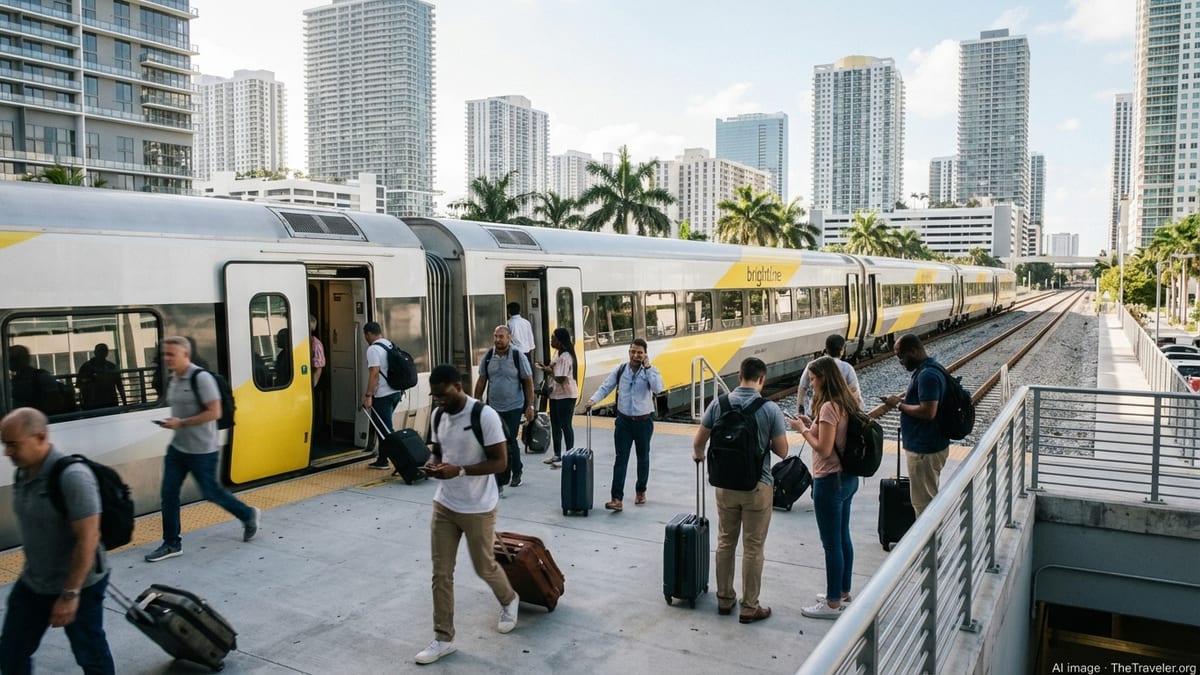
Brightline is currently the most significant new option for visitors who want to travel quickly between Central and South Florida without flying or driving. The privately operated higher speed service runs between Miami and Orlando, with intermediate stations in Aventura, Fort Lauderdale, Boca Raton and West Palm Beach. Trains use modern rolling stock, reserved seating and contemporary stations that feel more like small airports than traditional depots.
For many visitors the core benefit of Brightline is time savings and comfort. The trip between Orlando and West Palm Beach typically takes around two hours, while Orlando to Miami is generally scheduled at about three and a half hours, with multiple departures throughout the day. Onboard, passengers can expect assigned seats, at seat power outlets, complimentary Wi Fi and food and drink options. Two service classes are sold, with the higher tier offering lounge access and included snacks and beverages at most stations.
Brightline’s Orlando station sits within Orlando International Airport’s complex, connected to the main terminals by walkways and people movers. This location makes it particularly appealing for travelers arriving by air who wish to reach South Florida without renting a car. At the southern end, MiamiCentral station is in the heart of downtown, within walking distance or a short urban rail ride of many hotels, the business district and the port. Intermediate stations such as Fort Lauderdale and West Palm Beach are located in central areas with rideshare zones, local bus connections and parking.
Brightline frequently introduces special event services and promotional fares, for example additional trains and shuttle connections for major sports tournaments based in Miami. The company also periodically adjusts pricing, including commuter style passes for frequent riders, so visitors should review current fares and packages when planning trips. Demand can be high on weekends, holidays and during school breaks, and booking ahead is recommended for those periods.
Amtrak in Florida: Silver Service and the Auto Train
Amtrak remains the backbone of traditional intercity rail across Florida, especially for visitors arriving from other regions of the United States. Two long distance trains known as the Silver Star and Silver Meteor generally operate along the East Coast between New York and Miami, serving key Florida cities such as Jacksonville, Orlando, Tampa, West Palm Beach, Fort Lauderdale and Miami. Schedules and exact station stops can vary, but both trains typically provide once daily service in each direction on most segments.
These trains are oriented toward overnight and long haul travel, with coach seating and a limited number of sleeper accommodations. For visitors within Florida, they can be useful for connecting cities that Brightline does not yet serve directly, such as Tampa or smaller communities along the Atlantic coast. Traditional station buildings in cities like Orlando and Tampa often sit close to historic downtowns, making them convenient starting points for walking tours or short rideshare trips to hotels and attractions.
Another distinctive option is the Auto Train, which runs between the Washington region and Sanford, north of Orlando. This service allows passengers to bring their personal vehicles along, which are loaded onto specialized rail cars and unloaded on arrival. For visitors who want to use their own car in Florida but avoid the long drive down the East Coast, the Auto Train can be an appealing though usually premium priced alternative. It also offers an unusual overnight rail experience that some travelers specifically seek out.
Because Amtrak’s Florida routes cover very long distances, schedules can be affected by conditions elsewhere on the line, leading to occasional delays. Visitors using Amtrak for connections to cruises or time sensitive flights should plan plenty of buffer time and consider arriving the day before. Booking early is also important during peak periods such as winter holidays, spring break and major events in Orlando and Miami.
SunRail: Exploring Greater Orlando by Train
SunRail is a commuter rail line serving the Orlando metropolitan area, running on a north south axis roughly parallel to Interstate 4. It connects the northern city of DeLand through downtown Orlando to Poinciana in Osceola County. The service is primarily designed for workers and students, with weekday oriented schedules and a focus on rush hour frequency, though in recent years additional evening trains have been added to give riders more flexibility.
For visitors, SunRail can be a practical way to reach destinations such as downtown Orlando, the health and education campuses near the Health Village and Florida Hospital stations, or residential neighborhoods with growing restaurant scenes. Trains stop at a series of carefully restored historic depots and newer suburban stations, offering a different perspective on Central Florida than the familiar theme park corridors. Fares are distance based and can be purchased at machines in each station or through mobile platforms.
One important limitation for visitors is that SunRail currently does not operate regular weekend service, aside from occasional special event trains when advertised. As of late 2025 the system has focused on extending weekday service into later hours, including new late night northbound and southbound trips to help riders stay out later in the city. Travelers relying on SunRail should carefully check the latest weekday timetable and be mindful of last train times, especially when planning evening activities.
Looking ahead, planners are studying a project often referred to as the Sunshine Corridor, which would eventually connect SunRail more directly to Orlando International Airport, the International Drive resort area and major theme park districts. While this extension remains in the planning and funding stage, it reflects a broader trend toward giving both residents and visitors more car free options in one of the country’s busiest tourism markets. For now, SunRail is most useful for exploring urban Orlando rather than accessing the theme parks themselves.
Tri Rail: Linking South Florida’s Airports and Downtowns
Tri Rail is the primary commuter rail service in South Florida, operating along a corridor that roughly follows Interstate 95 from northern Palm Beach County through Broward County into Miami Dade County. It connects key hubs including West Palm Beach, Boca Raton, Fort Lauderdale, Hollywood and Miami’s major airport, with park and ride lots and bus transfers at many stations. The system runs multiple trains each weekday and somewhat reduced service on weekends, making it a flexible option for both residents and visitors.
For travelers arriving by air, Tri Rail can be particularly practical. Dedicated stations serve both Miami International Airport and Fort Lauderdale Hollywood International Airport, with people mover or shuttle connections into the terminals. This allows visitors to connect between the two airports or reach coastal cities without renting a car. Many hotels near downtowns and beaches are a short ride away by taxi, rideshare or local bus, and some offer shuttle services from nearby stations.
In early 2024 Tri Rail began serving MiamiCentral, bringing its trains directly into downtown Miami and creating an important link with Brightline. An express train pattern now offers a faster one seat ride between West Palm Beach and MiamiCentral during peak hours, with limited stops in Boca Raton, near Fort Lauderdale’s airport, and at the Metrorail Transfer Station. This express option can cut travel time by more than half an hour compared with all stop services, which is valuable for visitors trying to coordinate with flights or cruise departures.
Tri Rail continues to adapt its schedule and services to rising ridership, including later departures to accommodate airport workers and late evening arrivals. Fares are generally modest compared with intercity trains and can be purchased at station ticket machines, through the operator’s mobile app or integrated regional transit apps. Because Tri Rail shares tracks with freight and other passenger services, occasional delays are possible, so visitors should allow reasonable time buffers when connecting to time critical activities.
Planning Car Free Itineraries Across the State
With Brightline, Amtrak, SunRail and Tri Rail now in regular operation, visitors can assemble a variety of car free routes that cover much of Florida’s Atlantic side. One common pattern is to fly into Orlando, use Brightline to reach South Florida, then combine Tri Rail and local transit to explore different coastal cities before returning north. Another is to arrive by Amtrak from the Northeast, spend time in Jacksonville or Orlando, then continue south by either Amtrak or Brightline depending on the preferred route and schedule.
When planning such itineraries, the most important step is to think in terms of hubs and connections. Orlando International Airport, MiamiCentral, West Palm Beach, Fort Lauderdale’s airport station and downtown Tampa all serve as nodes where different modes intersect. Visitors should start by identifying their key destinations and then explore whether direct trains exist between them, or whether a hub transfer is necessary. It is often worth building in an overnight stay at a hub city to reduce the stress of tight connections and provide time to explore.
Because each operator manages its own ticketing and schedules, travelers will usually need to purchase separate tickets for each segment and consult multiple websites or apps. Regional trip planning apps in South Florida now combine information from several agencies and can simplify this process, showing options that blend Tri Rail, local buses and urban rail. Even with these tools, it remains wise to verify details such as station locations, baggage policies and last train times directly with each train operator shortly before travel.
Visitors who are new to rail travel in the United States should also keep expectations realistic. While Florida’s trains can be an enjoyable and often less stressful alternative to driving, not every area of the state is served, and some routes operate only a few times each day. Flexibility is important, and travelers willing to adjust schedules slightly, stay near stations and use local transit or short car trips for the last mile will generally find the experience more rewarding.
Practical Tips for Visitors Using Florida Trains
A bit of preparation goes a long way in making train travel across Florida smooth and enjoyable. First, consider your luggage. Brightline and Amtrak provide overhead space and dedicated baggage areas, and some services allow checked bags on longer routes, while commuter systems such as SunRail and Tri Rail are designed for lighter, carry on style luggage. Packing so that you can comfortably manage your bags on and off trains and through stations will make transfers easier, especially during busy times.
Second, pay close attention to station details. Some Florida train stations sit directly in walkable downtowns with clear signage and abundant services, while others are oriented to park and ride commuters with large parking lots and fewer amenities. In Orlando and Miami the main intercity stations are integrated into larger transportation hubs such as airports or downtown complexes. Reviewing station maps in advance can help you locate ride pickup zones, urban rail connections, ticket machines and restrooms without rushing.
Third, be mindful of service patterns and holidays. Commuter systems may not operate on major holidays and can have significantly reduced weekend service. Even intercity trains can run modified schedules around national holidays or during infrastructure work. Checking for service alerts and giving yourself extra time for connections is particularly important if you are heading to a cruise departure, major event or time specific attraction booking.
Finally, remember that Florida’s climate can be hot and humid much of the year. While trains and stations are generally air conditioned, platforms and station approaches may be partially open to the elements. Carrying water, sun protection and appropriate clothing will make waits on outdoor platforms more comfortable, especially in summer and during afternoon thunderstorms, which can bring short bursts of intense rain even on otherwise sunny days.
The Takeaway
Florida’s rail network has reached a point where visitors willing to plan carefully can experience much of the state without relying on a rental car. Brightline provides a fast, comfortable link between Orlando and South Florida’s major cities, while Amtrak connects Florida to the broader East Coast and offers additional options to cities like Tampa and Jacksonville. Regional systems including SunRail and Tri Rail complement these long distance routes by reaching local neighborhoods, airports and downtowns in Orlando and South Florida.
Service expansions, new stations and evolving fare structures mean that today’s options are likely to continue changing over the next several years. This dynamism is good news for travelers, who can expect more frequent trains, better connections and increasingly integrated ticketing tools. At the same time, it makes up to date research essential, particularly for complex multi city trips or visits tied to events and cruises.
For many visitors, the reward of planning around Florida’s trains is a more relaxed way to explore the state. Gliding past highway traffic, arriving in walkable downtowns and stepping off directly into airport terminals can turn necessary travel time into part of the experience. With a bit of forethought and flexibility, train routes across Florida can reshape how you see and move through one of America’s most visited states.
FAQ
Q1. Can I travel between Orlando and Miami entirely by train?
Yes. Brightline runs frequent trains between Orlando International Airport and MiamiCentral, with stops in Aventura, Fort Lauderdale, Boca Raton and West Palm Beach along the way.
Q2. Do I need a car to visit South Florida’s beaches if I use the train?
Not necessarily. Many coastal cities such as West Palm Beach, Fort Lauderdale and Miami have train stations close to downtowns where taxis, rideshares and local buses can take you to the beach in a short ride.
Q3. How far in advance should I book Brightline or Amtrak tickets?
For busy periods like holidays, school breaks and major events, booking several weeks ahead is wise. Outside peak times, you can often book closer to departure, but buying early usually provides better prices and seat choices.
Q4. Is SunRail useful for getting to Orlando’s theme parks?
SunRail mainly serves the urban corridor through downtown Orlando and nearby communities, not the main theme park area. To reach the parks you will typically need a separate bus, shuttle or car service from Orlando International Airport or other hubs.
Q5. Can I connect between Tri Rail and Brightline in Miami?
Yes. Tri Rail services now extend into MiamiCentral, the same downtown complex used by Brightline, making it possible to transfer between the regional commuter trains and the higher speed intercity service with a short walk inside the station.
Q6. Are Florida’s commuter trains safe and comfortable for visitors?
SunRail and Tri Rail are designed for everyday commuters and are generally considered safe and comfortable, with conductors on board, clear signage and standard security practices. As in any transit system, staying aware of your surroundings and keeping valuables secure is recommended.
Q7. Can I bring large luggage on commuter trains like SunRail and Tri Rail?
There are no checked baggage services on commuter trains, but you may bring carry on items you can manage yourself. During busy times it is considerate to avoid very large suitcases so that aisles and doors remain clear.
Q8. What happens if my train is delayed and I have a connection?
Some intercity operators may assist with rebooking if delays are significant, but commuter lines generally do not guarantee connections. When planning trips that involve transfers or onward flights and cruises, allow generous buffer time in case of disruptions.
Q9. Are there discounts for families or groups on Florida trains?
Brightline, Amtrak and regional operators periodically offer promotions or group discounts, especially for families, seniors or large parties. Checking each operator’s fare pages or apps before buying tickets can reveal current offers.
Q10. Is it realistic to plan an entire Florida vacation without renting a car?
It is increasingly realistic if you focus on cities well served by trains and local transit, such as Miami, Fort Lauderdale, West Palm Beach and Orlando’s urban core. If you want to explore rural areas or smaller beach towns, you may still find a short rental or occasional rideshare helpful.