

Greece is better known for island ferries and mountain roads than for its railways, yet traveling by train can be one of the most relaxed and revealing ways to cross the country. In recent years the national network has been undergoing a slow but visible transformation, with new safety systems, updated suburban services, and a renewed focus on digital ticketing. For visitors, that means a rail system that is still limited in reach but increasingly useful for key routes, especially around Athens and along the spine between the capital and Thessaloniki.
The State of Greek Rail in 2026
Greece’s modern rail story is one of contrasts. The core Athens to Thessaloniki corridor and the suburban network around the capital handle the majority of passenger traffic. Away from these axes, services are thinner and in some regions suspended altogether. At the same time, the system is in flux as authorities push through safety upgrades and operators invest in new rolling stock intended to make rail more reliable and appealing for both residents and visitors.
The 2023 Tempe rail disaster was a watershed moment that exposed long-standing weaknesses in signalling, staffing, and oversight. Since then, the government has tied its political fortunes to promises of a safer, more modern network, with a particular focus on the Athens–Thessaloniki line. Public scrutiny remains intense, but the post-accident period has triggered accelerated investment in technology, training, and infrastructure that travelers will begin to notice on board and at stations.
In parallel, Hellenic Train, the main passenger operator, has embarked on a renewal of its fleet. A flagship step is the multiyear program to introduce new electric multiple units designed for higher comfort, step-free access, and energy efficiency. These trains will not appear everywhere overnight, and for now many services still run with older stock, but over the coming years the experience on key intercity and suburban routes should gradually become smoother and more consistent.
For travelers planning a trip in 2026, the takeaway is that Greece’s railway is usable and often pleasant on its main routes, but it is not a dense European high-speed network. Schedules can change with little notice as tracks are upgraded, some rural lines are sparse or seasonal, and international rail links remain suspended. Advance planning and a flexible mindset are essential if you want to rely on trains as a backbone of your Greek itinerary.
Key Routes: Where Trains Make Sense
If you look at a map of Greece, the busiest rail spine runs from the port of Piraeus through central Athens and north to Thessaloniki, continuing toward the border with North Macedonia. This corridor carries long-distance intercity trains as well as the Athens Suburban Railway, known locally as the Proastiakos. For visitors, the most useful segment is between Athens and Thessaloniki, linking the country’s two largest cities in roughly four hours when the full timetable is operating, sometimes longer during periods of engineering work.
Along this axis several intermediate stops are of interest to travelers. Cities such as Larissa and Katerini offer gateways to Mount Olympus, Meteora, and the plains of Thessaly, while the port city of Volos is connected by a branch line that has seen intermittent service and may be subject to seasonal or temporary suspensions. Timetables should always be checked close to travel dates, as work on double tracking and signalling upgrades can lead to short-term changes and replacement buses on some stretches.
In the wider Athens region the Proastiakos is especially practical. Lines linking Piraeus, central Athens, the northern suburbs, Kiato in the Peloponnese, and Athens International Airport create a rail backbone across the metropolitan area. For example, one suburban line connects Piraeus to the airport, while another runs out along the northern coast of the Peloponnese to Kiato, where bus connections often continue to Patras. These routes operate with commuter-style trains and can be an efficient alternative to highway traffic, particularly during peak holiday periods.
Beyond this core, Greece’s railway coverage thins. The Peloponnese’s historic narrow-gauge network has largely closed to regular passenger service, though portions reopen occasionally for tourist trains. Northern Greece retains regional services east of Thessaloniki toward cities such as Alexandroupoli, but frequencies and comfort vary. Islands are not served by rail, so you will rely on ferries and domestic flights there. In practice, most visitors who choose rail combine it with buses, ferries, or rental cars to reach coastal resorts and island destinations.
Safety, Modernization, and Service Reliability
Safety understandably looms large in any discussion of train travel in Greece after Tempe. In response to public pressure, national authorities have accelerated the roll-out of modern signalling and monitoring systems, including the European Train Control System on the main intercity corridor. By early 2026, a digital platform provides real-time tracking of passenger trains across the country, allowing both officials and passengers to see current positions, estimated arrival times, and information about delays.
The new tracking system is being introduced in phases, beginning with the Athens–Thessaloniki line and then extending across the broader network. For travelers, this means growing access to live data that can be checked on screens at major stations or via digital tools. While this does not remove the possibility of delays caused by infrastructure work, weather, or operational issues, it increases transparency and helps passengers make informed decisions while on the move.
On the rolling stock side, Hellenic Train has committed to a substantial investment in new electric trains, with the first units expected to enter service partway through the second half of the decade. These models are designed with low-floor entrances for step-free boarding, improved air conditioning, modern passenger information displays, and better energy performance. Until the new trains are fully deployed, expect a mix of older intercity coaches and more modern electric multiple units on key routes.
Service reliability remains a work in progress. Timetable adjustments are frequent as the infrastructure manager, OSE, undertakes upgrades along critical sections of track. For example, the number of daily intercity services on Athens–Thessaloniki has fluctuated as work proceeds, with some trains suspended and others retimed. Travelers should avoid assuming that last year’s schedule still applies and instead confirm departure times and journey durations close to their travel date, ideally again on the morning of departure.
Understanding Operators, Trains, and Classes
Passenger trains in Greece are operated primarily by Hellenic Train, a company that emerged from the former state operator and is now owned by an Italian rail group. Infrastructure, including tracks and signalling, remains under the control of a separate public body. For visitors, this split is mostly invisible, but it helps explain why service changes can occur due to track works ordered by one entity even when trains themselves appear available.
On long-distance routes such as Athens–Thessaloniki, services are typically branded as Intercity or Intercity Express, indicating relatively fast trains with limited stops. These require reservations and operate with specific seat assignments. Comfort is comparable to standard European intercity services, with air-conditioned coaches, a mix of table and airline-style seating, and usually a small café bar or trolley service on board. Speeds are not high-speed by western European standards, but on upgraded sections trains can run at competitive journey times compared to driving.
Suburban and regional trains, especially on the Proastiakos around Athens and similar services near Thessaloniki, use electric multiple units that feel more like commuter trains. These usually operate with open-plan interiors, wide doors, and fewer onboard amenities, optimized for short to medium distances. Seating is unreserved, and many locals stand for part of the journey during peak times. Luggage racks are limited, so travelers with large suitcases should be prepared to keep bags close at hand.
Class structures are straightforward. Many services offer only a single standard class, particularly suburban and regional routes. On intercity trains, there is often a first-class section with slightly wider seats and a quieter atmosphere. The price difference is not usually extreme, so for longer journeys some travelers appreciate the extra comfort. However, standard class is generally sufficient, and the overall experience is shaped more by punctuality and crowding than by formal class distinctions.
How to Buy Tickets and Use Digital Tools
Ticketing in Greece is in the midst of a digital shift. The majority of travelers on intercity and many regional services are encouraged to purchase tickets online or through mobile applications. Official digital channels allow you to search timetables, compare fares, select seats where relevant, and store tickets on your phone. In most cases you can book up to a few minutes before departure, but for busy periods such as summer weekends, Easter, and major holidays, it is wise to secure intercity seats earlier.
At major stations in Athens, Piraeus, Thessaloniki, and other key hubs, staffed ticket counters and self-service machines remain available, though opening hours may be limited. A notable change in recent years has been the closure of ticket offices at a number of smaller stations across the country. In these locations, passengers are expected to buy tickets digitally or by phone. If this is not possible, it is generally permitted to board and purchase a ticket from the conductor on board, particularly on routes where station offices have officially closed.
Payment options are broad. Digital purchases usually accept major credit and debit cards, and onboard sales increasingly support contactless payments through cards, phones, and smartwatches, alongside cash. Discounts exist for children, seniors, university students, large families, and passengers with disabilities, though eligibility rules and documentation requirements vary. Foreign visitors will usually pay standard adult fares unless they hold recognized international passes or qualify for specific promotional offers.
In addition to official channels, Greece now offers nationwide digital platforms that provide real-time information about train movements, delays, and estimated arrival times. While tourists may not need to monitor live maps constantly, these tools can be reassuring during periods of disruption. Combine them with departure boards at stations, audio announcements in Greek and often English, and on-train displays where available to keep track of any changes to your journey.
International Links and Rail Passes
One of the more surprising aspects of Greek rail for visitors familiar with central Europe is the near absence of international passenger trains. As of early 2026, regular cross-border services connecting Greece to neighboring countries remain suspended, a legacy of earlier budget cuts and more recent safety and infrastructure challenges. Plans to restore some international connections exist but have not yet translated into a consistent, year-round timetable.
This has consequences for holders of Eurail and Interrail passes. These passes are still valid on participating Greek domestic trains, especially those operated by Hellenic Train, but they cannot currently be used to cross the border by train because no scheduled international passenger services are running. Instead, most overland travelers connect by bus across borders and then continue by rail inside neighboring countries, or they rely on flights and ferries for international legs of their journey.
Within Greece, certain pass products remain useful, particularly for travelers who plan multiple train journeys within a short timeframe. International rail passes may offer value if you combine Greek segments with more extensive travel in Italy or the Balkans, hopping between countries by ferry or coach. However, it is important to read the latest conditions and check which Greek services are included, as not all suburban or privately operated lines participate.
For visitors focusing primarily on islands, specialized ferry passes may be more relevant than rail passes. Those products often bundle domestic ferry crossings and occasionally include connections between major ports such as Patras and Piraeus. In practice, many travelers use a simple mix of point-to-point train tickets on mainland routes and separate ferry bookings to reach island destinations, avoiding the complexity of combining rail passes with limited domestic train coverage.
On Board: Comfort, Luggage, and Accessibility
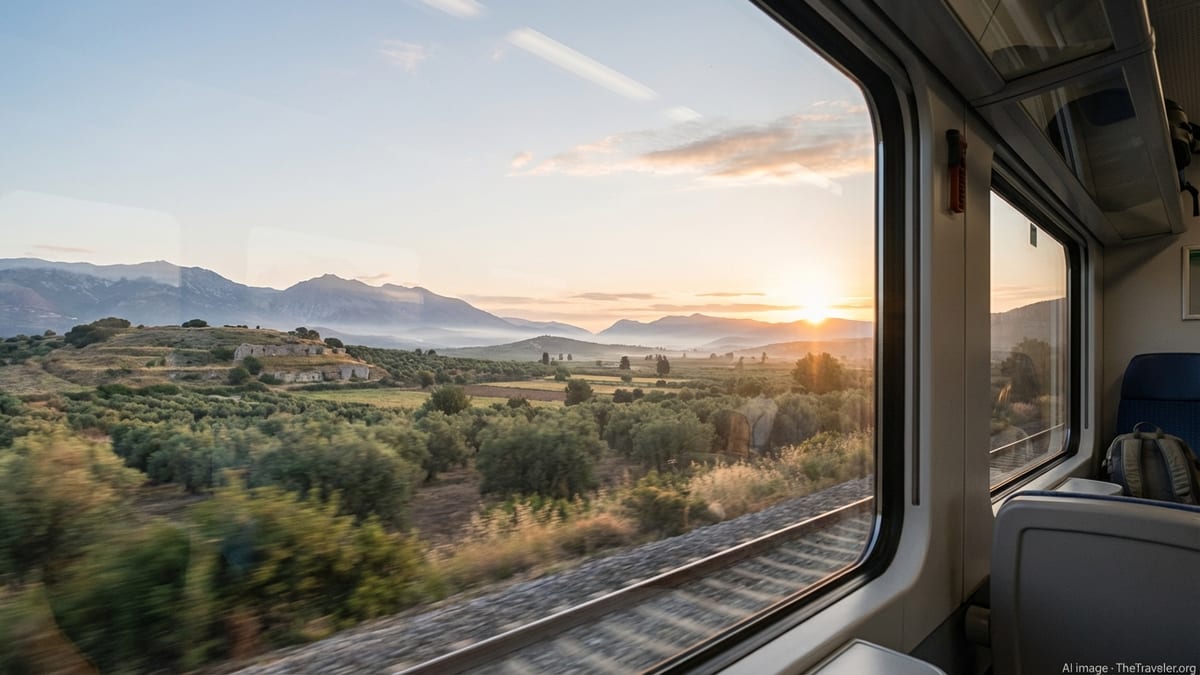
The onboard experience in Greece can feel relaxed compared to some high-intensity European rail networks. On intercity trains you can expect assigned seating, relatively generous legroom, and wide windows offering views of coastal plains, river valleys, and distant mountain ranges. Air conditioning is standard and generally effective, though during heatwaves some older coaches may struggle to maintain ideal temperatures, especially if the train is crowded.
Luggage space varies by train type. Intercity coaches typically offer overhead racks and larger areas near doors or at the end of carriages where bulky suitcases can be stowed. On suburban services, dedicated luggage zones are more limited, as trains are designed mostly for commuters. In practice, travelers keep suitcases beside their seats or in the vestibules near doors, taking care not to block passageways. There are usually no formal luggage checks, and size limits are loosely enforced, but common sense and courtesy go a long way.
Accessibility has become a higher priority as new trains are ordered and platforms upgraded. Many existing stations still feature stairs, uneven surfaces, or relatively high gaps between train and platform. However, low-floor rolling stock is gradually being introduced, and newer or refurbished stations on main corridors offer lifts, ramps, tactile paving, and clearer signage. Travelers with mobility impairments should research station layouts in advance and, where possible, contact the operator for assistance arrangements.
On-board amenities are modest but adequate. Toilets are standard on intercity and most regional trains, though cleanliness can fluctuate during long runs. Some long-distance services have a café bar selling drinks, snacks, and simple meals, while others rely on roving trolleys or expect passengers to bring their own provisions. Wi-Fi is not yet universal on Greek trains, and where it exists it can be patchy. Many passengers simply tether to mobile data connections, which are strong along much of the mainline but can fade in remote valleys and tunnels.
Stations, Suburban Lines, and Getting Around Cities
Major Greek rail stations are functional rather than grand, though several are undergoing upgrades. In Athens, the central railway station (often referred to as Larissa Station) serves as the hub for long-distance and suburban lines heading north, while the port of Piraeus anchors services connected to ferries and suburban trains. Thessaloniki’s main station handles both intercity and regional routes in northern Greece and is within easy reach of the city center via bus or taxi.
Across the network, station facilities vary significantly. Large hubs usually offer ticket counters, self-service machines, small shops or kiosks, and waiting areas. Smaller stops may provide little more than a shelter and a platform. With the closure of many local ticket offices, staff presence at minor stations can be minimal or absent outside peak periods. It is wise not to assume that every station will have food outlets, accessible toilets, or secure indoor waiting spaces, especially late at night or on weekends.
The Athens Suburban Railway plays a key role in city mobility. Lines connect Piraeus, central Athens, the airport, the northern suburbs, and the coastal city of Kiato, intersecting with the metro and tram network. This makes it possible to arrive by ferry in Piraeus, transfer to a suburban train, and continue either to the airport or toward the Peloponnese with a single rail-based journey. Frequencies vary but have generally improved in recent timetable updates, particularly on airport-connected segments where trains now run at more regular intervals.
In Thessaloniki and other cities, suburban and regional trains are complemented by urban buses and, in the case of Thessaloniki, a developing metro system. Taxis and ride-hailing services are widespread and relatively affordable for short hops to and from stations. When planning connections, allow extra time at large terminals, where signage can be mainly in Greek and platform changes may be announced at short notice over loudspeakers rather than via clear digital boards.
The Takeaway
Train travel in Greece rewards those who approach it with curiosity and flexibility. The network is not comprehensive, and the scars of past underinvestment and tragedy are still visible, but the main corridors are steadily improving. For journeys between Athens and Thessaloniki, for reaching the airport from the city center, or for exploring parts of the northern mainland, trains can offer a calmer, more scenic alternative to highways and domestic flights.
At the same time, it is important to be realistic. Timetables can shift, punctuality is not guaranteed, and many rural or cross-border routes that appear on older maps remain out of service. International rail travelers will often need to combine trains with buses and ferries, and island-hopping still relies almost entirely on the sea. Checking the latest schedules, using digital tools to monitor disruptions, and purchasing tickets in advance where possible all help minimize surprises.
If you are willing to adapt, Greek trains can add depth and texture to a trip, revealing landscapes and everyday life that you might miss from the air. Sit by a window as the line leaves Athens, watch the city fall away into the plains of Thessaly, and you will understand why, despite its limitations, the country’s evolving rail network continues to capture the imagination of travelers who value the journey as much as the destination.
FAQ
Q1. Is it safe to travel by train in Greece now?
The Greek rail system has undergone intensified safety upgrades since the Tempe accident, including modern signalling and real-time monitoring, but travelers should still expect a network in transition rather than perfection.
Q2. How long does the train from Athens to Thessaloniki take?
Journey times typically range from around four hours to slightly longer, depending on the timetable in effect, engineering works, and the specific intercity service you choose.
Q3. Do I need to reserve a seat on Greek trains?
On intercity services between major cities, reservations and assigned seats are standard, while suburban and most regional trains operate with open seating and no mandatory reservations.
Q4. Can I use Eurail or Interrail passes on trains in Greece?
Many Hellenic Train services accept Eurail and Interrail passes for domestic travel, but international passenger trains to and from Greece are not currently running, so cross-border trips require buses or ferries.
Q5. How do I get from Athens Airport to the city by train?
Athens International Airport is linked to central Athens and Piraeus by suburban trains that run throughout the day, offering a straightforward rail connection into the metropolitan network.
Q6. Are Greek trains usually on time?
Punctuality has improved on key routes but can still be affected by infrastructure works, weather, and operational issues, so it is wise to allow buffer time for connections.
Q7. Can I buy tickets at the station, or do I need to book online?
Major stations maintain ticket counters and machines, but many smaller stations have closed their ticket offices, so online or mobile booking is recommended whenever possible.
Q8. What is the luggage policy on Greek trains?
There is no rigidly enforced luggage allowance on most services, and passengers typically bring suitcases and bags on board, storing them in overhead racks or near their seats with basic common-sense limits.
Q9. Are Greek trains accessible for travelers with reduced mobility?
Accessibility is improving, particularly on newer trains and upgraded stations, but conditions still vary, so travelers with mobility needs should research routes and request assistance in advance when possible.
Q10. Can I rely on trains alone to explore all of Greece?
No, the rail network does not reach many islands and remote regions, so most travelers combine trains with buses, ferries, and occasionally rental cars to explore the country comprehensively.