

Train travel in Saudi Arabia has transformed dramatically in less than a decade, turning a country long associated with highways and domestic flights into one of the Middle East’s emerging rail hubs. At the center of this shift is the Haramain High Speed Rail, a fast, comfortable link between the holy cities of Makkah and Madinah, supported by an expanding national network that now connects Riyadh, Dammam, the northern frontier and key industrial zones. For visitors and residents alike, rail is becoming one of the most efficient and atmospheric ways to cross the kingdom’s vast desert landscapes.
The Rise of Modern Rail in Saudi Arabia
Saudi Arabia’s embrace of rail is closely tied to the country’s Vision 2030 agenda, which prioritizes better connectivity, tourism growth and more sustainable transport options. Historically, long distance mobility relied on domestic flights or long drives on multilane highways. Today, new and upgraded rail corridors are beginning to stitch together the kingdom’s main cities and industrial regions, offering a different perspective on its deserts, plateaus and coastal plains.
The flagship of this new era is the Haramain High Speed Railway, a 450 kilometer line between Makkah and Madinah with intermediate stops in Jeddah, King Abdulaziz International Airport and King Abdullah Economic City. Operating at speeds of up to 300 kilometers per hour, it cuts typical travel time between the two holy cities to around two hours and has become an essential part of Hajj and Umrah logistics, especially in peak seasons when road traffic is heaviest.
Alongside Haramain, Saudi Arabia Railways operates the North Train and East Train networks, which together extend thousands of kilometers from Riyadh to the Jordanian border and to the Gulf coast at Dammam. These routes began primarily as freight and mineral corridors but now carry passengers across a large swath of the country. For travelers, the result is a growing menu of rail journeys that combine practical convenience with a striking sense of distance and landscape.
Future projects, including a planned land bridge between Riyadh and Jeddah, aim to close remaining gaps between the Red Sea and Arabian Gulf. While timelines and scope may evolve, the overall direction is clear. Rail is moving from supporting role to backbone, especially on heavily traveled domestic corridors where it can ease pressure on airports and highways.
Inside the Haramain High Speed Rail Experience
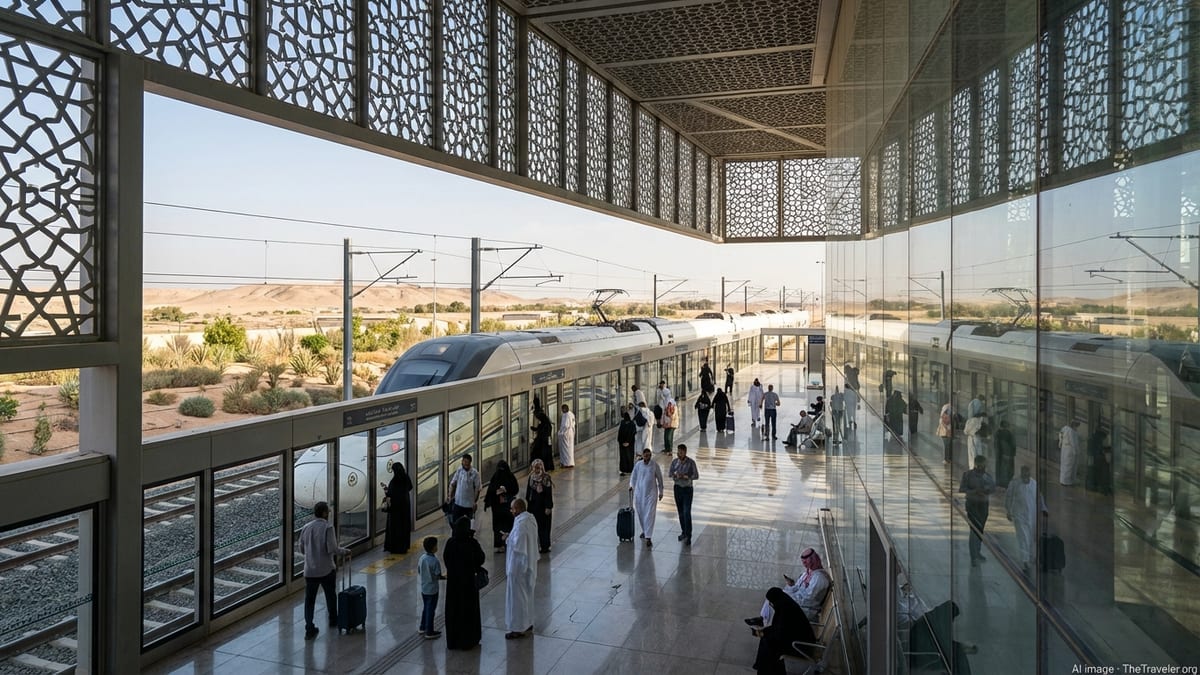
The Haramain High Speed Rail is designed as a modern, mostly reserved seat service that feels closer to European or East Asian high speed lines than to traditional regional trains. Trains are electric, with sleek white and silver exteriors that stand out against the tan and ochre tones of western Saudi Arabia. Interiors are air conditioned, bright and relatively spacious, with large windows framing the passing desert and low escarpments.
There are two main classes on board. Economy class offers airline style seating with generous legroom and overhead racks, while business class adds wider seats, more privacy and quieter coaches. All trains have a central café or bistro style car where passengers can buy drinks and light meals, and there are prayer areas to accommodate religious needs on longer runs between Jeddah and Madinah or Makkah and Madinah.
Service frequencies vary by season, with noticeably denser timetables in the weeks around Ramadan and the Hajj period. Outside peak times, travelers can usually choose from several departures per day between each pair of cities, with the fastest non stop services focusing on the full Makkah to Madinah run. Journey times between individual stops are short enough that many residents now use Haramain for day trips, especially between Jeddah, Makkah and King Abdullah Economic City.
Ticket prices are dynamic and shift with demand, class, and how early you book. Recent ranges suggest that economy fares on the main Makkah to Madinah leg commonly sit somewhere in the low to mid hundreds of Saudi riyals, with business class typically priced higher. Promotional offers, particularly around National Day or major events, sometimes bring prices down significantly. Because schedules and fares can change, it is wise to check official booking channels close to your travel date and to secure seats early during religious seasons.
Stations on the Haramain Corridor
Haramain’s five stations are as much a statement of Saudi Arabia’s architectural ambitions as they are functional transport hubs. Each combines Islamic inspired geometry with modern engineering, using vaulted roofs, repeating patterns and tall colonnades that recall traditional mashrabiya screens and mosque courtyards. Inside, high ceilings and abundant natural light help keep the spaces airy even when crowds swell.
Makkah station sits in the Rusaiyfah district, a few kilometers from the Grand Mosque and integrated with park and ride facilities that channel pilgrims into shuttle buses and taxis. During busy periods, coordinated flows guide arriving passengers toward dedicated transport to the central Haram area, helping to reduce congestion in the narrow streets of central Makkah.
Jeddah’s Al Sulaymaniyah station acts as the city’s primary Haramain hub, located inland from the Corniche but well connected to major urban highways. A separate Haramain station at King Abdulaziz International Airport is linked by a short branch line. For many international visitors, this airport stop is the first encounter with the Saudi rail system. Arriving passengers can clear formalities and walk directly into the rail terminal, then board high speed services onward to Makkah, Jeddah city or Madinah.
Further up the coast, King Abdullah Economic City station serves both residents and business visitors to the growing industrial and residential zone around King Abdullah Port. At the northern end of the line, Madinah’s station lies a short drive from the Prophet’s Mosque, with extensive parking, prayer facilities and vertical circulation designed to move large numbers of people efficiently. Across all stations, you can expect amenities like ticket counters, waiting halls, food outlets, retail kiosks, mosques and separate areas for families and individuals in line with local norms.
Planning a Haramain Journey: Routes, Seasons and Practical Tips
For international visitors, the most common itineraries on Haramain involve moving between Jeddah’s airport, Makkah and Madinah. A typical route might see a traveler arrive at King Abdulaziz International Airport, transfer directly to the airport station, ride to Makkah for Umrah, then travel onward to Madinah before looping back to Jeddah. Others use the line in reverse, arriving via Madinah’s airport and finishing in Makkah.
Travel times are competitive with both road and air once airport procedures and road congestion are taken into account. The full Makkah to Madinah journey usually takes around two hours by the fastest services, and shorter segments between Jeddah and Makkah or Jeddah and Madinah run well under three hours. Trains are fully reserved, so you need a dated ticket with a specific departure time and seat. Flexibility around departure times varies by fare type, and changes or cancellations are usually possible but may incur fees.
Seasonality is a critical consideration. During Hajj and the last ten days of Ramadan, demand surges and many seats are pre allocated to organized pilgrimage groups. Individual travelers should plan well in advance, expect tighter security and queuing at stations, and allow extra time for boarding. Outside the religious peaks, the experience is more relaxed, and it is often easier to find last minute seats, especially on midweek or midday trains.
Practical preparation helps the journey go smoothly. Aim to arrive at the station at least 45 to 60 minutes before departure, particularly if you need to collect tickets or check baggage. Pack light hand luggage if possible, keep your passport and booking confirmation accessible for security checks, and factor in local dress codes and prayer times. If you are connecting from or to a flight, leave a healthy buffer in case of delays, as high speed train tickets are not automatically protected by airline schedules.
Beyond Haramain: North and East Train Routes
While Haramain captures international headlines, Saudi Arabia’s conventional rail lines are just as transformative for domestic travelers. The North Train network stretches from Riyadh toward the Jordanian border, running via Al Majmaah, Qassim, Hail, Al Jouf and Qurayyat. Originally designed to move phosphates and bauxite from mines to processing plants and Gulf export terminals, the corridor now supports regular passenger services that open up the northern heartlands to visitors.
Northbound trains from Riyadh traverse landscapes that shift from central plateau to more rugged northern terrain. Daytime services use modern locomotive hauled trains with both economy and business class, seated coaches and a restaurant car. Night trains, on the other hand, provide sleeper cabins and the option to transport private cars on board between Riyadh and Qurayyat, a rare feature in the Gulf region that appeals to families and long term residents relocating between regions.
To the east, another passenger corridor links Riyadh to Dammam, passing through Al Hofuf and Abqaiq on the way to the Gulf. This East Train route, upgraded and expanded in recent years, offers a practical alternative to driving the long, straight highway across the desert. Onboard amenities are similar to those of the North Train, with two classes of seating, a restaurant coach and prayer spaces. For business travelers commuting between the capital and the energy hub of the Eastern Province, the line can be more predictable than flying, especially during busy holiday and school travel periods.
Together, the North and East lines complement the Haramain corridor by serving the rest of the country. While they do not yet offer the 300 kilometer per hour speeds of the high speed line, they deliver a calmer way to experience Saudi Arabia’s varied geography and smaller cities, from the oasis landscapes around Al Ahsa to the northern fields and desert ridges near Al Jouf.
Future Rail Vision: Land Bridge and Network Integration
Looking ahead, one of the most anticipated projects is the proposed land bridge between Riyadh and the Red Sea coast around Jeddah. The concept is to create a direct, high capacity rail corridor linking the Gulf and Red Sea ports, allowing freight to bypass longer maritime routes and enabling through passenger services that could one day connect Dammam, Riyadh and Jeddah on a single axis. Recent public statements from Saudi Railways executives suggest the project is now expected to be delivered in phases over the coming years, with full completion targeted before the mid 2030s.
In practical terms, such a land bridge would fill one of the largest remaining gaps in the national network. Today, travelers who want to move by rail between the Haramain corridor and Riyadh or Dammam typically have to combine train and road journeys or connect via air. A continuous rail spine from the Gulf to the Red Sea would unlock the possibility of itineraries such as Dammam to Makkah entirely by train, with a simple interchange in the capital.
Saudi rail planners are also exploring additional high speed and higher speed upgrades on existing lines, as well as urban and regional metro projects. These include enhancements to shorten travel times on the Riyadh to Dammam route and to support new economic and tourism zones. Although the details and timelines remain fluid and are sometimes adjusted as national priorities evolve, the direction points toward more interlined services and integrated ticketing, making it easier for passengers to combine different routes across the country.
For travelers planning trips over the next few years, the practical takeaway is that today’s rail map is only a starting point. New segments and improved timetables are likely to appear gradually, especially ahead of major international events the kingdom will host. Staying flexible and checking the latest official information before securing long distance plans is the safest approach.
What to Expect Onboard: Comfort, Culture and Scenery
Across both high speed and conventional routes, Saudi trains share a broadly similar onboard experience shaped by a mix of international standards and local customs. Coaches are air conditioned against the intense desert heat, with filtered air and tinted windows softening the glare. Seating layouts usually follow a two by two pattern in economy and a more spacious layout in business, with reclining seats, fold out tables and power outlets increasingly common on newer stock.
Prayer rooms or designated prayer areas are a standard feature on longer distance trains, reflecting the centrality of religious practice in daily life. Calls to prayer are sometimes announced quietly over the public address system, especially on services that pass through prayer times. Dress is modest, particularly on routes that serve Makkah and Madinah, and passengers are expected to respect gender segregated areas or family zones where designated.
Catering options vary by route and class, but most long distance services offer a mix of snacks, hot drinks and simple meals, either via a café car or trolley service through the coaches. While menus may not match the variety of a full service airline, they are sufficient for journeys of two to five hours. Bringing your own water and light snacks is widely accepted and can be a good idea during busier periods when queues form at the café counter.
The scenery is a quiet but memorable part of the experience. High speed Haramain trains race along a largely coastal inland strip, passing low hills and glimpses of the Red Sea hinterland. North Train services reveal broader shifts in topography, from central plateau to northern grasslands and desert. On the Riyadh to Dammam line, the view is a more meditative expanse of sand, scrub and the occasional cluster of palm trees, broken by industrial infrastructure as you approach the Gulf.
The Takeaway
Train travel in Saudi Arabia is no longer a niche option. With the Haramain High Speed Rail providing a fast, reliable link between the holy cities and coastal hubs, and the North and East routes connecting the capital to the kingdom’s frontiers and the Gulf, rail has become a serious alternative to highways and short haul flights. It offers not only convenience and comfort, but also a different way of understanding the distances and landscapes that define the country.
For pilgrims, high speed trains simplify complex multi city itineraries, especially when timed around flights into Jeddah or Madinah. For business travelers, the network offers time efficient links between Riyadh, Dammam and emerging economic zones. For curious visitors, it opens a path into lesser known regions that were once impractical to reach without a car. As future projects gradually knit the system together into a more continuous national grid, rail is set to play an even greater role in how people move across Saudi Arabia.
Anyone considering a journey should approach rail as they would any long distance trip. Plan early during religious seasons, use official channels to verify schedules, and allow generous connection times. Do that, and you will find that crossing Saudi Arabia by train is not just a way to get from one city to another, but an experience that adds texture and perspective to any visit.
FAQ
Q1. What cities does the Haramain High Speed Rail connect?
Makkah and Madinah are the termini, with intermediate stations in Jeddah, King Abdulaziz International Airport and King Abdullah Economic City.
Q2. How long does the Haramain train take between Makkah and Madinah?
The fastest services usually complete the journey in around two hours, although exact times vary by timetable and stopping pattern.
Q3. Do I need to book Haramain tickets in advance?
Yes. All seats are reservable and popular departures, especially around Ramadan and Hajj, often sell out, so advance booking is strongly recommended.
Q4. What classes are available on Saudi long distance trains?
Most services offer economy and business class seating, while some North Train night services add private sleeper cabins and car carrying coaches.
Q5. Is there luggage space on board?
Yes. Trains typically have overhead racks for smaller bags and designated spaces for larger suitcases, with baggage check in desks available at major stations.
Q6. Are the trains suitable for families and children?
Saudi trains are widely used by families. Many stations and trains provide family friendly seating areas and facilities aligned with local customs.
Q7. Can I travel by train between Riyadh and Jeddah today?
There is not yet a direct passenger rail line between Riyadh and Jeddah, so travelers normally combine flights, road transport or connections via other cities.
Q8. How early should I arrive at the station before departure?
Arriving 45 to 60 minutes before departure is a sensible minimum, and during peak pilgrimage seasons it is wise to allow even more time.
Q9. Are prayer facilities available on trains and at stations?
Yes. Major stations and most long distance trains include dedicated prayer areas, and schedules are generally mindful of key prayer times.
Q10. Is rail travel in Saudi Arabia accessible for visitors who do not speak Arabic?
Key signage is usually in both Arabic and English, and staff on major routes are accustomed to assisting international passengers, especially in airport and pilgrimage hubs.