

More news on this day
Transatlantic business travel is roaring back between Europe and North America, and few carriers are benefiting more than International Airlines Group, where robust corporate demand and premium bookings are driving record profits and a fresh phase of network growth.
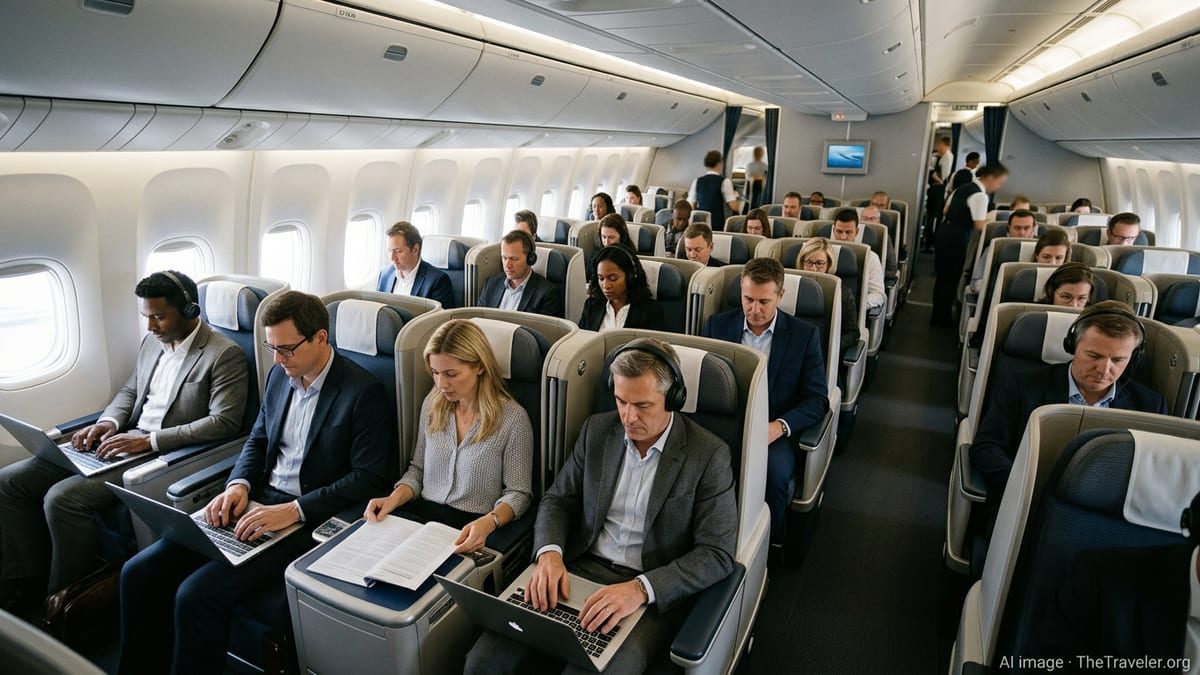
Corporate Demand Rebounds on the North Atlantic
International Airlines Group, the parent of British Airways, Iberia, Aer Lingus, Vueling and Level, is leaning heavily on the North Atlantic just as corporate customers return in strength. Group executives say business demand on routes linking key hubs such as London Heathrow, Dublin and Madrid with New York, Boston, Chicago and other financial centers remained strong through late 2025 and into early 2026, with first quarter bookings described as "looking really well" by chief executive Luis Gallego.
According to recent commentary to investors, British Airways is seeing particularly solid corporate traffic flowing from the United States to London, while business demand from the United Kingdom into the US is characterized as robust. That two‑way strength is important for yields, allowing the group to keep premium fares firm even as broader consumer sentiment shows signs of cooling. It has helped push IAG’s annual revenue to more than 33 billion euros and operating profit to about 5 billion euros, putting the group ahead of many European rivals on profitability.
Industry data supports the story behind those headline numbers. The International Air Transport Association reported that international passenger traffic reached a record high in 2024, with premium cabins outpacing economy in growth terms. Premium class travel, which includes business and first class, expanded faster than overall traffic worldwide, underscoring how corporate budgets have reopened for long‑haul trips after several years of video calls and travel freezes.
Global forecasts from the Global Business Travel Association add further momentum, with worldwide business travel spending estimated in the mid‑trillion‑dollar range and expected to set fresh records through 2025 and beyond. Europe and North America remain among the highest‑spending regions, and the transatlantic corridor is again one of the most valuable long‑haul markets by revenue.
Premium Cabins Drive Yields and Product Investment
The surge in transatlantic business travel is being felt most acutely at the front of the aircraft. IATA data shows that premium cabins grew slightly faster than economy worldwide in 2024, and that pattern is particularly evident on Europe–North America routes, where corporate contracts, flexible fares and loyalty‑driven upgrades all support higher average ticket values. Newer cabin products, such as club suites and refreshed lie‑flat seats, are designed specifically to capture this demand.
For IAG, British Airways’ long‑running focus on corporate travelers through Heathrow and Iberia’s links from Madrid to US and Latin American cities provide a natural foundation. The group has invested in upgraded business‑class seats, improved lounges and more reliable onboard connectivity, aware that spending on travel is returning but expectations have risen. Corporate buyers now demand not only schedule and safety but also a seamless digital experience, from rebooking options during disruptions to stable high‑speed Wi‑Fi that allows work to continue at 35,000 feet.
Travel management companies report that premium economy has also become a sweet spot for corporate policies, especially on transatlantic routes where cost‑control remains a priority. Industry data for 2024 show premium economy international tickets growing faster than many other segments, as companies blend savings with employee comfort. For airlines like British Airways and Iberia, those cabins offer higher margins than standard economy while preserving an attractive price gap versus full business class.
Higher yields from premium cabins are cushioning carriers against persistent cost pressures, including wage inflation, airport charges and investment in more sustainable fleets. IAG and its peers are channeling a portion of those profits into new aircraft with more fuel‑efficient engines and into sustainable aviation fuel purchases, both of which are slowly reshaping the economics and the environmental profile of long‑haul business travel.
How IAG Compares With European Rivals
While transatlantic business demand is a bright spot for IAG, the picture is more mixed across Europe. Airlines such as Lufthansa Group and Air France‑KLM have flagged some softening in leisure and corporate bookings from parts of continental Europe into the United States, citing economic uncertainty and shifting traveler preferences. In contrast, IAG’s exposure to London and Dublin, along with its strong joint ventures with American partners, has provided a relatively resilient flow of higher‑yield traffic.
Sector analysis of European airlines shows IAG outpacing its main rivals on operating margins, thanks largely to the strength of its North Atlantic portfolio. One recent comparison put the group’s quarterly margin at nearly 19 percent, far higher than figures reported by Lufthansa and Air France‑KLM, both of which continue to work through restructuring programs and network adjustments. Investors have rewarded that performance, with IAG’s share price holding up better than many regional peers through a volatile 2024.
Even so, executives caution that corporate travel is unlikely to return in full to pre‑pandemic patterns. IAG has previously stated that it does not expect short‑haul corporate trips, especially one‑day or overnight meetings within Europe, to fully recover as many companies rely on hybrid work and videoconferencing. The focus instead is on long‑haul journeys where in‑person contact still delivers the greatest value, such as deal‑making, industry conferences and complex project work.
This shift is reshaping how airlines allocate wide‑body capacity. IAG continues to tilt flights toward high‑demand North Atlantic and selective Latin American routes, while remaining nimble on secondary US cities where demand is more sensitive to macroeconomic headlines or political developments. The goal is to defend and grow share in the most profitable corporate corridors, even as overall international visitor numbers to the US show signs of softening.
Pricing, Capacity and What Travelers Should Expect
For corporate travelers and their travel managers, the transatlantic business travel surge carries clear implications. First, fares in business and premium economy cabins are likely to remain elevated on core business routes linking major financial, tech and political centers on both sides of the Atlantic. With premium seats close to or above pre‑crisis load factors and a finite number of wide‑body aircraft available, airlines have little incentive to discount heavily, especially during peak conference seasons and around major events.
Second, travelers can expect ongoing fine‑tuning of schedules and aircraft types. IAG and its peers are actively swapping in larger aircraft or higher‑premium configurations on routes where corporate demand is strongest, while trimming or seasonally adjusting weaker services. For passengers, that may mean more choice of departure times on flagship routes such as London–New York, but fewer nonstop options from some secondary European cities to the US as capacity is consolidated through major hubs.
Third, the renewed importance of transatlantic business travel is reinforcing the role of joint ventures and alliances. IAG’s ties with American Airlines and other partners in transatlantic immunized joint ventures allow closer coordination of schedules, pricing and corporate contracts, which in turn can stabilize capacity and improve connection options. For multinational firms, booking through these alliances often simplifies negotiations and helps secure consistent service standards across carriers.
Finally, service differentiation is likely to widen. As airlines compete for high‑value corporate accounts, investment in lounges, check‑in priority, onboard catering and sleep‑friendly cabins is accelerating. At the same time, stricter corporate policies and sustainability targets mean travelers may be asked to justify each long‑haul trip more carefully, choose rail for shorter sectors, or accept premium economy instead of business on some journeys. The net effect is a market where transatlantic business travel is both busier and more scrutinized than at any point in recent memory, with IAG currently one of its biggest winners.