

Transportation costs are a central factor in evaluating relocation to Thailand. For many expatriates, mobility patterns will determine whether living without a car is realistic, how commuting affects monthly budgets, and how transport expenses vary between Bangkok, secondary cities and resort areas. This briefing outlines the main transport modes available to expats in Thailand in 2026 and provides indicative cost ranges to support relocation planning.
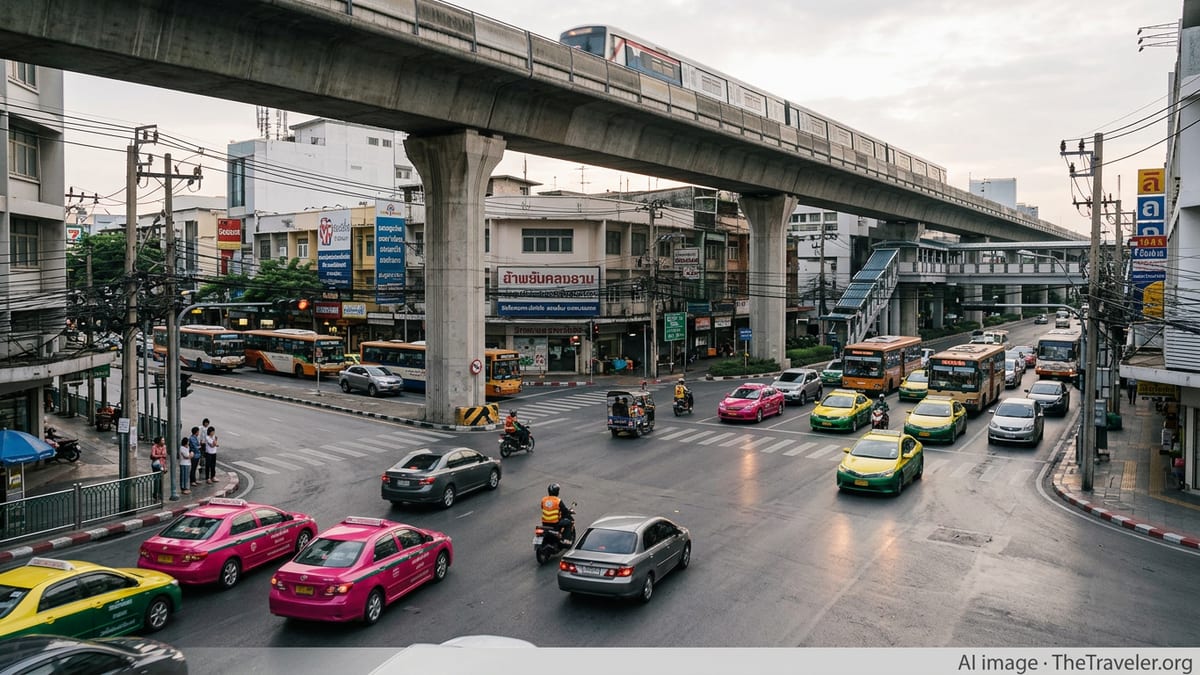
Overview of Transportation Structure and Cost Drivers
Thailand offers a mix of modern urban rail systems, extensive public bus networks, metered taxis, motorcycle taxis, ride hailing platforms, and private vehicle use. For most expatriates, transport spending is driven primarily by daily commuting patterns in Bangkok or another large city, frequency of intercity travel, and the decision to own or lease a car or motorcycle. Short urban trips can be relatively inexpensive by international standards, while longer-distance commutes or reliance on private vehicles expose expats to fuel prices, tolls and parking charges.
Key cost drivers include regulated fares on mass transit and taxis, fuel prices that track global energy markets, government subsidy or flat-fare policies on specific rail lines, and congestion patterns in Bangkok. As of early 2026, retail fuel prices for common gasoline blends in Thailand are generally in the high 20s to low 30s baht per liter, while diesel has been temporarily capped at just under 30 baht per liter, creating a relatively predictable cost base for operators and private motorists.
From a relocation planning perspective, expats should distinguish between living in central Bangkok with heavy use of rail transit and occasional taxis, versus suburban or provincial locations where reliance on motorcycles or cars is much higher. In practice, many urban expats use a multimodal mix: rail for predictable commuting, ride hailing for door to door trips, and occasional intercity buses or low cost airlines for regional travel.
Overall, transportation is often a smaller share of total living costs than housing or schooling, but it is an area where choices about neighborhood, workplace location and vehicle ownership can shift monthly expenditures by several thousand baht.
Urban Rail Systems and Metro Fares
Bangkok’s urban rail network is the backbone of cost efficient commuter transport for expats who live and work within reach of the stations. It includes the BTS Skytrain system, the underground and elevated MRT lines, newer monorails, the Airport Rail Link and two commuter style Red Line routes. Most systems use distance based pricing with stored value cards or contactless bank cards, though recent policy initiatives have introduced flat fare caps on several lines to moderate commuting costs.
On core BTS and MRT lines, typical single journey fares for adults start in the mid teens in baht and increase with distance, often into the 40 to 50 baht range for longer cross city trips. Government policies have introduced flat maximum fares of about 20 baht per ride on certain MRT and commuter rail corridors for registered passengers, while some extensions on the BTS Green Line operate with slightly different fare tables. For expats who commute on these subsidized segments, total monthly rail costs can be noticeably lower compared with fully distance based pricing.
In practical budgeting terms, an expat commuting on rail twice daily, five days per week, might expect to spend approximately 1,500 to 3,000 baht per month, depending on line choice, journey length, and whether any capped fare schemes are available for their route. Occasional off peak or weekend usage would add modestly to this amount. Compared with many major international cities, this level of expenditure is relatively moderate, but it requires living and working in catchment areas of the rail network to be realistic.
Outside Bangkok, urban rail is limited, although secondary cities may have limited commuter rail or planned mass transit projects. As of 2026, most expats in Chiang Mai, Phuket, Pattaya or other provincial centers will rely primarily on road based modes, which changes the cost profile substantially.
Public Buses, Songthaews and Informal Transit
Public buses in Bangkok and provincial cities remain one of the lowest cost options, though they are less commonly used by new expatriates due to language barriers, route complexity, and comfort expectations. City bus fares in Bangkok typically range from under 10 baht on non air conditioned services to around 15 to 25 baht on air conditioned routes, depending on distance. Newer bus rapid transit style services and special routes may have slightly higher price points, but still remain well below taxi or ride hailing costs per kilometer.
In many provincial cities and resort areas, shared pickup trucks adapted for passengers, known locally as songthaews, function as semi fixed route public transport. Fares are usually flat or zoned, commonly starting in the low tens of baht for short hops around town, with higher amounts for out of town segments. For expats willing to integrate into local systems, songthaews can keep routine local travel costs very low relative to private taxis or car use.
Informal vans and minibuses also operate between cities and within metropolitan regions, usually on fixed routes with per seat pricing. These services can be cost effective for intercity trips, but they are less central to day to day commuting calculations for most white collar expats. However, for those who travel frequently to industrial zones or satellite provinces, minivan fares in the low hundreds of baht per journey can accumulate and should be considered in overall relocation budgeting.
As with other low cost modes, the trade off is typically between time, comfort, crowding and cost. An expat who prioritizes air conditioned comfort and door to door convenience will likely rely more on rail where available, or on taxis and ride hailing, which raises monthly transport expenditure compared with heavy bus and songthaew use.
Taxis, Motorcycle Taxis and Ride Hailing Costs
Metered taxis are widely available in Bangkok and some major tourist or commercial centers. Official fare structures set a base flag fall, followed by per kilometer and waiting time components. In Bangkok, the base fare is around 40 baht for the first kilometer, with incremental charges for additional distance and time in traffic. Policy discussions in recent years have introduced or implemented small surcharges during rush hours or late night periods to address supply constraints, but the core per kilometer charges remain relatively modest.
Typical short taxi journeys entirely within central Bangkok often cost between 70 and 150 baht depending on distance and congestion. Longer cross town trips or airport transfers can run into the 200 to 400 baht range, excluding expressway tolls. Given Bangkok’s congestion, waiting time charges can meaningfully affect the final fare on some routes, especially during peak commuting periods or in heavy rain. For expats who use taxis daily for commuting instead of rail, monthly costs can easily exceed 3,000 to 5,000 baht or more.
Motorcycle taxis stationed at corners and transit hubs are an important part of the first and last mile network. Fares are typically negotiated or posted on local boards, often starting in the range of 20 to 30 baht for very short hops and rising with distance. For expats comfortable with this mode, motorcycles can greatly reduce travel time on short congested segments at a relatively low cost. However, safety perceptions and corporate travel policies sometimes limit their use for work related commuting.
Ride hailing platforms such as Grab and Bolt operate in major Thai cities and provide app based pricing that often mirrors or slightly exceeds metered taxi costs. Dynamic pricing, booking fees and platform margins mean that peak time fares can be substantially higher than official taxi meter rates, though promotions occasionally moderate costs. Expats who rely heavily on ride hailing for all local travel, rather than mixing in rail or buses, may see monthly transport spending rise into the mid four figures in baht, especially if commuting distances are significant.
Private Car or Motorcycle Ownership for Expats
Ownership or long term rental of a car or motorcycle significantly alters the cost structure of transportation in Thailand. While it provides flexibility and expands residential options beyond rail served neighborhoods, it introduces ongoing expenses that can outweigh savings from avoiding taxis and ride hailing, particularly in Bangkok’s congested environment.
For cars, recurring costs include fuel, routine maintenance, insurance, annual registration, parking charges and any loan or lease payments. With petrol prices in early 2026 commonly near 30 baht per liter, fuel costs for a compact car used for moderate daily commuting can easily reach several thousand baht per month. Parking in central Bangkok office areas may add daily charges that, over a month, rival or exceed what a commuter would have spent on rail fares.
Motorcycles and scooters are more fuel efficient and cheaper to purchase, so they are widely used among local residents and some expatriates, especially in provincial cities where traffic moves more smoothly than in Bangkok. Fuel spend for a small motorcycle used for short commutes may be only a few hundred baht per month, but this must be weighed against higher accident risk, weather exposure and any corporate or family safety considerations. In many relocation policies, dependents are discouraged from regular motorcycle use for commuting.
From a purely financial standpoint, car ownership starts to make more sense for expats who live far from rail lines, have family transport obligations, or frequently travel between cities in regions where public transport is sparse. Even in such cases, detailed budgeting should compare the combined cost of leasing, fuel, insurance and parking against the alternative of arranging occasional private transfers or renting vehicles as needed.
Regional Variations: Bangkok vs Secondary Cities and Resorts
Transportation cost patterns vary notably between Bangkok, secondary cities such as Chiang Mai or Khon Kaen, and resort areas like Phuket, Pattaya or Koh Samui. Bangkok offers the broadest range of modes and the lowest marginal cost for frequent urban commuting due to its rail network and regulated taxi fares, but congestion and parking scarcity raise the cost of private car use.
In many secondary cities, absence of metro style rail means expats rely more on private motorcycles, cars, or local songthaews and tuk tuks. While distances are often shorter and traffic lighter, taxi or ride hailing availability can be more limited, and negotiated tourist premiums are more common in heavily visited zones. For expats living in provincial centers with regular commuting needs, the main recurring costs tend to be motorcycle fuel, occasional car fuel, and ad hoc taxi or ride hailing trips for specific errands.
Resort and island locations introduce another dynamic. Short trips on local songthaews or tuk tuks may be inexpensive for residents, but fares quoted in tourist areas can be significantly higher than Bangkok meter taxi rates for comparable distances. Expats who settle in such locations on a long term basis often acquire motorcycles or compact cars to control costs and ensure reliable mobility. This shifts spending toward fuel and maintenance and away from daily fare payments, with the trade off of higher capital and risk exposure.
Relocation evaluations should therefore be location specific. An expat family planning to live near a BTS or MRT station in Bangkok may be able to avoid car ownership entirely and keep monthly transport costs within a few thousand baht, while a family in a suburban estate outside rail coverage may need to budget substantially more for car related expenses, despite similar income levels.
Commuting Scenarios and Monthly Cost Benchmarks
To provide decision grade guidance, it is useful to consider a few common commuting scenarios and their approximate monthly cost implications for expatriates in Thailand. These scenarios are indicative and will vary with personal habits and housing choices, but they provide a framework for comparing options.
First, a rail dependent commuter living within walking distance of a BTS or MRT station and working in central Bangkok might make two to four rail journeys per day on weekdays and a few additional trips on weekends. Assuming average rail fares in the range of 20 to 40 baht per trip, this profile could result in a monthly transport spend between roughly 1,500 and 3,500 baht.
Second, an expat relying primarily on taxis or ride hailing for daily commuting in Bangkok, with two medium length trips per workday plus some evening and weekend journeys, may average 150 to 250 baht per trip. This can translate into monthly spending in the vicinity of 4,000 to 8,000 baht, not including occasional longer airport or intercity runs.
Third, an expat who owns a car in Bangkok but still makes some use of rail or taxis for specific trips will face a more complex cost stack. Fuel for daily commuting can add several thousand baht per month, parking near offices may add another substantial amount, and insurance and maintenance must be annualized into a monthly equivalent. It is not uncommon for total transport related outlays in such a scenario to reach or exceed 10,000 baht per month, especially for larger vehicles or longer commutes.
The Takeaway
Transportation costs in Thailand for expatriates are moderate by many global standards, but they are highly sensitive to location, commuting patterns and choices around private vehicle ownership. Bangkok’s expanding rail network allows many expats to maintain reasonable monthly transport budgets by relying on distance based or capped fare systems, complemented by occasional taxis or ride hailing for convenience. In contrast, expats in suburban or provincial settings often depend more heavily on motorcycles or cars, shifting spending toward fuel, maintenance and parking.
From a relocation decision perspective, the most impactful choices are neighborhood selection relative to rail lines, willingness to use local buses or songthaews, and whether to own a vehicle. Prospective expats should model likely daily routes and modes before committing to housing. In many cases, selecting a home near reliable rail or bus corridors can significantly reduce both financial costs and time lost in traffic, improving the overall viability of a long term stay in Thailand.
FAQ
Q1. Can an expat in Bangkok reasonably live without owning a car?
An expat living and working near BTS or MRT stations can generally manage without a car by combining rail, occasional taxis, motorcycle taxis and ride hailing, keeping monthly costs moderate.
Q2. How much should an expat budget monthly for commuting by metro in Bangkok?
A typical full time commuter using BTS or MRT can expect to spend roughly 1,500 to 3,000 baht per month, depending on distance and line specific fare caps.
Q3. Are taxis in Bangkok significantly cheaper than in Western cities?
Taxi fares in Bangkok are usually lower than in major Western cities, with short trips commonly under 150 baht, though congestion and any surcharges can increase totals.
Q4. How do fuel prices affect expat transportation costs?
Fuel prices around 30 baht per liter influence taxi tariffs and make car ownership more costly, especially for longer commutes or larger vehicles used daily.
Q5. Are ride hailing apps more expensive than street taxis?
Ride hailing often costs slightly more than metered taxis due to booking fees and dynamic pricing, but offers convenience, route transparency and cashless payment.
Q6. What are typical transportation costs in provincial Thai cities for expats?
In provincial cities, many expats rely on motorcycles, songthaews and occasional taxis, often keeping routine monthly transport costs lower than in Bangkok, excluding car ownership.
Q7. Is it cost effective for an expat family to own a car in Thailand?
Car ownership can be cost effective for families living far from rail lines or making frequent regional trips, but fuel, parking and maintenance add substantial ongoing expenses.
Q8. How much do short motorcycle taxi rides cost in Bangkok?
Short motorcycle taxi rides typically start around a few tens of baht and increase with distance, offering a fast but higher risk way to bridge gaps between transit and home or office.
Q9. Are public buses a practical option for expats?
Public buses are extremely low cost, usually under 25 baht per ride, but route complexity, crowding and limited English signage make them better suited to expats comfortable with local systems.
Q10. How can an expat minimize transportation costs when relocating to Thailand?
Choosing housing close to rail lines or reliable bus routes, avoiding unnecessary car ownership, and using taxis or ride hailing selectively are the most effective ways to keep transport costs down.