

More news on this day
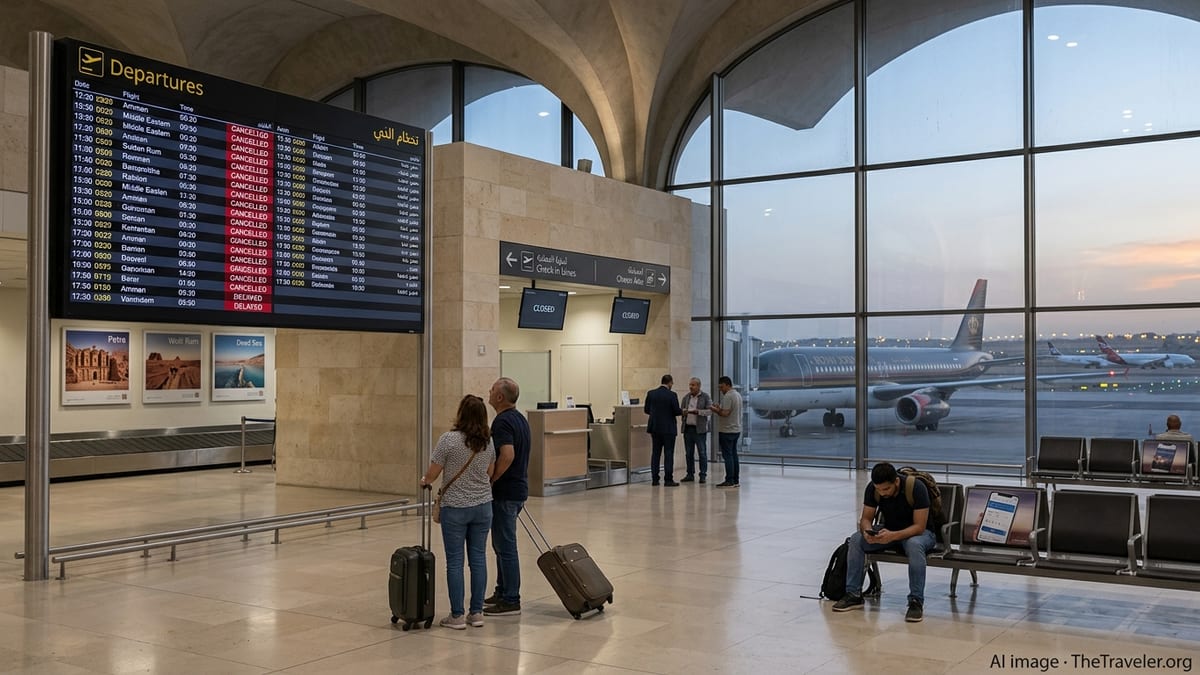
Jordan’s tourism jewel Petra is facing a sudden and severe visitor downturn as partial airspace closures and widespread flight suspensions across the Middle East disrupt travel routes into the kingdom at the start of the 2026 spring season.
Get the latest news straight to your inbox!
Regional Airspace Turmoil Reaches Jordan
Commercial aviation across the Middle East has been heavily disrupted in recent weeks following the escalation of the 2026 Iran conflict, with reports indicating broad suspensions or severe curbs on regular passenger flights. Publicly available aviation notices show that Jordan has implemented repeated night and afternoon closures of its airspace, forcing carriers to cancel or reroute services and sharply reducing available seat capacity into Amman.
Coverage from international news agencies describes a patchwork of closures from the Gulf to the Levant, with the United Arab Emirates and other key hubs restricting traffic while emergency and evacuation flights receive priority. This has created a fragmented network where many traditional long-haul and regional connections are either unavailable or subject to last-minute changes, complicating itineraries for travelers bound for Jordan.
For a tourism sector that relies heavily on air arrivals through Queen Alia International Airport, the timing is especially sensitive. March and April typically mark the beginning of Jordan’s high season, when tour groups and independent travelers converge on Petra, Wadi Rum and the Dead Sea. The new wave of flight suspensions is interrupting that pattern just as the industry had been consolidating a post-pandemic and post-2024 recovery.
From Recovery Highs To Sudden Lows In Petra
Before the latest security crisis, Petra had been on a clear upward trajectory. Official data released over the course of 2025 indicated that the site recorded more than half a million visitors that year, with multiple months showing double-digit growth compared with 2024. Local media coverage highlighted April, October and November 2025 as particularly strong months, with foreign tourists returning in significant numbers and several days posting the highest visitor totals since before the Gaza war.
Analysts tracking Jordan’s tourism performance noted that Petra accounted for roughly one fifth of all visits to key heritage and nature destinations nationwide, confirming its status as the principal draw for international visitors. New low-cost routes from European cities, relaxed entry measures and domestic promotion campaigns were credited with driving the rebound, while the site’s global profile as a UNESCO World Heritage treasure continued to anchor most itineraries.
The current air travel disruption has quickly reversed that momentum. Tour operators report that bookings for Petra-focused trips scheduled for late March and April have been postponed or cancelled as travelers struggle to secure flights into Amman or Aqaba. Industry commentaries describe unprecedented day-to-day volatility in arrivals, with some coaches running half empty and local guides in Petra speaking of the quietest early-spring streets in years.
Flight Freeze Ripples Through Jordan’s Tourism Economy
The impact of the regional flight freeze extends well beyond the sandstone facades of Petra’s Treasury. Jordan’s tourism strategy in recent years has positioned Petra as the anchor of broader circuits linking Amman’s cultural sites, the Dead Sea, Wadi Rum and the northern ruins of Jerash. When visitor numbers at Petra fall sharply, businesses along this entire chain feel the effect.
Publicly available economic analyses on Jordan had already warned that the war in Gaza and a succession of security incidents were undermining tourism income in 2024, even as the sector attempted to consolidate earlier gains. Reports from development organizations in 2025 highlighted Petra’s vulnerability to regional shocks, noting that global travelers often perceive Jordan through the broader lens of Middle East stability rather than its specific on-the-ground conditions.
With airlines trimming schedules and some travelers reluctant to transit major regional hubs, tourism-dependent jobs in Petra’s surrounding communities are again at risk. Hoteliers, transport providers, handicraft vendors and desert camp operators depend on a predictable flow of group and independent travelers. Commentaries in local outlets describe businesses reactivating contingency plans used during the pandemic period, including staff rotations, reduced operating hours and increased emphasis on domestic visitors.
Government Messaging and Industry Adaptation
Jordanian tourism authorities and local destination managers have maintained a consistent message that tourist sites, including Petra, remain open and that internal travel continues to function normally despite regional airspace restrictions. Previous short-term airspace closures in 2025, when Jordan briefly suspended flights as a precaution during earlier regional tensions, did not affect site operations, and current statements similarly emphasize continuity on the ground.
Recent policy documents and strategy papers from Jordan’s tourism planners highlight efforts to diversify source markets, strengthen overland connections and expand cultural experiences in and around Petra. These include the development of additional hiking and heritage trails, new community-based tourism products and seasonal festivals designed to encourage longer stays. Such initiatives may help cushion the blow from temporary disruptions in air arrivals, especially if regional travelers and residents respond to targeted promotions.
Industry observers also point to the potential role of alternative routings for determined visitors. While many direct connections into Amman are limited, some travelers are exploring combinations of flights to less affected airports, followed by overland travel into Jordan where border crossings remain open. However, this option adds cost and complexity and is unlikely to fully offset the drop in mainstream package tourism while the broader flight freeze persists.
What Travelers Should Expect In The Coming Weeks
For prospective visitors, the evolving situation means that Petra remains accessible in principle but harder to reach in practice. Airline schedules across the region continue to shift at short notice, and aviation authorities have indicated that airspace restrictions may be adjusted in line with changing security assessments. Travel advisors currently recommend that visitors monitor airline communications closely and be prepared for route changes, longer journey times or last-minute cancellations.
On the ground in Petra itself, travelers who do make it to Jordan are likely to encounter unusually low crowds for the season. Comment threads and traveler reports from early March 2026 describe quieter trails, shorter queues at ticket offices and more availability in local accommodations than is typical for this time of year. While this may appeal to some visitors seeking a more tranquil experience, it also underscores the scale of the downturn confronting local businesses.
Looking ahead, much will depend on how quickly regional airspace can reopen to regular commercial traffic and whether confidence in Middle East travel corridors can be restored ahead of the peak summer period. For now, Petra stands as a symbol of how swiftly geopolitical turbulence in the skies can translate into empty streets at one of the world’s most celebrated archaeological sites.