

More news on this day
From Tehran to Tulum, a volatile mix of war, airspace closures and cartel violence is colliding with peak booking season, triggering a sharp rise in travel anxiety as spring 2026 gets underway.
Get the latest news straight to your inbox!
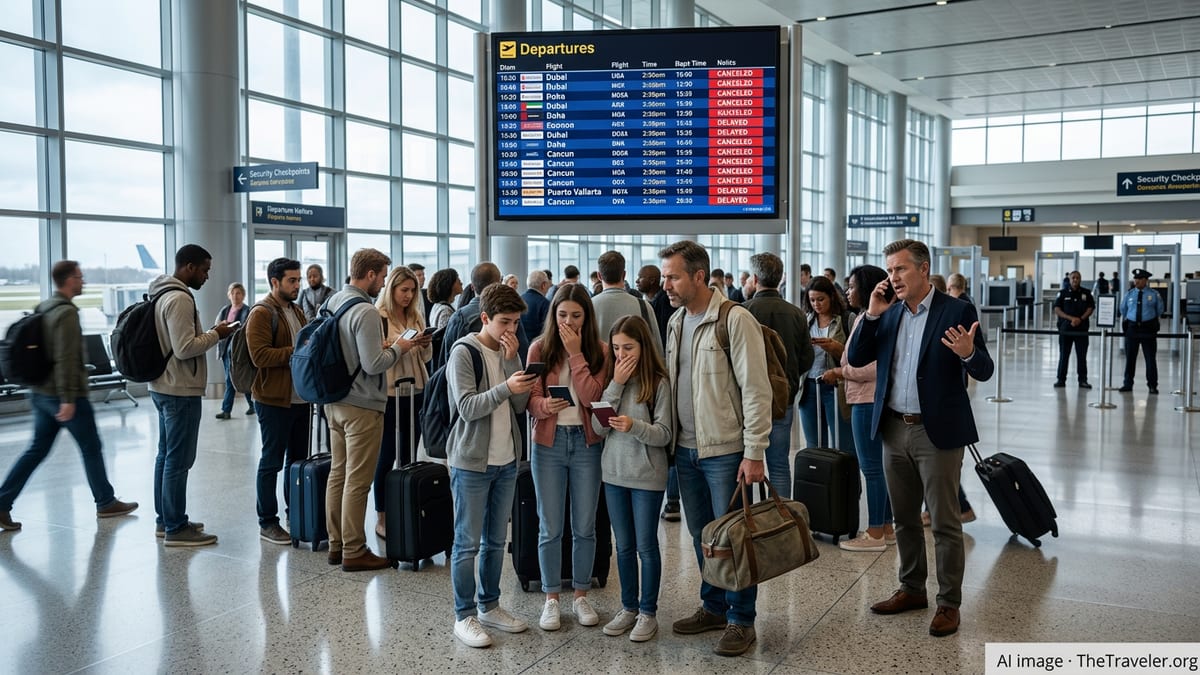
Middle East War Pushes Travelers to Reroute and Cancel
The latest U.S. and Israeli strikes on Iran, launched on February 28, have rapidly transformed the map for global travelers. Within days, Iran retaliated with missiles and drones across the region, prompting airport closures, airspace restrictions and urgent government warnings. Commercial airlines from Europe, the Gulf and North America have curtailed or suspended flights over Iran, Iraq, Israel and several Gulf states, forcing last‑minute diversions and longer routings between Europe and Asia.
According to recent advisories from business aviation groups and airline notices, key hubs in Iran remain effectively shut, while operations in parts of the United Arab Emirates, Qatar, Bahrain and Saudi Arabia are heavily disrupted or subject to sudden changes. Travel industry analysts say even travelers whose journeys do not touch the Middle East are feeling the impact, as carriers shift aircraft and crews, tighten schedules and raise fares on remaining long‑haul corridors.
The logistical fallout is magnified by the psychological shock of a new war in Iran. Reports of strikes on civilian infrastructure and repeated missile barrages have undercut confidence in the wider region, with tour operators in Europe warning of widespread cancellations to destinations as far afield as the eastern Mediterranean and the Caucasus.
Governments Issue Worldwide Warnings as Evacuations Accelerate
As the conflict escalated in late February and early March, governments moved quickly to update their guidance. On February 28, the U.S. State Department issued a Worldwide Caution, explicitly linking the advisory to the launch of combat operations in Iran and urging Americans everywhere to review security alerts and contingency plans. In subsequent days, Washington ordered drawdowns of nonessential staff at multiple embassies and consulates in the region, signaling a long, uncertain period of instability for residents and visitors alike.
European governments have taken similar steps. France has been organizing emergency flights, overland convoys and sea routes to extract its nationals from Iran, Lebanon and neighboring countries, while the United Kingdom has warned citizens to avoid several Gulf destinations outright. Evacuation flights have become a nightly feature at some regional airports where security conditions permit, while in others, airspace closures have forced travelers to shelter in place and await overland options.
For travel agencies and corporate travel managers, the fast‑moving advisories present a complex risk puzzle. Industry bulletins from global business travel associations now recommend that companies treat the broader Middle East as a high‑volatility environment, with preapproved evacuation plans, alternate routings via Central Asia or Africa, and real‑time tracking for staff on the move. Leisure travelers, by contrast, often lack that support network, heightening feelings of vulnerability even when they are far from the front lines.
Mexico’s Security Flashpoints Cloud Spring Break Season
At the same time, Mexico’s perennial appeal as a sun‑and‑sand escape is being tested by fresh security shocks. In late February, large‑scale security operations and cartel reprisals in several states led to road blockages, vehicle fires and sporadic gun battles, prompting the U.S. Embassy and consulates to urge Americans in affected areas to shelter in place. Flights in and out of airports serving Guadalajara and Puerto Vallarta were temporarily suspended, and brief security alerts extended to areas near major Caribbean resorts.
The U.S. State Department’s countrywide advisory for Mexico, last updated in August 2025, already urged travelers to avoid or reconsider travel to multiple states because of crime and kidnapping risks. State‑level leaders have added their own warnings this year, with officials in Texas publicly pressing residents to heed federal guidance before crossing the border for holidays or medical visits. While tourism infrastructure in major resort areas remains robust, security analysts say cartel responses to high‑level arrests have entered a more unpredictable phase, with short, intense flare‑ups affecting transport corridors tourists rely on.
These developments come just as students and families across North America prepare for spring break and shoulder‑season trips. Travel advisers report a noticeable uptick in worried calls about whether to proceed with plans to Cancún, Los Cabos or smaller coastal towns. Many bookings are going ahead, but travelers are demanding more detailed neighborhood‑level safety briefings, flexible cancellation policies and backup accommodation options away from potential flashpoints.
Anxiety Levels Rise as Safety Joins Price and Politics in Trip Decisions
Safety concerns were already reshaping travel choices before the current crises. A 2025 European holiday survey found that more than half of respondents cited wars and conflicts as a key factor in destination selection, a sharp jump from pre‑pandemic years. The new fighting in Iran and high‑profile incidents in Mexico have amplified that trend, turning abstract worries into concrete dilemmas about where, and whether, to travel this spring.
Travel risk consultants say the emotional impact often extends beyond the actual danger. Even travelers headed to stable destinations report second‑guessing itineraries that involve transiting Middle Eastern hubs or flying over the Gulf. Others are rethinking quick escapes to Mexican border cities in favor of domestic trips, influenced as much by headlines and social media clips as by official crime statistics.
Psychologists who work with anxious travelers note that this season’s stressors overlap: political polarization at home, images of war abroad and financial pressure from higher airfares and hotel rates. The result is a more fragile sense of control. Some travelers respond by delaying bookings until the last minute, while others seek reassurance in structured tours, comprehensive insurance and detailed contingency plans.
How Travelers and the Industry Are Adapting for Spring 2026
In response, the travel industry is racing to adapt. Major airlines have expanded change‑fee waivers for itineraries touching the Middle East, allowing customers to reroute or postpone without penalty within set windows. Some carriers are reconfiguring schedules to bypass conflict zones entirely, adding capacity on northern routes over parts of Central Asia and Eastern Europe, even when that means longer flight times and higher fuel costs.
Tour operators and travel management companies, meanwhile, are foregrounding security in their marketing and client communication. Destination briefings that once focused on restaurants and beaches now routinely include information on protest patterns, local law enforcement capacity and nearby medical facilities. In Mexico, several large hotel groups have quietly strengthened private security and coordination with local authorities, emphasizing controlled access, monitored transport and 24‑hour on‑property support.
For individual travelers, experts recommend a blend of pragmatism and preparation rather than blanket avoidance. That includes monitoring government advisories in real time, registering trips when possible, confirming that insurance covers war or civil unrest disruptions, and building flexibility into itineraries through refundable rates and backup routing options. The underlying message from risk professionals this spring is not that global travel must stop, but that in an era of overlapping conflicts and security shocks, informed decisions and layered safeguards have become as essential as a valid passport.