

More news on this day
A tightening of U.S. entry rules, rolling flight disruptions across Asian hubs and a sharp rise in short European city breaks are combining to redefine the global travel map in early 2026, creating fresh winners and losers in an industry still recalibrating after the pandemic.
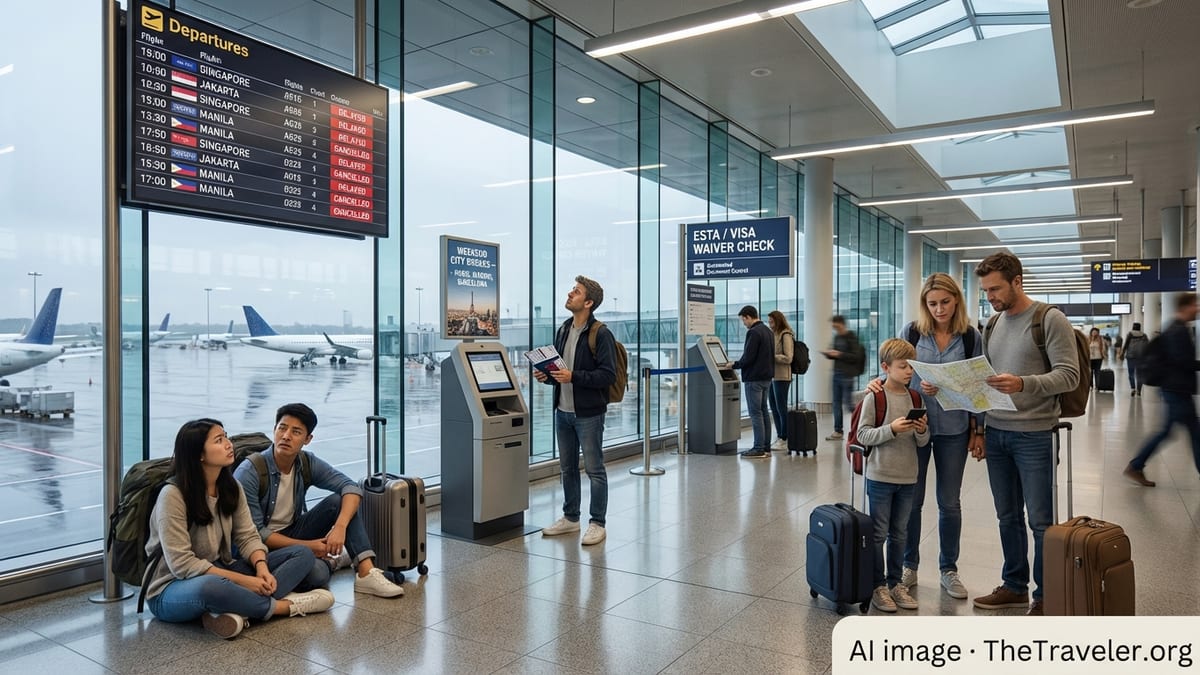
New ESTA Proposals Put the U.S. Under Scrutiny
The United States, long one of the world’s most visited countries, is facing a new reputational test as proposed changes to its Electronic System for Travel Authorization raise alarms among tourism leaders. The draft rules, highlighted this week by industry groups, would require many visitors from visa-waiver countries to provide far more detailed information, including expanded disclosure of social media activity, as part of their pre-travel clearance.
Research commissioned by the World Travel and Tourism Council suggests those plans could substantially dampen demand. Modelling points to millions fewer international arrivals from visa-waiver markets by 2026 if the more invasive questions are introduced, along with a multibillion-dollar hit to visitor spending and more than a hundred thousand U.S. jobs put at risk. The findings underline how sensitive global travellers have become to both perceived privacy intrusions and bureaucratic friction at the border.
Travel companies in Europe and Asia say clients are already asking whether the United States is becoming a less welcoming destination compared with rivals such as Canada, the United Kingdom or Japan. Agents report some customers shelving tentative plans for trips to New York, Orlando or the U.S. West Coast in favor of destinations with simpler entry processes and fewer unknowns. That shift in sentiment is significant for an economy that has yet to fully regain its pre-2019 share of long-haul tourism.
Washington officials insist that security remains the primary driver of any changes, but the timing is awkward. The United States is already contending with broader geopolitical tensions and a patchwork of travel bans affecting certain nationalities under earlier presidential proclamations that took effect in January 2026. Tourism boards and city marketing organizations are now racing to reassure partners overseas that the vast majority of leisure visitors will continue to be welcomed as before, even as the details of the new ESTA questions are debated.
Asian Flight Disruptions Highlight Fragile Recovery
While would-be visitors to the United States grapple with policy uncertainty, travellers within Asia are confronting more tangible chaos: crowded departure halls, rolling delays and sudden cancellations. Operational data from early February showed more than a thousand delayed flights in just two days across Southeast Asia, with Singapore, Jakarta, Manila and Cebu among the hardest-hit airports as schedules buckled under a mix of heavy demand, weather and infrastructure constraints.
Singapore’s Changi Airport, which handled close to record passenger volumes last year, has found that even relatively small operational hiccups can now ripple rapidly through its tightly banked waves of connecting flights. A delay of under an hour on an inbound regional service can strand hundreds of passengers trying to make long-haul departures to Europe, the Middle East or North America, forcing airlines into a scramble of rebookings and overnight hotel arrangements. For travellers, the effect is long queues, missed events and a renewed sense that air travel in Asia remains brittle.
Indonesia and the Philippines are facing similar choke points. Jakarta’s Soekarno Hatta International has repeatedly surfaced near the top of regional disruption tallies, reflecting both the sheer number of domestic and international flights it handles and the limited slack in its runway and gate capacity. In Manila and Cebu, sustained demand since the 2025 holiday peak has left terminals operating close to their limits, amplifying the impact of even minor technical issues or air traffic control restrictions.
These problems come on the heels of high-profile shocks elsewhere in the region. In India, the abrupt scheduling crisis at low-cost giant IndiGo in December 2025 forced the cancellation of thousands of flights when the carrier failed to adapt rosters to new crew rest rules, leaving wedding parties and business travellers scrambling. In South Korea, heightened safety inspections following a Jeju Air accident and further technical incidents prompted that airline to cut capacity by up to 15 percent for the winter season. Together, the disruptions offer a stark reminder that Asia’s aviation rebound, while impressive on paper, is still heavily exposed to regulatory shifts, staffing bottlenecks and ageing fleets.
Travellers Pivot Routes as Reliability Becomes a Selling Point
The immediate consequence of Asia’s recurring disruptions has been a spike in social media posts documenting missed connections and improvised overland journeys. But industry analysts say the longer-term impact may be a gradual rewiring of travel flows, as both leisure and corporate travellers show increasing willingness to pay a premium for perceived reliability and clear communication.
Some multinational companies have already begun quietly adjusting internal travel policies, favouring carriers and hubs with stronger on-time performance and clearer consumer protections. Travel managers say employees heading to regional meetings are more likely to be routed through airports such as Tokyo or Seoul rather than more congested hubs if the schedule allows, in an effort to reduce the risk of multi-leg itineraries unravelling. For high-value trips, an extra connection via a Gulf hub with a reputation for operational resilience is becoming more palatable than risking a tight same-day transfer in a congested Southeast Asian gateway.
At the same time, travellers are rethinking what they consider an acceptable amount of risk for discretionary journeys. Agents in India and Southeast Asia report more clients asking about flexible ticket options, refundable fares and travel insurance that covers missed connections, even on short regional hops. Some families are choosing to consolidate several shorter trips into a single, longer holiday, arguing that if they are going to endure the prospect of disruption at airports, they want the payoff of a more substantial break.
Airlines in the region are under pressure to respond. Several carriers have brought forward fleet maintenance checks, hired additional ground staff and adjusted minimum connection times in their booking engines. Others are investing in more sophisticated passenger-notification tools, promising real-time updates and faster automatic rebooking for disrupted passengers. Yet with demand rising and margins still tight, there is limited appetite for large-scale schedule padding that would significantly reduce capacity.
Europe Becomes the Default Short-Haul Escape
As uncertainty grows around long-haul trips and transpacific connections, Europe’s tourism industry is capitalising on a different story: the resurgence of short, frequent city breaks and spontaneous weekend escapes. Data from hotel booking platforms heading into the 2025 to 2026 winter season showed demand for European city breaks surging, with particular strength in Spain, Italy and selected Central and Eastern European capitals.
Paris and London remain at the top of global city rankings in terms of demand, benefiting from extensive air links and a deep inventory of hotels. Yet some of the fastest growth is now being recorded in destinations such as Madrid, Barcelona and Rome, where year-round cultural programming and relatively mild winters make them attractive for off-season getaways. Warsaw and other emerging cultural centres in Central Europe are also registering double-digit increases in bookings, helped by competitive pricing and improved air and rail connectivity.
The renewed appetite for quick European escapes is not limited to traditional peak periods. Operators in the United Kingdom and continental Europe reported one of their busiest early January booking periods on record, as consumers seized on so-called “Sunshine Saturday” promotions to lock in both summer holidays and spring city breaks. Short-haul flights departing major European hubs for weekend trips to Iberia, the Mediterranean and historic capitals are filling up weeks earlier than they did a year ago, even as travellers remain notably price-conscious.
Industry observers say Europe’s relative political stability and predictable entry requirements are part of its appeal in the current climate. For many would-be holidaymakers weighing up a complex trip to the United States or a multi-stop itinerary across Asia, the simplicity of a two- or three-night break in a nearby European city, with low-cost carriers and frequent rail options as backup, has become hard to beat.
City Breaks Evolve Beyond Quick Selfies
The shape of Europe’s weekend getaways is changing alongside their volume. Recent trend reports point to travellers stretching traditional two-night stays into three or four nights, booking further in advance and seeking more immersive experiences once they arrive. Rather than racing between landmarks, visitors are building itineraries around food markets, neighbourhood walks and small cultural venues, aided by a proliferation of local tours and experiences bookable via major platforms.
This evolution is visible across many of the continent’s most in-demand cities. In Barcelona and Madrid, hoteliers say guests are increasingly asking for recommendations beyond the usual Gaudí or Prado circuit, including day trips to lesser-known coastal towns or wine regions. In Rome and Milan, museums and galleries are experimenting with later opening hours and special evening programming to attract weekend visitors who want to avoid daytime crowds and combine sightseeing with dining.
The rise of more considered city breaks is also reshaping accommodation trends. Boutique hotels and apartment-style stays with kitchenettes are seeing strong demand from travellers who want the freedom to shop at local supermarkets and cook occasionally rather than dine out for every meal. Wellness-add-on options, such as access to thermal baths, rooftop yoga or guided runs, are increasingly marketed as part of weekend packages, tapping into travellers’ desire to return home feeling refreshed rather than exhausted.
For destinations, the challenge is to harness this growth without overwhelming local infrastructure or fuelling further resident backlash against overtourism. Several major cities have introduced or increased tourist taxes, tightened rules on short-term rentals and promoted off-season events in secondary neighbourhoods to spread visitor flows more evenly.
Competitive Pressures Reshape Long-Haul Networks
Behind the scenes, regulatory shifts in Europe are poised to further complicate the global picture, particularly for long-haul links between Europe and Asia. New European Union climate rules are increasing the mandated use of sustainable aviation fuel on flights departing EU airports, significantly raising costs for airlines based in the bloc. Executives at major European carriers warn that without compensating measures, a substantial share of their Asia-bound flights could become uneconomical over the coming decade.
Airlines based in the Gulf and in Turkey, which are not subject to the same sustainable fuel mandates on all of their routes, are positioning themselves to capture additional Europe to Asia traffic through their hubs. Carriers such as Emirates, Qatar Airways and Turkish Airlines have been expanding capacity and touting their ability to offer competitive fares on multi-leg itineraries via Dubai, Doha or Istanbul. For passengers already wary of disruption in certain Asian hubs, the promise of seamless connections through these mega-hubs is an increasingly persuasive selling point.
At the same time, Asian airlines are selectively adding capacity on routes that tap into the growing demand for Europe’s city breaks and cultural travel. Singapore Airlines’ decision to resume non-stop flights to Riyadh from June 2026, after a 12-year pause, illustrates how carriers are seeking to balance regional pressures with opportunities in new or revived markets. Middle Eastern and European carriers are also eyeing secondary European cities as potential targets for new long-haul services, particularly those that have demonstrated strong growth in weekend tourism.
For travellers, the result is a complex mix of choice and constraint. While more routes and combinations are becoming technically available, the interplay of climate policy, cost pressures and operational fragility means that not all of today’s options will remain viable. Experts advise passengers planning multi-stop itineraries between Europe and Asia in 2026 and 2027 to pay close attention to schedule changes and to book through-tickets where possible, rather than piecing together separate legs.
How Travellers Are Adapting to the New Travel Landscape
Amid policy shifts and operational turmoil, travellers themselves are proving remarkably adaptable. Surveys conducted by travel insurers and booking platforms show a steady increase in demand for flexible fares, higher take-up of trip protection policies and a rising willingness to adjust destinations based on entry requirements or reported disruption levels. Instead of committing early to a single major long-haul trip, many consumers are building a portfolio of travel plans for the year, anchored by one or two European city breaks that feel predictable and easy to execute.
Industry analysts note that travellers are also becoming more sophisticated in how they assess risk. Frequent flyers are paying closer attention to airline reliability metrics, aircraft types and crew rest rules, particularly after the IndiGo crisis in India highlighted how regulatory changes can ripple quickly through schedules. Social media and real-time flight tracking tools have made it easier for passengers to monitor patterns of delay at certain hubs and to adjust their choices accordingly.
For U.S. tourism officials, the danger is that heightened awareness of bureaucracy and disruption elsewhere will make any perceived tightening of ESTA rules more damaging than it might have been a decade ago. In a world where travellers are acutely sensitive to friction, even the suggestion of more intrusive questioning at the border can tip the balance in favour of a weekend in Lisbon, Paris or Barcelona over a longer, more complex journey to New York or Los Angeles. With early 2026 already marked by high-profile flight disruptions in Asia and strong demand for European city breaks, the United States risks being cast as the outlier, just as competition for global visitors intensifies.
For now, the travel industry’s message to consumers is one of cautious pragmatism. Check entry rules before booking, build in buffers around important events, consider travel insurance and keep expectations flexible. The chaos of 2026 is not deterring people from travelling, but it is changing how they plan and where they feel most confident spending their time and money.