

Travellers across northern and central Alberta faced an unexpected wave of disruption on February 17, as at least 10 flights were cancelled across Grande Prairie, Calgary, and Edmonton, snarling schedules for passengers booked with Air Canada, WestJet, and Sunwing-linked services.
Ten Cancellations Ripple Across Alberta’s Air Network
What began as a routine mid-February travel day quickly deteriorated into a patchwork of cancellations and rolling delays across three key Alberta airports. By Monday afternoon, airport departure boards in Grande Prairie, Calgary, and Edmonton collectively showed 10 flights scrubbed from the schedule, many of them operated by or on behalf of Air Canada and WestJet, with knock-on impacts to leisure itineraries previously sold under the Sunwing brand.
Airports in Grande Prairie and Edmonton, both crucial links between northern communities and larger hubs, reported short-haul cancellations that severed connections to Calgary and beyond. In Calgary, one of Canada’s busiest hubs and WestJet’s primary base, the loss of several departures and arrivals compounded existing congestion and left passengers scrambling to rebook onto later flights or alternative routings.
Although the total number of affected flights is modest compared with the national schedule, the concentration of cancellations in Alberta had outsized consequences. Many of the scrubbed services were feeder flights, which play a critical role in connecting northern Alberta travellers to national and international networks through Calgary and Edmonton.
For some passengers, a single cancellation meant missed sun destinations, lost business meetings, or disrupted family visits. For airlines already navigating operational headwinds in early 2026, it marked another stress test of resilience in a winter season that has been anything but routine.
Winter Weather, Tight Schedules, and a Fragile System
Behind the latest bout of travel turmoil lies a familiar culprit: winter. A cold-weather system sweeping across the Prairies brought low ceilings, gusty winds, and intermittent snow, adding strain to an aviation ecosystem already stretched by seasonal pressures. Even when runways remain technically operational, harsher conditions slow de-icing, lengthen turnaround times, and reduce the pace at which aircraft can safely depart and arrive.
WestJet, which has reported a spike in winter-related disruption across its network this season, has faced particularly acute pressure at Calgary, where a tight rotation of narrow-body aircraft leaves little slack when conditions deteriorate. When one aircraft falls behind, the delay can cascade into subsequent flights, forcing schedule resets that sometimes culminate in cancellations when crew duty-hour limits or airport curfews loom.
Air Canada has not been immune either. As the country’s flag carrier, it relies on finely tuned hub operations in major cities such as Calgary and Edmonton. A single weather event in one region can reverberate across its national network, snarling connections and prompting tactical cancellations on shorter domestic legs to protect long-haul operations.
While Grande Prairie operates on a smaller scale, the effects of even one cancelled departure can be dramatic for local travellers. With fewer daily frequencies and limited competition, there is often no same-day alternative when a flight is dropped, transforming what might be a minor delay at a major hub into an overnight stay for passengers in the Peace Country.
WestJet, Air Canada, and the Ghost of Sunwing
The disruptions also highlight an evolving competitive landscape in Canadian aviation. Sunwing Airlines, long associated with winter getaways from Western Canada, has formally ceased operations as a standalone carrier, with its aircraft and routes fully integrated into the WestJet network in 2025. That means passengers who still think of their trips as “Sunwing flights” are now, in most cases, actually flying on WestJet metal or codeshare services.
As a result, network shocks that hit WestJet resonate directly across what used to be the Sunwing leisure portfolio. Vacationers departing from Calgary or Edmonton to sun destinations, or connecting from Grande Prairie via Calgary, find themselves caught up in the same operational storm, even if their booking documents still reference Sunwing packages or branding.
Air Canada, for its part, has maintained a mix of mainline and regional operations into Alberta’s secondary markets, balancing its hub strategy between Calgary, Edmonton, and larger eastern gateways. When weather or resource constraints force difficult choices, the carrier, like its rival, often prioritises high-density trunk routes and international connections. That can leave communities such as Grande Prairie exposed to a higher risk of same-day cancellations when systems come under strain.
For travellers, the distinction between airline brands matters less than the practical outcome: a cancelled boarding pass, a rebooked itinerary, and a race against the clock to salvage vacation days or work commitments.
Passengers Face Long Lines, Tight Options, and Uncertain Plans
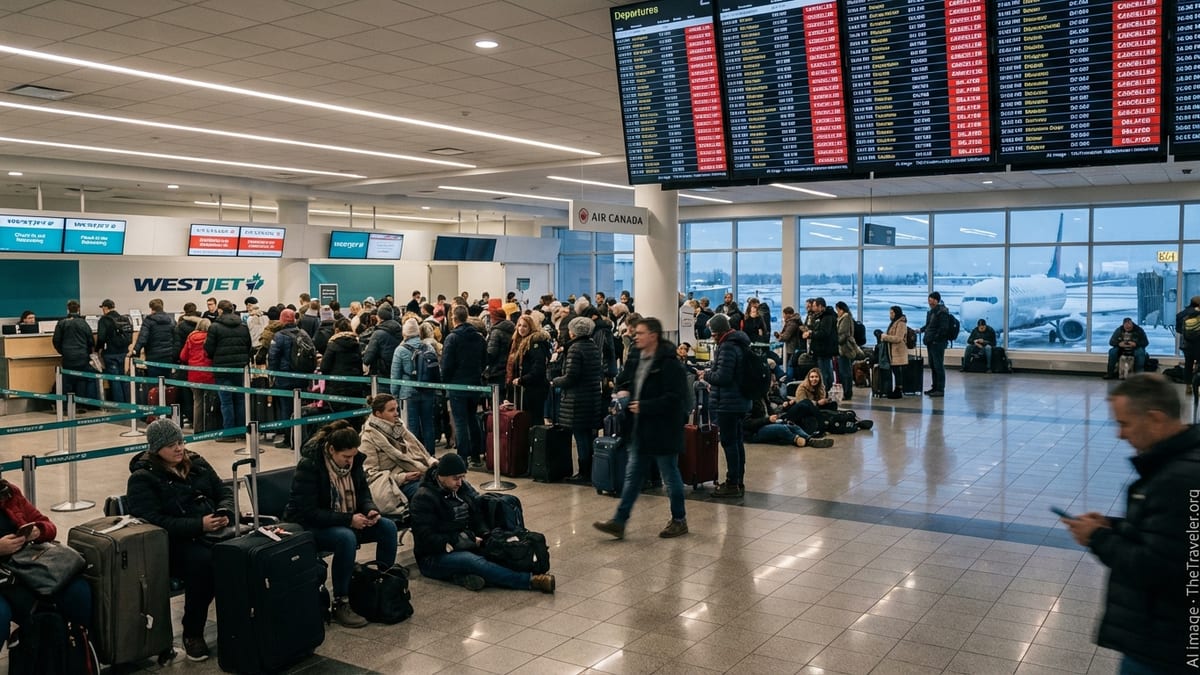
Inside terminal buildings on February 17, the human impact of those 10 cancellations was immediately visible. In Calgary, serpentine queues formed at customer service counters as WestJet and Air Canada agents tried to accommodate hundreds of displaced passengers, rebooking them onto later flights out of already busy hubs. Phone lines and chat services saw a surge in demand as travellers unable to reach an agent in person sought digital alternatives.
In Edmonton, travellers bound for domestic connections and southern vacation spots spoke of hours spent in line, punctuated by shifting departure times and changing gate information. While many were eventually rebooked, some families reported splitting across different flights or even different days due to limited remaining seat capacity. Others opted to abandon their air travel plans entirely, seeking refunds or travel credits instead.
Grande Prairie passengers encountered a more binary reality. With far fewer daily departures compared with Calgary or Edmonton, options to re-route around a cancelled flight were constrained. Some travellers turned to long-distance driving on winter highways to reach appointments in Edmonton or Calgary, trading airport uncertainty for the risks of seasonal road travel. For those heading for once-a-week leisure charters or tightly timed connections, a missed leg often meant an entire trip lost.
While front-line staff worked to assist as many people as possible, the visible frustration underscored how quickly confidence in travel plans can erode when even a small cluster of cancellations hits multiple airports at once.
Fuel Shortages, Route Cuts, and a Shifting Canadian Air Map
The turbulence in Alberta is unfolding against a broader backdrop of structural change in Canadian aviation in early 2026. Airlines have been re-evaluating their route networks, cutting less profitable services, and concentrating capacity on core markets as they confront volatile demand, higher operating costs, and geopolitical shocks.
WestJet has already announced significant reductions to its United States flying for the coming spring and early summer, including the suspension of several transborder routes from Edmonton and adjustments to Calgary services. At the same time, the carrier is absorbing former Sunwing and Swoop aircraft into a unified operation, a complex process that can introduce short-term scheduling and crew-planning challenges even as it promises longer-term efficiencies.
Air Canada and WestJet have also been forced to respond to external disruptions beyond Canada’s borders. A deepening aviation fuel crisis in Cuba, exacerbated by geopolitical tensions and an effective oil blockade, has led Canadian airlines to suspend or sharply curtail services to the island, stranding some vacationers and further tightening the allocation of aircraft across winter leisure routes.
These strategic shifts mean that when weather or operational issues do arise, carriers often have fewer spare aircraft and crews available to recover quickly. In practice, that can translate into more aggressive use of pre-emptive cancellations on shorter domestic segments, like those linking Grande Prairie with Calgary or Edmonton, in order to protect higher-yield or international flights.
What Stranded Travellers Are Being Offered
For passengers caught in Monday’s disruption, the fine print of airline policies suddenly became critical. Both Air Canada and WestJet offer rebooking options when flights are cancelled for reasons within or outside their control, though the specifics vary by fare type, booking channel, and the nature of the disruption.
Travellers whose flights were cancelled outright were generally entitled to be rebooked on the next available departures to their destinations, at no additional cost, subject to seat availability. In some cases, particularly where overnight stays were required, airlines arranged hotel vouchers or meal credits, though availability tended to be more constrained in smaller markets such as Grande Prairie.
For those booked on package holidays historically associated with Sunwing, compensation and assistance levels depended not only on the operating airline’s obligations but also on the terms of the vacation provider. Some travellers reported being offered future travel credits instead of cash refunds, a common industry practice that can nevertheless frustrate customers facing immediate out-of-pocket expenses for food, ground transport, or last-minute alternative bookings.
WestJet and Air Canada both highlighted self-service tools as a first port of call, encouraging passengers to use airline apps or websites to monitor flight status and rebook where possible. However, intermittent digital bottlenecks and the complexity of multi-leg itineraries meant that many travellers still ended up in airport queues, where resolution could be slow and outcomes unpredictable.
Your Rights Under Canada’s Air Passenger Protection Rules
Beyond immediate rebooking and goodwill gestures, Canada’s Air Passenger Protection Regulations set out specific rights for travellers whose flights are cancelled or significantly delayed. The level of compensation and assistance depends on the size of the airline, the length of the delay in reaching the final destination, and whether the disruption was within the carrier’s control, within its control but required for safety, or outside its control altogether.
Where a cancellation is deemed within the airline’s control and not related to safety, affected passengers on large carriers such as Air Canada and WestJet may be eligible for financial compensation once delays exceed certain thresholds. Even when disruptions stem from weather or air traffic control constraints that fall outside an airline’s control, carriers must still offer rebooking on the next available flight and, in many cases, provide food vouchers or accommodation when overnight stays become unavoidable.
Determining the exact cause of a specific cancellation, however, can be challenging for passengers standing at a departure gate. Airlines are required to communicate the reason for disruptions, but the practical distinction between weather-related, safety-related, and operational decisions is often opaque. As Monday’s events in Alberta showed, a mix of winter conditions and network management choices can blur those lines in the eyes of travellers.
Consumer advocates continue to urge passengers to document their experiences, keep receipts for extra costs such as hotels and meals, and file formal complaints with airlines and, if needed, with the Canadian Transportation Agency. Even modest claims can add up when cancellations strike repeatedly during a busy season.
How Travellers Can Build More Resilient Itineraries
With Alberta’s latest disruption illustrating how swiftly travel plans can unravel, frequent flyers and industry experts alike are re-emphasising strategies to reduce risk, particularly during the heart of winter. One recurring recommendation is to book earlier departures whenever possible, giving more room in the day to absorb delays or rebook after cancellations.
Connecting passengers, especially those starting from smaller airports such as Grande Prairie, are also being advised to allow longer layovers in hubs like Calgary and Edmonton. While longer connection times may be less convenient under normal circumstances, they can provide a crucial buffer when de-icing backlogs or weather interruptions compress schedules.
Another key tip is to keep airline apps installed and notifications enabled, as carriers increasingly push real-time updates and rebooking options directly to passengers’ phones. In several cases on Monday, travellers who responded quickly to digital rebooking prompts secured scarce seats on alternative flights before they were snapped up by others in the same situation.
Ultimately, the cluster of cancellations across Grande Prairie, Calgary, and Edmonton on February 17 underscores a broader reality of winter 2026 travel in Canada: even as airlines refine their networks and upgrade technology, harsh weather and a finely balanced system mean that a handful of scrapped flights can still unleash travel chaos far beyond what raw numbers alone might suggest.