

More news on this day
Hundreds of thousands of travelers were left stranded or severely delayed this weekend as sweeping airspace closures across the Middle East forced major airlines to suspend flights, shut down key hub airports and rip up global schedules with little warning.
Key Middle East Hubs Grind to a Halt
Airspace closures by Iran, Iraq, Kuwait, Bahrain, Qatar and other states, combined with a temporary halt to traffic over the United Arab Emirates, have effectively shut down some of the world’s busiest transit hubs. Dubai International, Abu Dhabi’s Zayed International and Doha’s Hamad International all reported mass cancellations and diversions as missile strikes and retaliatory attacks escalated across the region.
Flight-tracking data showed virtually no civilian aircraft over large parts of the Gulf and surrounding airspace, an extraordinary sight in a corridor that normally connects Europe, Asia, Africa and Australasia. Aviation analytics firms estimated that more than a thousand flights were cancelled globally within hours, with many more delayed or forced into extended routings that skirted the conflict zone.
Authorities in several Arab states also announced temporary closures of maritime corridors alongside airspace restrictions, heightening concerns over regional stability. Officials stressed that the measures were driven by security considerations as militaries intercepted missiles and drones over multiple countries.
Local aviation regulators said they were reviewing the situation on an hourly basis, but warned that restrictions could be extended if hostilities continue, complicating planning for airlines that rely on predictable overflight rights and tight connection banks.
Global Airlines Suspend Routes and Reroute Long-Haul Flights
Flag carriers and low-cost airlines across Europe, Asia and the Americas rushed to adjust operations as the scale of the shutdown became clear. Emirates confirmed a temporary suspension of flights to and from Dubai until at least March 2, while Etihad halted departures from Abu Dhabi for much of March 1, citing ongoing regional airspace disruption and the need to ensure passenger safety.
Qatar Airways scaled back operations as Qatari airspace was affected, while Turkish Airlines and its low-cost subsidiary Ajet cancelled services to Lebanon, Syria, Iraq, Iran and Jordan until early March. European groups including Lufthansa, Swiss and several leisure carriers suspended services to Tel Aviv, Beirut, Oman and Dubai for the weekend, and put longer holds on some Israel-bound flights.
Indian regulators advised domestic airlines to avoid the airspace of multiple Middle Eastern countries, prompting Air India, Air India Express and IndiGo to scrap or curtail hundreds of international services. Many flights between India and Europe, North America or Africa that would normally route over the Gulf were cancelled outright, while others faced lengthy detours that added hours to journey times and disrupted crew scheduling.
Outside the immediate region, airlines from Australia, the United Kingdom and North America have also paused services or diverted aircraft away from affected airspace. Routes that used to rely on “Kangaroo Route” connections via Gulf hubs are being shifted to alternative gateways such as Singapore or Perth, but capacity constraints mean many travelers are still struggling to secure replacement seats.
Passengers Stranded in Terminals and En Route
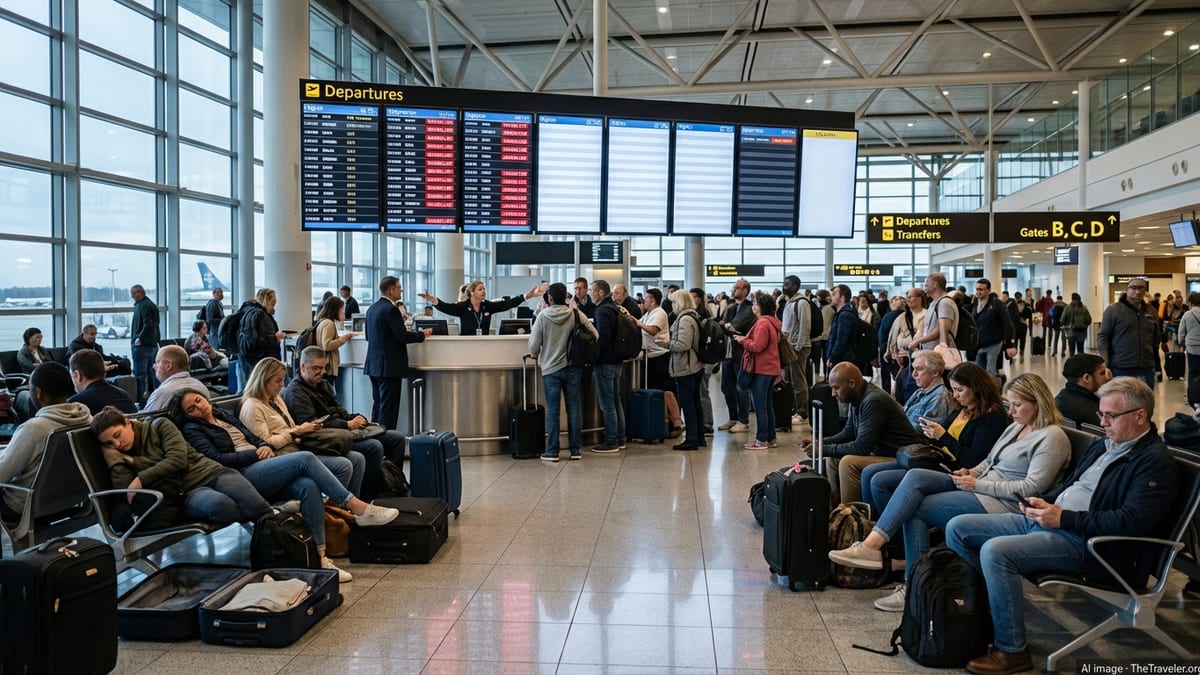
The sudden shutdown left thousands of passengers bedding down on terminal floors, queuing at makeshift customer service desks or watching information boards flick endlessly between “cancelled” and “delayed” notices. At Dubai and Abu Dhabi, travelers reported being held on board aircraft before being asked to disembark, with little clarity on when alternative flights might operate.
Transit passengers have been particularly hard hit, as those passing through Middle Eastern hubs mid-journey found their onward sectors cancelled and immigration procedures complicated by visa rules. Families returning from holidays, migrant workers heading back to jobs in the Gulf and business travelers on tight itineraries all faced overnight stays in crowded terminals and uncertainty about accommodation or meal support.
Elsewhere, long-haul flights already en route when airspace closures were announced were forced to divert to secondary airports, some far from passengers’ original destinations. This triggered a cascade of missed connections across airline networks and left crews and ground staff scrambling to reposition aircraft and manage duty-time limits.
Travel insurers and consumer advocates are urging passengers to document out-of-pocket expenses and keep all communications from airlines, noting that rebooking rights, compensation and care obligations vary significantly by carrier and jurisdiction. With schedules repeatedly revised, many travelers are warned not to head to the airport until they have a confirmed new itinerary.
Operational and Safety Considerations Behind the Closures
Aviation safety experts say the sweeping airspace restrictions reflect a conservative risk assessment in an environment where missiles, drones and military aircraft are active across multiple flight information regions. Even if civilian aircraft are not direct targets, the potential for misidentification or stray projectiles in busy skies has prompted authorities to act decisively.
Airlines are also mindful of past incidents in which passenger jets were struck amid regional conflicts. Many carriers have longstanding internal protocols that require them to avoid certain altitudes or routes whenever military activity escalates, and insurance providers may refuse coverage for operations in designated high-risk zones.
Operationally, rerouting around large swathes of closed airspace creates knock-on challenges for fuel planning, crew hours and aircraft availability. Flights between Europe and South or Southeast Asia often use Middle Eastern corridors for the most efficient tracks; avoiding them can add hours of flying and make some trips uneconomical in the short term.
Air traffic control agencies in neighboring regions, including parts of Central Asia, North Africa and Eastern Europe, are now managing higher-than-normal volumes as diverted flights funnel through narrower corridors. Controllers have introduced additional spacing and altitude restrictions to maintain safety, further constraining available capacity.
What Travelers Should Do Now
With the situation evolving by the hour, airlines are urging passengers booked on affected routes to monitor official channels closely before heading to the airport. Many carriers have rolled out temporary rebooking and refund waivers, allowing travelers to change dates or destinations without penalties, or to request full refunds on cancelled services.
Industry groups advise travelers to check not only departure and arrival airports but also the routing of connecting flights, as itineraries that do not touch the Middle East directly may still rely on overflight rights in closed airspace. Those with urgent travel needs are being encouraged to consider alternative routings via unaffected hubs, accepting longer journey times and possible overnight stops.
Travel agents and corporate travel managers report heavy call volumes as they rebook clients onto limited alternative options. Some are prioritizing essential travel for medical, family or critical business reasons, while deferring discretionary trips until airlines publish more stable schedules.
While some governments have issued advisories against non-essential travel to parts of the region, aviation authorities have stopped short of predicting how long the disruption will last. For now, industry officials say the timeline for restoring normal operations will depend on both security developments and the speed at which airspace regulators feel confident reopening key corridors.