

More news on this day
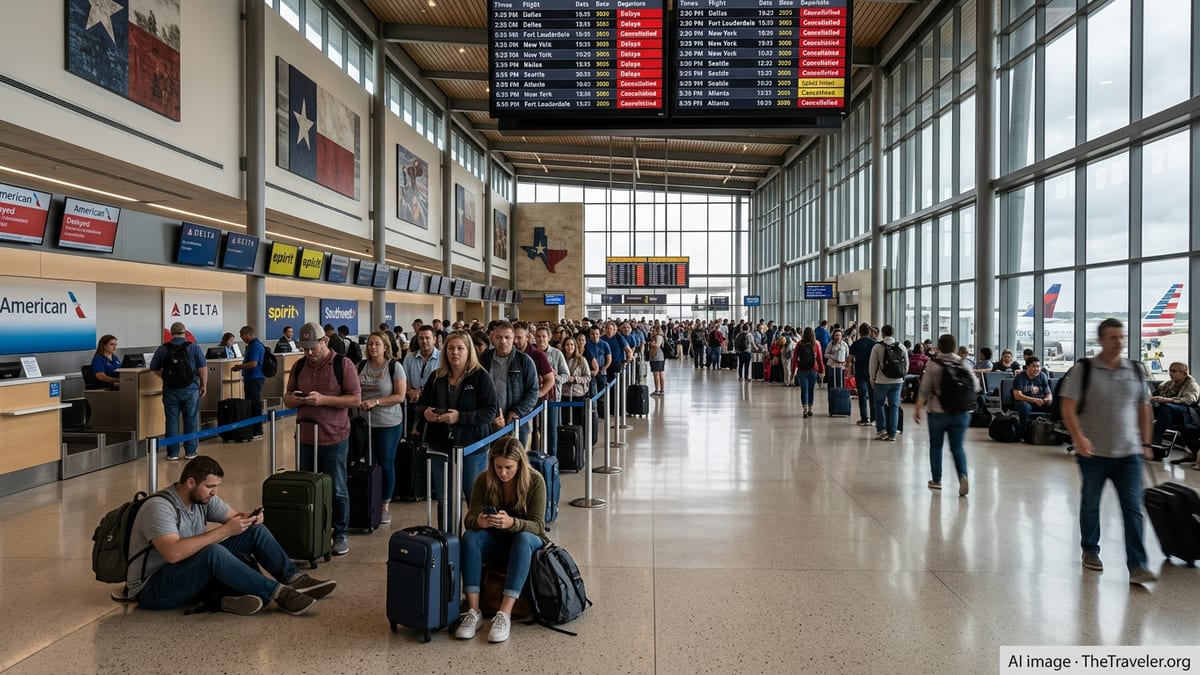
Travelers at Austin–Bergstrom International Airport faced mounting frustration on Saturday, March 7, as at least 22 flights were canceled and more than 100 delayed, with disruptions rippling across key domestic routes operated by American Airlines, PSA Airlines, Delta Air Lines, Spirit Airlines, Southwest Airlines and other carriers.
Major Carriers Pull Flights as Delays Cascade Across Network
The wave of disruption at Austin–Bergstrom built steadily through the morning as airlines began trimming schedules and pushing back departure times, citing a mix of upstream congestion, crew availability problems and weather impacts elsewhere in the country. By early afternoon, internal airport and aviation data reviewed by TheTraveler.org showed at least 22 departures and arrivals scrubbed from the board and well over 100 flights suffering significant delays.
American Airlines and its regional affiliate PSA Airlines were among the hardest hit at Austin, pulling multiple flights to Dallas–Fort Worth and other hub cities, and pushing others deep into delay windows. Delta Air Lines, Spirit Airlines and Southwest Airlines also reported disrupted operations, compounding crowding at gates and security checkpoints as passengers jockeyed to rebook scarce open seats.
The timing amplified the impact. With March travel demand climbing and Austin’s growing status as a tech and leisure gateway, many services on Saturday were operating near full loads. Cancellations on high-demand routes left some travelers with limited or no same-day alternatives, particularly those relying on single daily frequencies or tight connections onward.
Airline representatives described the situation as a “network-driven” event, emphasizing that bottlenecks at major hubs and air traffic management programs in other regions were feeding delays all the way through to Austin. That meant even flights operating under clear skies at Austin–Bergstrom were vulnerable to rolling disruptions.
Key Routes to Dallas, Fort Lauderdale, New York and Seattle Disrupted
The turmoil was most visible on some of Austin’s busiest domestic corridors. Short-haul shuttles to Dallas–Fort Worth and Dallas Love Field, crucial for both business travelers and connecting traffic, saw clusters of cancellations and long delays through the afternoon and evening. With Dallas–Fort Worth already managing its own congestion, delayed inbound aircraft and out-of-position crews hampered efforts to restore normal schedules.
Farther afield, links from Austin to Fort Lauderdale and other Florida destinations were also affected, with Spirit and Southwest among the carriers adjusting timetables. The disruptions created particular stress for leisure travelers beginning spring-break trips, many of whom arrived at the airport to find departure times sliding repeatedly or their flights removed entirely from departure displays.
High-profile long-haul domestic routes did not escape unscathed. Services from Austin to New York–area airports and to Seattle, operated by a mix of American, Delta, Spirit, Southwest and their partners, registered a string of late departures and scattered cancellations. Knock-on effects spread to connecting traffic bound for Europe and the West Coast, as missed connections forced airlines to reaccommodate passengers on already crowded later flights.
Atlanta, a critical Southeastern hub and frequent connection point for Austin travelers, also figured prominently in Saturday’s disruption pattern. Delta’s operations on the Austin–Atlanta corridor saw delays that rippled into late evening bank structures in both cities, hobbling efforts to normalize the schedule.
Passengers Confront Long Lines, Sparse Options and Mounting Costs
For travelers on the ground at Austin–Bergstrom, the operational picture translated into long customer-service lines and a scramble for information. By midday, queues at some carrier counters stretched across terminal concourses as passengers attempted to secure alternative routings, hotel vouchers and meal credits while delays stretched into multiple hours.
Many customers reported receiving a series of short rolling delays that ultimately culminated in cancellations, a pattern that can leave passengers stranded at the airport for most of the day. Families heading to connecting cruises in Florida, business travelers en route to early-week meetings in New York and Seattle, and weekend visitors returning from Austin’s events calendar all found themselves competing for a limited number of open seats on later flights.
Rebooking proved particularly challenging on routes with limited daily frequency or on smaller regional aircraft, where capacity is constrained even under normal conditions. Travelers without flexible tickets or elite frequent flyer status faced higher change fees or fare differences when trying to move to remaining flights that still showed available inventory.
Local hotel operators near the airport reported an uptick in last-minute bookings late in the day as stranded passengers gave up on reaching their destinations Saturday night. Rideshare traffic between the terminal and nearby lodging spiked accordingly, adding an extra layer of cost and inconvenience for those forced into unplanned overnights.
Operational and Weather Factors Combine to Stress the System
Aviation observers noted that Saturday’s problems at Austin cannot be attributed to a single cause. While weather at Austin–Bergstrom itself remained relatively benign for much of the day, storms and low ceilings at other major hubs, including Denver and Chicago, triggered ground-delay programs and volume controls that rippled outward through airline networks.
Because Austin is heavily dependent on connecting traffic flowing through hub airports like Dallas–Fort Worth, Atlanta, New York and Fort Lauderdale, disruptions at those nodes can quickly translate into local cancellations when aircraft and crews fail to arrive on schedule. Once rotations slip by several hours, recovery can be slow, particularly later in the day when crew duty-time limits and gate availability become more binding constraints.
Airlines also continue to operate with relatively tight staffing in some work groups, leaving less slack in the system when irregular operations strike. Industry data from recent months shows that while overall cancellation rates have fallen from the worst of the pandemic-era meltdowns, delay durations have crept higher, meaning that when things go wrong, passengers are more likely to face multi-hour waits.
At Austin, which has experienced sustained growth in both domestic and international service, the surge in demand has occasionally outpaced terminal and apron capacity, especially during peak morning and evening periods. On days like Saturday, that can exacerbate the impact of upstream disruptions as lines build at security checkpoints and aircraft wait for open gates.
What Travelers Can Do as Austin Weathered Another Difficult Day
With no single airline or route spared entirely from Saturday’s turmoil, consumer advocates stressed the importance of preparation and flexibility for anyone flying in or out of Austin–Bergstrom in the current environment. They urged passengers to monitor flight status vigilantly in the 24 hours before departure, using both official airline apps and airport information boards to detect early signs of trouble.
Experts recommend that travelers with critical same-day commitments build additional buffer time into itineraries, avoid tight connections through historically congested hubs where possible, and consider early-morning departures, which are statistically less exposed to knock-on delays from earlier legs. For routes with multiple daily frequencies, shifting to an earlier flight can improve the odds of same-day recovery if disruptions occur.
Passengers whose flights are significantly delayed or canceled are encouraged to familiarize themselves with their carrier’s contract of carriage and federal passenger rights, particularly regarding rebooking, refunds and, in some cases, compensation. In practice, starting the rebooking process through an airline app or phone channel while simultaneously standing in line at the airport can increase the chances of securing scarce replacement seats.
For Austin, Saturday’s rough travel day underscores both the airport’s growing importance in the national network and its vulnerability to system-wide shocks. As carriers continue to refine schedules and the busy spring and summer travel seasons approach, the ability of airlines and airport officials to coordinate responses to irregular operations will play a significant role in how often local passengers are forced to endure the kind of prolonged disruptions seen this weekend.